
Eyal Crossing, Habla, Irtah (Sha’ar Efrayim), Wed 10.11.10, Morning

Translation: Suzanne O.
Dawn Shift
Irtah/Ephraim Crossing
4:30 a.m.
Noise and shouts from the surge of labourers, the end of which we are unable to see, greets us. The usual horrifying routine is in place at the labourers' entrance to the roadblock. For a whole 10 minutes no one crosses.
4:40 a.m.
The sound of the muezzin that fills the valley brings the opening of the turnstiles with it – how strange! 30 – 50 labourers enter per minute, 10 minutes later we move over to the exit. Someone pointed out that only two lanes are functioning. Later we counted 4 – 5. When we asked we were told that it is O.K. today. "If only it were like this every day".
Since the beginning of the week they have been spending less time in the rooms.
Let's hope that it continues in which case they can make other arrangements. If they don't have to take into account the endless waiting at the crossing – they won't have to get up every day at 2:00 a.m.!
Once again we hear complaints about the late opening on Fridays.
Eyal Crossing
5:40 a.m.
We went through the gate; at the eastern side of the roadblock the traffic of people is light. The great mass has already crossed. Within a few minutes an armed guard arrives and asks us to leave. There is a crowd and a huge queue in front of the turnstiles at the exit. They have already been through the inspections and left the building – what is the point of an additional turnstile? And where will they put the next one? Day is already breaking outside – the intensity and brilliance of the petunia flowers beside the fences looks grotesque. A group of people remarked again on the limitation on the amount of food that can be brought in – not a kilo of sugar and not a bottle of oil, even a small one, not a jar of olives and not more than a tiny packet of herbs – a security threat – the ticking bomb in the bags of food.
6:20 a.m. On the road leading from Eyal Crossing to Road 55, which serves the settlement Tsofin, a gate has been set up (we didn't note its number); it is an inspection roadblock for the few Palestinians who are allowed to cross it: labourers (builders mainly) at Tsofin and land owners (from Kalkilya and the surrounding villages who have been cut off from their lands with the building of the winding fence around Qalqiliya). According to the tile layer with whom we talked they go through another inspection at the entrance to Tsofin, "there is more work there now", because they are building a new estate. During the whole day's work they are accompanied by a guard who gets paid from the wages of the labourers. This, in addition to the fact that the wages in the settlement are lower than those received by those permitted to cross into and work in Israel… The man we spoke to got married a few days ago (we congratulated him) and hopes that when he, please god, has a child he will be considered less dangerous and be able to get a permit to work in Israel…
The labourers get to the roadblock in cars, park them behind the roadblock and are transported or walk to Tsofin or to their lands.
We didn't stop at Eliyau crossing but we saw that a few labourers are still crossing.
Habla gate
6:40 a.m.
The gate opened on time and functions normally: five at a time enter for an inspection of documents and permits. There is some kind of argument in the queue, it causes a stoppage of the crossing by the soldiers who are quite rigid today, and it continues to move again only as quiet breaks out (i.e.: the Palestinians are taught a lesson). The two school buses cross after the drivers are inspected and a soldier has walked through the bus (the children are used to it…).
At 7:15 a.m. almost everyone has crossed and we leave.
Eyal Checkpoint / Crossing
See all reports for this place-
Eyal Checkpoint is intended for pedestrians and Palestinians only. This is the main barrier for workers to cross from the center of the West Bank. Workers with a work permit to enter Israel can pass through it for trade, medicine, and visiting prisoners. The checkpoint was built on the Green Line north of Qalqilya in the separation barrier that surrounds the city. The checkpoint began operating in 2004 by the military. Opening hours on weekdays from 04:00 to 19:00. We started holding shifts there in 2007. We arrived at the checkpoint before it opened at 4 in the morning. We reported on the difficult conditions and the long and cramped queues of workers who must continue their journey by commuting to work throughout Israel. At the end of June 2009, the checkpoint was operated by a civil security company, The transit time has been gradually shortened, today it is faster, but the Palestinians still have to arrive very early to make it to the transportation. Usually, about 15,000 people pass through.
-
Habla
See all reports for this place-
Habla CP (1393)
The Habla checkpoint (1393) was established on the lands of the residents of Qalqilya, on the short road that
connected it for centuries to the nearby town of Habla. The separation barrier intersects this road twice and cut off the residents of Qalqilya from their lands in the seam zone.(between the fence and the green line).
There is a passage under Road 55 that connects Qalqilya to the sabotage This agricultural barrier is used by the farmers and nursery owners established along Road 55 from the Green Line and on both sides of the kurkar road leading to the checkpoint.
This agricultural checkpoint serves the residents of Arab a-Ramadin al-Janoubi (detached from the West Bank), who pass through it to the West Bank and back to their homes. The opening hours (3 times a day) of this agricultural checkpoint are longer than usual, about an hour (recently shortened to 45 minutes), and are coordinated with the transportation hours of a-Ramadin children studying in the occupied in the West Bank.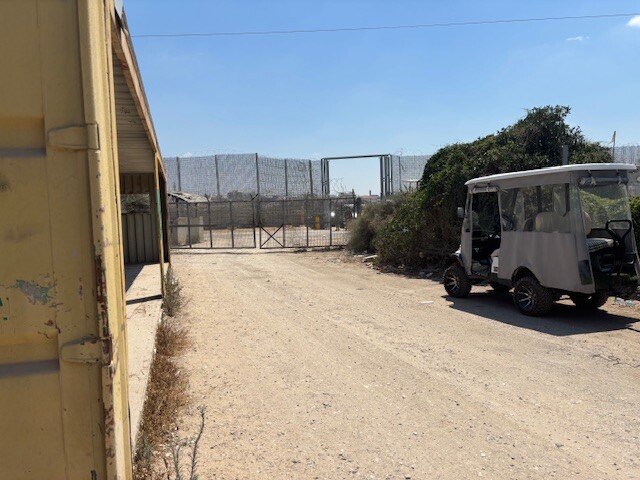 Nina SebaAug-18-2025Habla: The gate is in the process of closing
-
Irtah (Sha'ar Efrayim)
See all reports for this place-
The checkpoint is for Palestinians only. It is the main barrier to the passage of workers from the northern West Bank to Israel. Workers with a permit to work in Israel and also for trade (with appropriate permissions), medicine, and visiting prisoners. One can cross the checkpoint only on foot. The checkpoint is located north of Road 557 and south of Tulkarm. Operated by a civil security company, opening hours: between 4:00 and 19:00 on weekdays. As members of Machsom Watch, we began our shifts to this location in 2007. We arrived before it opened at 4 in the morning and report since, on the harsh conditions and the long and crowded queues of workers. The workers who pass by continue their journey by transportation to work throughout Israel. In the first period of its activity, about 3,000 and then 5,000 people passed through this checkpoint every day. Due to the small number of checking points and arbitrary delays for long periods of time in the "rooms", workers feared losing their transportation. Hence workers leave their homes at 2:30 at night to be among the first. Today, 15,000 pass and the transition is faster. Workers are still leaving their homes very early to get past the checkpoint at 7 p.m. In an adjacent compound, there is a terminal for the transfer of goods on a commercial scale, using the back-to-back method.
-