
Far’oun, ‘Azzun, follow-up of blocking roads and theft of land by bureaucratic means
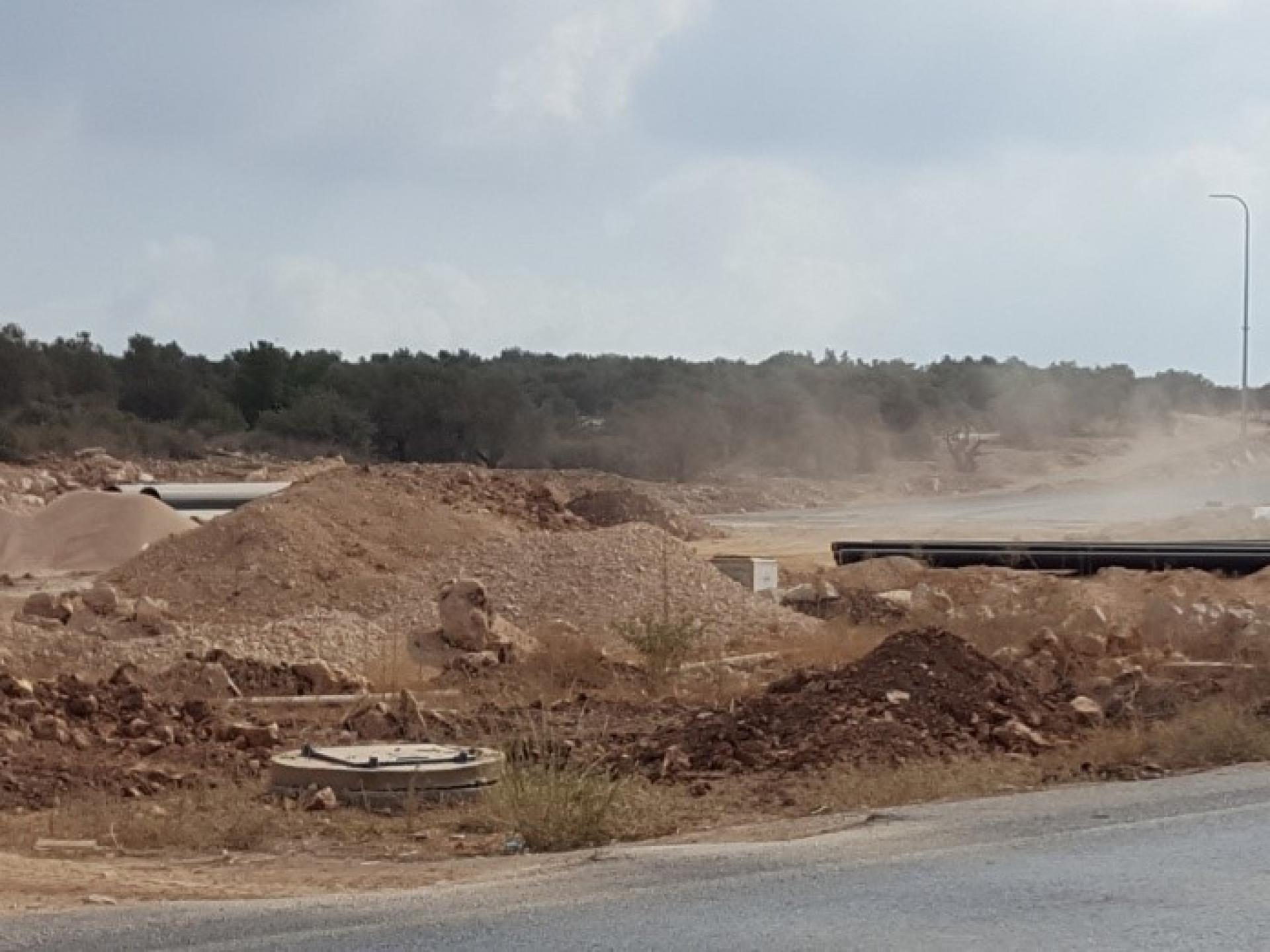

‘Azzun
We went with a driver to visit ‘Azzun, where we dropped off many parcels of clothing and toys. Z. seems somewhat disconsolate at the results of his treatments at Hadassah.
The purpose of our visit was to update Karin’s August 10th report about the army’s blocking the route that passes under Highway 55, leading to the agricultural lands north of the road that belong to residents of ‘Azzun. As a result of the roadblock, residents of Far’oun are unable to access some 1500 dunums of olives, groves and greenhouses (a right turn from ‘Azzun’s main road toward the exit, then a right turn after the mosque). The road was blocked on 17.7.17. In addition, Y. updated us (by phone on 13.8) that he removed the roadblock under the bridge on his own initiative. Soldiers came again and blocked the road with earth and large boulders and he removed them again. The road is still impassable to vehicles.
When Y. didn’t answer his phone, we went to the municipal building and met S., the head of the municipality, who gladly accompanied us. S. took us to see another area where a number of unpaved roads used by ‘Azzun farmers were blocked by a fence that was erected along Highway 55. Now it’s impossible to cross the road other than by a detour which takes hours with agricultural equipment. The road leads to Ma’aleh Shomron and cuts off many farmers from their land, some 700-1000 dunums.
The unpaved roads and the crossing below Highway 55 were closed about four months ago as collective punishment of the entire locality, because the army claimed children threw stones at vehicles crossing the bridge. The problem will become much more serious when the olive harvest begins. Abou70 families (including the head of the municipality) have olive groves to which access is blocked. The photo of the fence erected on Highway 55 shows the carob trees, whose fruit is ripe but which S. hasn’t picked because of the difficulty accessing the land. He also told us that many in ‘Azzun haven’t recently received permits, and that every night soldiers enter homes, get adults and children out of bed, interrogate, ask for phone numbers. Recently things have become worse and the harassment has become more frequent. ‘Azzun has 12,000 residents, most of them unemployed. About 1500 residents of ‘Azzun are forbidden to enter Israel.
Far’oun
We made an appointment with S. to receive an update about the permits (crossing permits to agricultural land). We met at his home. Last Sunday there was to have been a meeting of municipality staff and the Palestinian liaison office, but it didn’t occur. He said that the head of the municipality assigned two municipal employees to handle the agricultural permits, and they don’t want to speak to anyone (including Machsom Watch) without “instructions” from the Palestinian DCL. He said he told Amira Hass, the journalist, about it, and she promised to contact a Palestinian minister she knows to find out what’s going on.
While we spoke, S.’s sister phoned to report the army had arrived at her home. She lives with two married sons and their families. We accompanied him to her home and saw two military vehicles, six soldiers and a captain. He claimed that Palestinians who lack permits to work in Israel use a nearby home to access the road and reach Israel, and they want the family to keep an eye out, prevent that happening and report to the army. Otherwise, the captain threatened, the family won’t be allowed to access their fields and soldiers will come at night and get the family members out of bed. We tried to intervene but the assertive officer angrily shut us up. It’s not clear why it’s the family’s job to ensure that people don’t infiltrate illegally to Israel. Are they IDF employees? Isn’t that the army’s job?
“Who are you?” the officer asked. I showed him the tag and said “Machsom Watch.” “Oh, yes, you’re the ones who publicize when we don’t open the gate on time. But we have many things to do…We’re protecting you, and also the Palestinians…there are incidents we must deal with…” he said angrily. We were glad to hear someone reads our reports…and parted, not amicably.
We returned to S.’s home. He told us about the problems with permits for ‘Azzun. In general, it’s the same story Mikki reported on 19.7 regarding Deir el-Ghusun. The main point is that for the past two months (since the strike ended) the permit-granting process for farmers with land in the seam zone (between the separation fence and the Green line to the west) has become significantly worse. Many people who received permits in the past are now being refused, and there are endless demands for more documents and more papers that applicants must provide to the DCL before their application will be considered. Most of the difficulties have to do with the tabu, granting permits only to those whose name appears in the tabu, and not to other family members. There are all kinds of demands for new tabu documents (for example, because the names aren’t clear), and obtaining a new tabu document is a time-consuming and expensive process. Other new difficulties in recent months: an attorney can no longer obtain a tabu document. Sometimes the application indicates the wrong agricultural gate number and the Palestinian must submit a new application and wait for a new permit. At Far’oun gate (708), even someone with a permit is not allowed to cross without a donkey or a tractor. Many can’t even afford to buy a donkey, but they want to reach their land, to cultivate it, irrigate, spray and clear brush. It’s simply impossible for the elderly.
We received some data but couldn’t check because we weren’t at the municipality. Last Sunday 24 applications were submitted. The Palestinian DCL returned 15 immediately because it was clear they wouldn’t be approved. 50 applications were submitted in July, 15 were returned for tabu issues and only 4 were approved. We’ll try to discuss with the Israeli DCL what’s going on with some applications we have information about.
Far’oun has 5000 residents, 80% with similar problems. They have 4000 dunums of land in the seam zone.
When S.’s father died he, his two brothers and his father’s two wives inherited only 11 dunums of land. To divide it among the heirs they must obtain a surveyor, which they can’t afford. A new application costs NIS100. An attorney costs an additional NIS150.
In 1997, S. bought a small plot, half a dunum. Tabu registration cost NIS2500. The Palestinian Authority charges 1 dinar per square meter. With such high costs, how can Palestinians who inherited land register them in their name in the tabu? And when they’re not registered in the tabu, the sovereign doesn’t allow them to access their lands for cultivation. Another form of land theft.
'Azzun
See all reports for this place-
Azoun (updated February 2019)
A Palestinian town situated in Area B (under civil Palestinian control and Israeli security control),
on road 5 between Nablus and Qalqiliya, east of Nabi Elias village. The inhabitants are allowed to construct and improve infrastructures. The Separation Fence has confiscated lands belonging to the town's people. In 2018 olive tree groves owned by one of its inhabitants were confiscated for the sake of paving a road to bypass Nabi Elias. Azoun population numbers 13,000, its economic state dire. Its infrastructures are poor, neglect and poverty rampant. In the meantime, the town council has completed paving an internal road for the inhabitants' welfare.
Because of its proximity to the Jewish settler-colony of Karnei Shomron and its outposts, the town suffers the intense presence of the Israeli army, especially at nighttime: soldiers enter homes, arrest suspects, trash the house and sometimes ruin it, as they do in numerous places in the West Bank. At times a checkpoint closes the entrance to the town, so no one can come in or get out.
-
Far'un CP
See all reports for this place-
Far'un CP
A checkpoint near the Palestinian town Far'un, which is located near the Green Line, about 4 kilometers south of Tulkarm . About 5,000 residents (2018) 2,000 people moved abroad and their homes were left empty.
When the separation barrier was built in the early 2000's, about 4,000 dunams owned by the village were separated from the local farmers. In 2009, following a petition by the residents, the Israeli High Court ordered a change in the route of the fence. In May 2011 work began, and in 2013 it was completed. Following the movement of the fence, 1,400 dunams are located within the village area and for the 2,600 dunams remained in the Seam Zone behind the Separation barrier. The can arrive to these only through Far'un agricultural checkpoint 708.
MachsomWatch have been in touch with the village farmer since the early 2000s - visiting and documenting the checkpoint and the township . Over the years, the opening frequency of the checkpoint has changed from time to time: sometimes 3 times a week, sometimes twice a week, and sometimes it closed completely for a certain period without explanation. In addition - the checkpoint is opened usually only twice a day and this makes it difficult to cultivate, because the farmers are not able to stay in the fields all day. Throughout the years there were many delays in opening times the checkpoint and the farmers sometimes have to wait hours until they can go to work their plots.
The most difficult problem is the limited number of permits approved by the Civil Administration for the transition to tillage. Many landowners have problems with lands that are not registered in their name but in the name of a deceased father. Registering is very expensive if the father had several sons and daughters to whom the land belonged after his death. They have no money to transfer their father's land in their name. Before the walls, block settings and gates that do not open, they divided the plot they inherited and had no problems processing. Today everything is complicated. Plots that have not been cultivated for several years may become state lands and pass to the settlers, residents of the seam area.
 Mar-21-2022Anin Checkpoint: A magnificent breach in the center of the checkpoint
-
