
Farsiya Jordan Valley: Escorting Palestinian shepherds without rioting by settlers

We are a group of “shepherd escorts” who come to the shepherding communities in the Jordan Valley, to protect them by our very presence from disturbances and abuse by the settlers. We stay near them 24 hours a day because of the escalation of violence against them.
We arrived in Farsiya in the morning. Tomer, Adi, Sasha, and Yifat went to accompany Ahmed to the pasture. Others, who did not arrive with us, already went to accompany N. and Yosef to the pasture. Efrat and I, Micky, remained in the encampment to be a “protective presence”; that is, in case aggressive settlers arrive at the camp during the hours the men are in the pasture. We walked around between the tents; we spoke with family members, asked how they were, and what they needed. We finally settled in the volunteers’ tent (which was set up especially for us), and Efrat, with my help, taught the children how to make pom poms from colored wool thread. It was not easy to work with a new group for the first time. Some of the children were offended; others had no patience and resisted. Slowly, everyone got used to working orderly and quietly, and after two hours, almost everyone left with wonderful pom poms, which they attached to their bicycles.
Twice, the children called “The Jews are coming!” The Jews are a nickname the children use for the army and the settlers. A settler car entered the path that leads to the encampment, but immediately turned around and left. Another car entered and this time it was a Palestinian “gazlan,”( like an ice cream truck, but with sweets and drinks) from Ein el Bide, that travels around and sells goods to children. For half a shekel it is possible to buy Bamba ( an Israeli snack) or another sweet. The mothers bought and treated us to tasty cake.
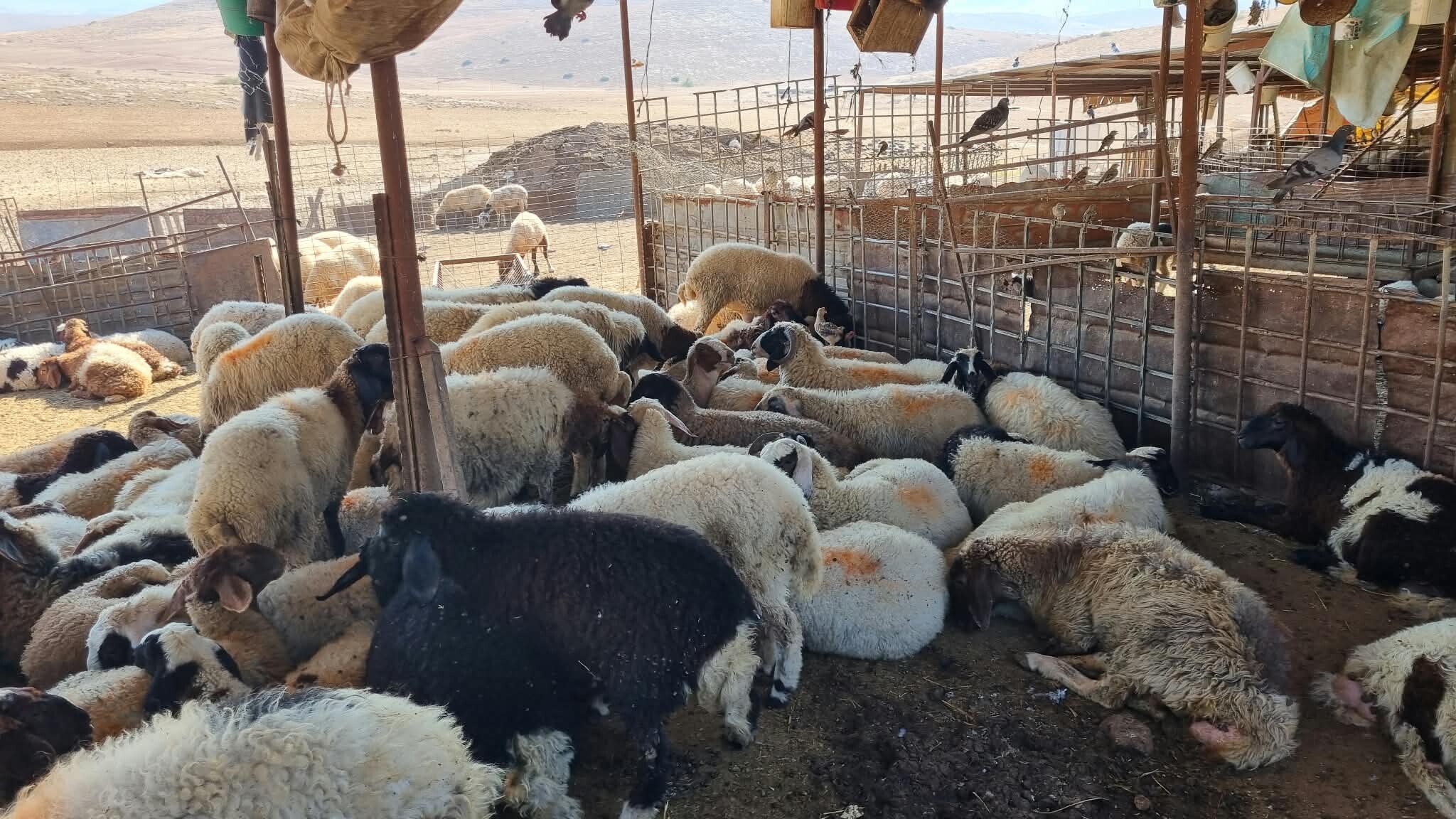
At 15:00, we helped A.’s wife and grandmother to fill the troughs with barley and hay—supplemental food for the sheep in addition to the grass they eat during grazing.
At 15:30, the flock returned, running, to the troughs to satisfy their hunger. Those (volunteers)
accompanying, reported on pleasant grazing on a day that was cloudy but not rainy. There was no harassment from the settlers.
In our free time, we sat and had friendly conversations with the locals. Tomer examined A.’s previous burn on his leg and bandaged it. We drank tea with A., and afterward, coffee with M., and finally left at 18:00 to go back to Tel Aviv.
Jordan Valley
See all reports for this place-
Jordan Valley The Jordan Valley is the eastern strip of the West Bank. Its area consists of almost a third of the West Bank area. About 10,000 settlers live there, about 65,000 Palestinian residents in the villages and towns. In addition, about 15,000 are scattered in small shepherd communities. These communities are living in severe distress because of two types of harassment: the military declaring some of their living areas, as fire zones, evicting them for long hours from their residence to the scorching heat of the summer and the bitter cold of the winter. The other type is abuse by rioters who cling to the grazing areas of the shepherd communities, and the declared fire areas (without being deported). The many groundwaters in the Jordan Valley belong to Mekorot and are not available to Palestinians living in the Jordan Valley. The Palestinians bring water to their needs in high-cost followers.
 Bosmat HetzroniSep-10-2026Samra. Sheep resting at noon
-
