
Far’un
Following our endless verbal and written requests to the DCL, and a letter from the Far’un council to the Palestinian DCL and from there to the Israeli DCL, it has been decided to open Checkpoint 708 gate during Ramadan at 12:00 instead of 16:00. We went there to confirm.
‘Azzun
Leora met a blacklisted Palestinian to have him sign a document from Sylvia’s staff, and visited Z.’s shop to deliver parcels of clothing and household goods.
We drove north to Far’un, via Jayyous, Kufr Jimal, and Jabbara.
Checkpoint/agricultural gate 708 is supposed to open at 12:00 during Ramadan, instead of at 16:00.
12:10 We see no soldiers. I start to call the DCL to determine why. They promise to find out. Time passes, no soldiers. Today it is very hot.
12:25 A Hummer passes on the security road without stopping.
I continue calling the DCL and the crossings officer. They’re looking into it. They’re always looking into it…without results. Who even gives a damn?
They’re on their way. What’s the hurry? Let them wait!
12:44 Another military Hummer arrives, and this one stops. The Palestinians who’d found some shade beyond the hill begin to approach the fence.
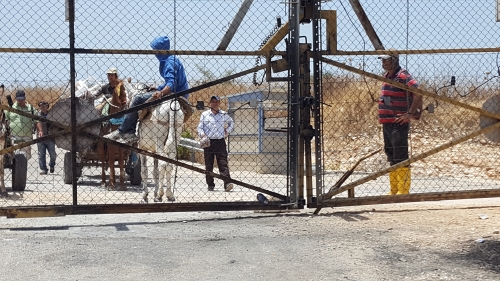
12:48 The gate finally opens and 11 Palestinians, plus carts, come through, including our acquaintance S.
I’m notified by the crossings officer that the gate opened at 12:27.
But he’s not here, and I am. The reports he receives from the military unit aren’t correct, and I’ve already mentioned this in the past. I told him that he is constantly being given false information, and he should investigate whether it’s correct. He doesn’t respond.
The delays in opening gate 708 aren’t new. I’ve been seeing them for months.
In the afternoon of June 7 the gate opened at 18:06 instead of 16:00 – two hours and six minutes late. So what? The Palestinians can wait. Ramadan started the previous day, and some of them are surely fasting. It’s not enough that they’re working in the fields in the severe heat, they also have to wait hours for the gate to open while the soldiers report to the DCL that they’re on their way… And the delay? A security incident. That’s the usual response.
That’s the humiliating daily reality. The forces of the occupation.
We drive to S.’s home and receive the names of people not permitted to access their lands, to check them with the DCL.
The issue of dumping refuse that has been turned over to Yesh Din – the contractor is now dumping it elsewhere. There are still piles of construction rubble on Far’un’s agricultural land. Maysun, the Yesh Din representative who had viewed the site, promised to report the matter to the Ministry of the Environment.
Far'un CP
See all reports for this place-
Far'un CP
A checkpoint near the Palestinian town Far'un, which is located near the Green Line, about 4 kilometers south of Tulkarm . About 5,000 residents (2018) 2,000 people moved abroad and their homes were left empty.
When the separation barrier was built in the early 2000's, about 4,000 dunams owned by the village were separated from the local farmers. In 2009, following a petition by the residents, the Israeli High Court ordered a change in the route of the fence. In May 2011 work began, and in 2013 it was completed. Following the movement of the fence, 1,400 dunams are located within the village area and for the 2,600 dunams remained in the Seam Zone behind the Separation barrier. The can arrive to these only through Far'un agricultural checkpoint 708.
MachsomWatch have been in touch with the village farmer since the early 2000s - visiting and documenting the checkpoint and the township . Over the years, the opening frequency of the checkpoint has changed from time to time: sometimes 3 times a week, sometimes twice a week, and sometimes it closed completely for a certain period without explanation. In addition - the checkpoint is opened usually only twice a day and this makes it difficult to cultivate, because the farmers are not able to stay in the fields all day. Throughout the years there were many delays in opening times the checkpoint and the farmers sometimes have to wait hours until they can go to work their plots.
The most difficult problem is the limited number of permits approved by the Civil Administration for the transition to tillage. Many landowners have problems with lands that are not registered in their name but in the name of a deceased father. Registering is very expensive if the father had several sons and daughters to whom the land belonged after his death. They have no money to transfer their father's land in their name. Before the walls, block settings and gates that do not open, they divided the plot they inherited and had no problems processing. Today everything is complicated. Plots that have not been cultivated for several years may become state lands and pass to the settlers, residents of the seam area.
 Mar-21-2022Anin Checkpoint: A magnificent breach in the center of the checkpoint
-
