
Habla, Irtah (Sha’ar Efrayim),
04.10 Irtah. Dawn shift
Cold and rainy and less workers are expected to come. The line begins at the entrance and people climb the fences so as to push themselves into the line. Part of the passage from the turnstile to the entrance where the magnometer posted is not covered and people run through it. When they get to the magnometre some of them had to take off their shoes on the wet ground.
We were surprised at the number of women coming to work. At the exit we met some of them and spoke to them and they said that they were working picking strawberries. They pick between the intervals of rain. One asked me if I had children and told me that that she has three and that's enough. Another woman whom we met complained that on Fridays, there is no separate entrances for women and asked us to deal with this.
On our way to the side of the exit a man speaking Hebrew told us, "It is good that you continue coming, but all the while we hope that things will improve and nothing does.”
About 5 o’clock we went back to the entrance and saw that the line had become much shorter. People come and go, through in a steady stream. The problem about the rain was the lack of shelter for the workers after the checking.
Habla 06.30.
The opening of the gates were delayed. The amount of workers arriving was small because of the rainy & cold weather. The checking was done as should be. That is that 5 at each time had to run in the rain in the direction of the booths and to the entrance and also then to the exit and to the gates.
We drove home. At the gate “the entrance to Israel” We aroused the suspicions of the ‘keeper of the gate” who demanded to know from where we came, where we had been and was only satisfied when she could check the car baggage & our Ids and after one more telephone conversation we were allowed to go on our way leaving behind us a long line of cars (settlers?) who were delayed because of us.
Habla
See all reports for this place-
Habla CP (1393)
The Habla checkpoint (1393) was established on the lands of the residents of Qalqilya, on the short road that
connected it for centuries to the nearby town of Habla. The separation barrier intersects this road twice and cut off the residents of Qalqilya from their lands in the seam zone.(between the fence and the green line).
There is a passage under Road 55 that connects Qalqilya to the sabotage This agricultural barrier is used by the farmers and nursery owners established along Road 55 from the Green Line and on both sides of the kurkar road leading to the checkpoint.
This agricultural checkpoint serves the residents of Arab a-Ramadin al-Janoubi (detached from the West Bank), who pass through it to the West Bank and back to their homes. The opening hours (3 times a day) of this agricultural checkpoint are longer than usual, about an hour (recently shortened to 45 minutes), and are coordinated with the transportation hours of a-Ramadin children studying in the occupied in the West Bank.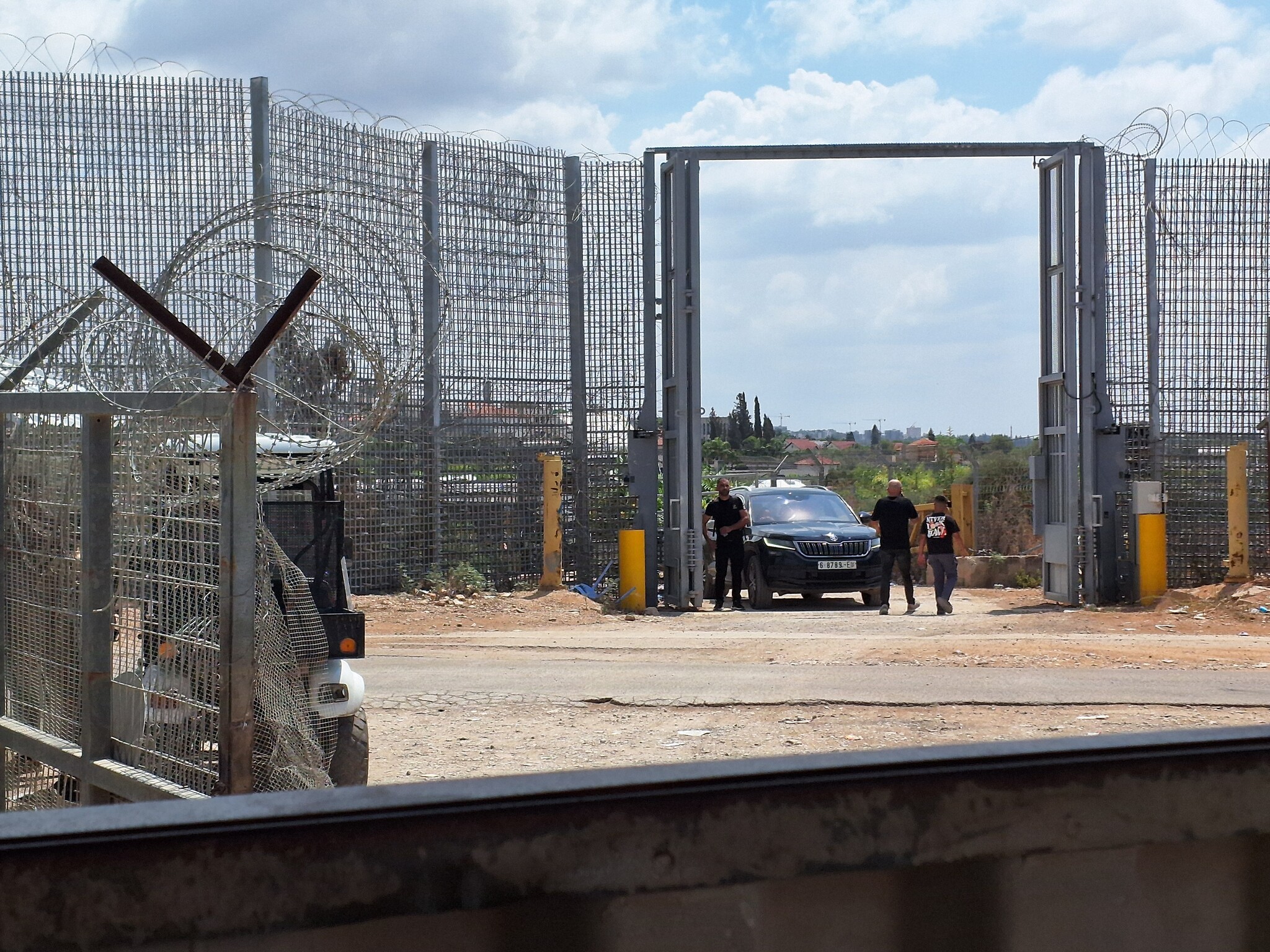 Ronit Dahan-RamatiAug-31-2026Habla. The gate is open
-
Irtah (Sha'ar Efrayim)
See all reports for this place-
The checkpoint is for Palestinians only. It is the main barrier to the passage of workers from the northern West Bank to Israel. Workers with a permit to work in Israel and also for trade (with appropriate permissions), medicine, and visiting prisoners. One can cross the checkpoint only on foot. The checkpoint is located north of Road 557 and south of Tulkarm. Operated by a civil security company, opening hours: between 4:00 and 19:00 on weekdays. As members of Machsom Watch, we began our shifts to this location in 2007. We arrived before it opened at 4 in the morning and report since, on the harsh conditions and the long and crowded queues of workers. The workers who pass by continue their journey by transportation to work throughout Israel. In the first period of its activity, about 3,000 and then 5,000 people passed through this checkpoint every day. Due to the small number of checking points and arbitrary delays for long periods of time in the "rooms", workers feared losing their transportation. Hence workers leave their homes at 2:30 at night to be among the first. Today, 15,000 pass and the transition is faster. Workers are still leaving their homes very early to get past the checkpoint at 7 p.m. In an adjacent compound, there is a terminal for the transfer of goods on a commercial scale, using the back-to-back method.
-
