
Habla, Jebara – Children’s Gate, Kafrait Te’enim Crossing, Thur. 28.3.13 morning
Translation: Suzanne O.
Habla
6:50 a.m.
The gate is open; there are about 30 people in the queue as well as cars and carts. The checks take place slowly. A man is sent back and his ID card is returned to him. We hear from afar "I went to the DCO and it didn't help". Later he brings some kind of boss who tries to talk to the soldiers, but to no avail.
Many people leave on bicycles, also leaving are a tractor with a trailer, a horse and cart and cars.
7:15 a.m.
A bus carrying girls arrives, the driver goes in to be checked, returns 8 minutes later. Now a minibus with boys arrives, the driver is checked immediately. A pickup truck full of plants leaves, a flock of sheep leave for pasture.
We monitored a labourer: it took 25 minutes from the moment he arrived until he left.
We continued on with Nadim and passed by Jayus. At 7:50 we stopped near FalAmiah Gate. The gate is open but no one is to be seen. All around the fields of wild oregano scent the air. We stopped for coffee in the village of Gamal and chatted with the owner. He told us that most of the villagers work in Israel because they are unable to make a living from agriculture.
8:45 a.m.
We arrived at the Children's Gate at Gibara, Gate No. 753, via the village of Sur Va-Ras. We asked permission to cross. The soldiers immediately took our ID cards and went to telephone. Meanwhile about 8 soldiers, most of them religious, started to interrogate us. They don't understand why we call the current situation occupation and asked again and again if we had read the Bible. The discussion was comparable to a conversation with the deaf. One soldier told us that Jebara is going to become part of Territory A of Palestine. Of course we were not permitted to cross and, after they held our documents for a while, we left in the direction of Kafrait/Te'enim Crossing. We stopped in Shufa and saw the concrete blocks which had, in the past, blocked the crossing from Shufa to Izbet Shufa. On our arrival at Te'enim Crossing we saw that the Gate to Jebara from Road 557 has been abandoned, it is now surrounded by a fence.
Falamiya
See all reports for this placeHabla
See all reports for this place-
Habla CP (1393)
The Habla checkpoint (1393) was established on the lands of the residents of Qalqilya, on the short road that
connected it for centuries to the nearby town of Habla. The separation barrier intersects this road twice and cut off the residents of Qalqilya from their lands in the seam zone.(between the fence and the green line).
There is a passage under Road 55 that connects Qalqilya to the sabotage This agricultural barrier is used by the farmers and nursery owners established along Road 55 from the Green Line and on both sides of the kurkar road leading to the checkpoint.
This agricultural checkpoint serves the residents of Arab a-Ramadin al-Janoubi (detached from the West Bank), who pass through it to the West Bank and back to their homes. The opening hours (3 times a day) of this agricultural checkpoint are longer than usual, about an hour (recently shortened to 45 minutes), and are coordinated with the transportation hours of a-Ramadin children studying in the occupied in the West Bank.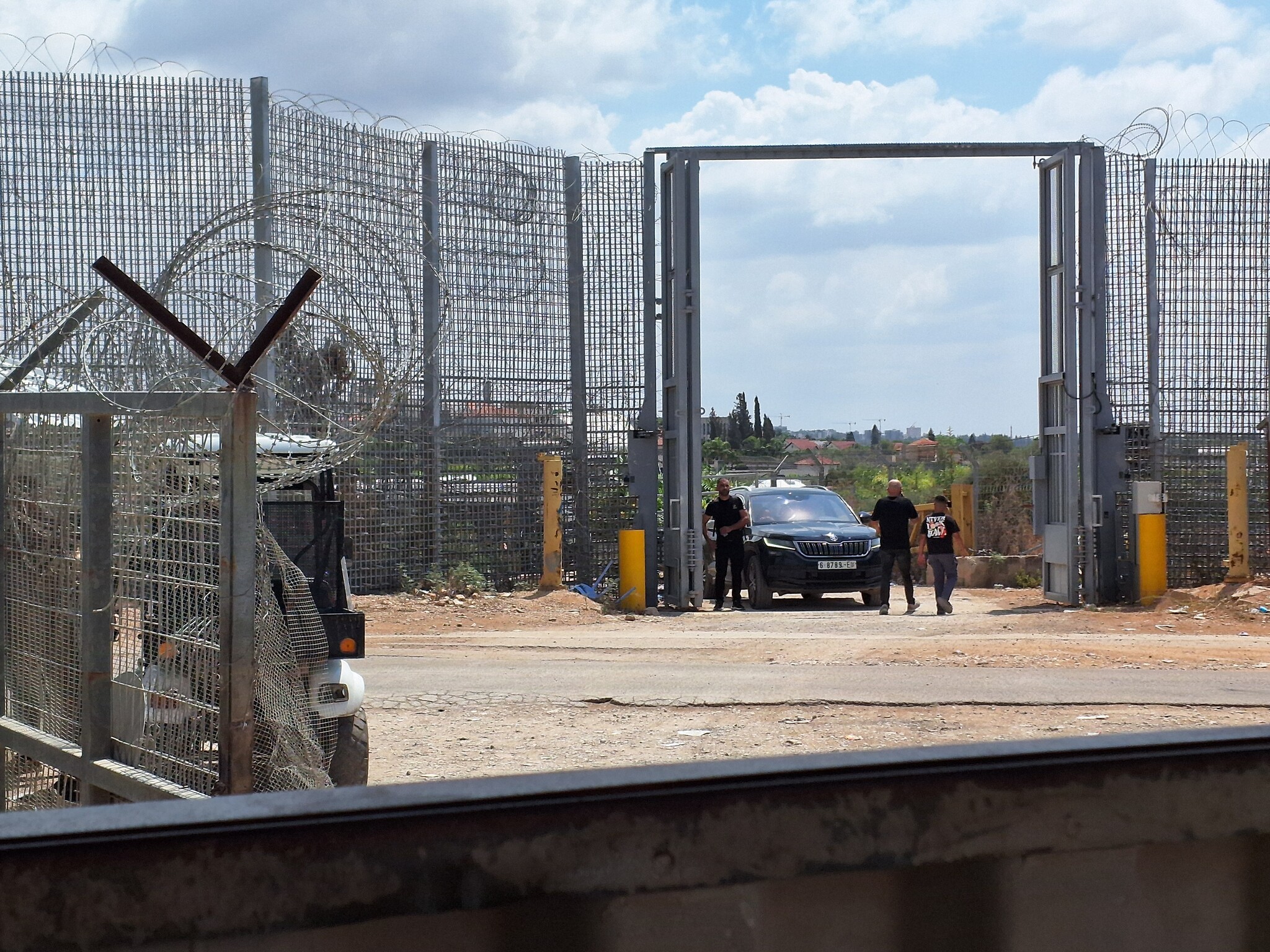 Ronit Dahan-RamatiAug-31-2026Habla. The gate is open
-
Jayyus North (935)
See all reports for this placeJubara (Kafriat)
See all reports for this place-
The Jabra checkpoint was on Road 557, south of Tulkarm, on the side of the Figs Pass, which is located within the Palestinian Authority (a few kilometers east of the Green Line), and serves as an entry barrier from the territories to Israel. The checkpoint to the village of Jubara, which until 2013 was in the seam area, blocked and surrounded by a fence, was intended for the passage of the family members of the house next to the checkpoint, and also for the MachsomWatch volunteers (with special permission only), on their way to checkpoint 753. on the other side of the village. The soldiers supervising the "fig crossing" also supervised the crossing at this checkpoint, in our shifts we often waited a long time until the key was found and the gate opened. The checkpoint was abolished and became part of the separation fence that was moved west following the High Court.
-
Kufr Jammal
See all reports for this place-
Kufr Jammal This village, rising about 200 meters over sea level, is located about 14 kilometers south of Tul Karm town and about 17 kilometers from the Mediterranean Sea. The families living there since the mid-18th century number about 3,000 persons at present. The village has lost thousands of dunams of its northern and western lands due to the construction of the Separation Barrier, leaving the lands themselves behind the barrier. After the Israeli Supreme Court ruling in 2011, the barrier was moved to the west and many farmlands were returned to their owners. It is a quiet village, its relations with the nearby settler-colony of Sal’it are favorable, and many of the villagers work in the colony’s industrial plants. Farmers cross the agricultural checkpoint close to this settler-colony in order to tend their fields unhampered. However, there are numerous acts of harassment and disorder taking place when the village farmers cross the other agricultural checkpoints: gates do not open at hours suitable to the farmers’ needs, and for a short period of time only; the Civil Administration usually prevents all kinds of crops except olives; tractors and other farm equipment are forbidden entry; only a single permit is issued per family, and occasionally such permits are confiscated and their re-issue is delayed – the common excuse is usually “security reasons”. How do the villagers make their living? Holders of work permits inside Israel travel at 3 a.m. to Eyal Checkpoint near Qalqiliya town in order to make it on time to their workplace at Sal’it (close to their village) and elsewhere. Owners of vegetable patches who hold permits are allowed to reach their fields beyond the Separation Barrier through the distant Falamiya Checkpoint. Importantly, fields returned to the village show amazing improvement intending, irrigation and farming variety – and instead of the neglected olive tree groves that were accessible only to holders of transit permits through agricultural checkpoints usually closed, farming has now flourished. (updated Jan 2021)
-
