
Habla, Ras ‘Atiya, Mon 19.4.10, Morning
6:40 Agricultural passage, Hablah
The soldiers the gates slowly. A military policewoman chats and amuses herself with the driver of the jeep and on her telephone, while the Palestinians wait…
6:50 The first three people enter and, after 5 minutes, come out and return to the back of the line. It isn't clear to us why, and the soldiers won't answer our questions.
7:00 It seems that only those having permits on which it is written specifically that they are farmers are permitted to pass; up till now, 3 women and 1 man have gone through. For all the workers with work permits on which it is written "regional passage permit", and who are agricultural workers or work in greenhouses in the area, there is no passage because of the closure, even though they are not going to work in Israel itself. Even the tractor and a truck and a horse and wagon, working in this area of greenhouses are not permitted to go through.
The policewoman sits outside the inspection booth and the soldiers check by hand the few people who have the "good" permit.
7:20 We call the Hotline, the DCO and Sargeant Th., the officer in charge of crossing points. After several attempts, we spoke with all of them. The answer? The issue is under treatment and checking…there is a special order…
7:30 We decided to go to the checkpoint of Ras Atiyyah to see if the students got through. On the way to Ras Atiyyah, we passed the Bedouin settlement of Arab Ramdin, and saw all the children waiting on the hill for the bus which probably again did not get a permit.
7:40 At the checkpoint of Ras Atiyyah there is no one waiting to enter, but there was a group of about 10 teachers who just now came out of the inspection booth and the village. We think that they were detained for a long time for inspection. A bus arrives bringing children to the school in the village. The driver got out for inspection and the soldiers got on the bus and took out 3 youths who were also waiting for inspection.
A second bus arrived with the children from the Bedouin village. It turns out that the driver who was supposed to collect them was not allowed to cross through! So, he called another driver from Ras Atiyyah, who went to pick up the children. We see that the first bus went through, and then the second one, so we returned to Hablah.
On the way, we picked up a boy from the Bedouin settlement who had been sent home by the soldiers because he forgot his permit at home. It was a long way to walk, and he certainly won't get back to school today.
8:00 Hablah. Nothing has changed here, the two nursery owners who employ most of the workers who were waiting on the other side of the fence to come through were trying to persuade the soldiers that they guarantee their workers, but this, of course, does not convince the soldiers. I again have some lengthy conversations with Y. at the Hotline, who really is trying to help and even gets back to me several times, and with Hamal at the DCO…and the problem continues its "treatment"…
8:15 Time passes and the soldiers begin to close the gates, even though I was told that they would be given an order to let the workers through. Y. got back to me with this news and I tell her that the soldiers are closing the gates and say that, within two hours they will open them again…what's the problem? let them wait…then the unbelievable happens – the soldiers once again open the gates.
8:30 The first workers go through and we all breathe more easily. Y., from the Hotline, calls back and asks what is happening, and I announce to her that the workers are going through.
8:50 Taysar, from the DCO, arrives to see if everything has worked out. By 9:10, everyone has gone through.
Did we achieve a small victory over the system, with the help of good people (whose job it is) from the Hotline and the DCO? In the nursery of Omer we raised a glass of tea in honor of the triumph! We returned home.
Habla
See all reports for this place-
Habla CP (1393)
The Habla checkpoint (1393) was established on the lands of the residents of Qalqilya, on the short road that
connected it for centuries to the nearby town of Habla. The separation barrier intersects this road twice and cut off the residents of Qalqilya from their lands in the seam zone.(between the fence and the green line).
There is a passage under Road 55 that connects Qalqilya to the sabotage This agricultural barrier is used by the farmers and nursery owners established along Road 55 from the Green Line and on both sides of the kurkar road leading to the checkpoint.
This agricultural checkpoint serves the residents of Arab a-Ramadin al-Janoubi (detached from the West Bank), who pass through it to the West Bank and back to their homes. The opening hours (3 times a day) of this agricultural checkpoint are longer than usual, about an hour (recently shortened to 45 minutes), and are coordinated with the transportation hours of a-Ramadin children studying in the occupied in the West Bank.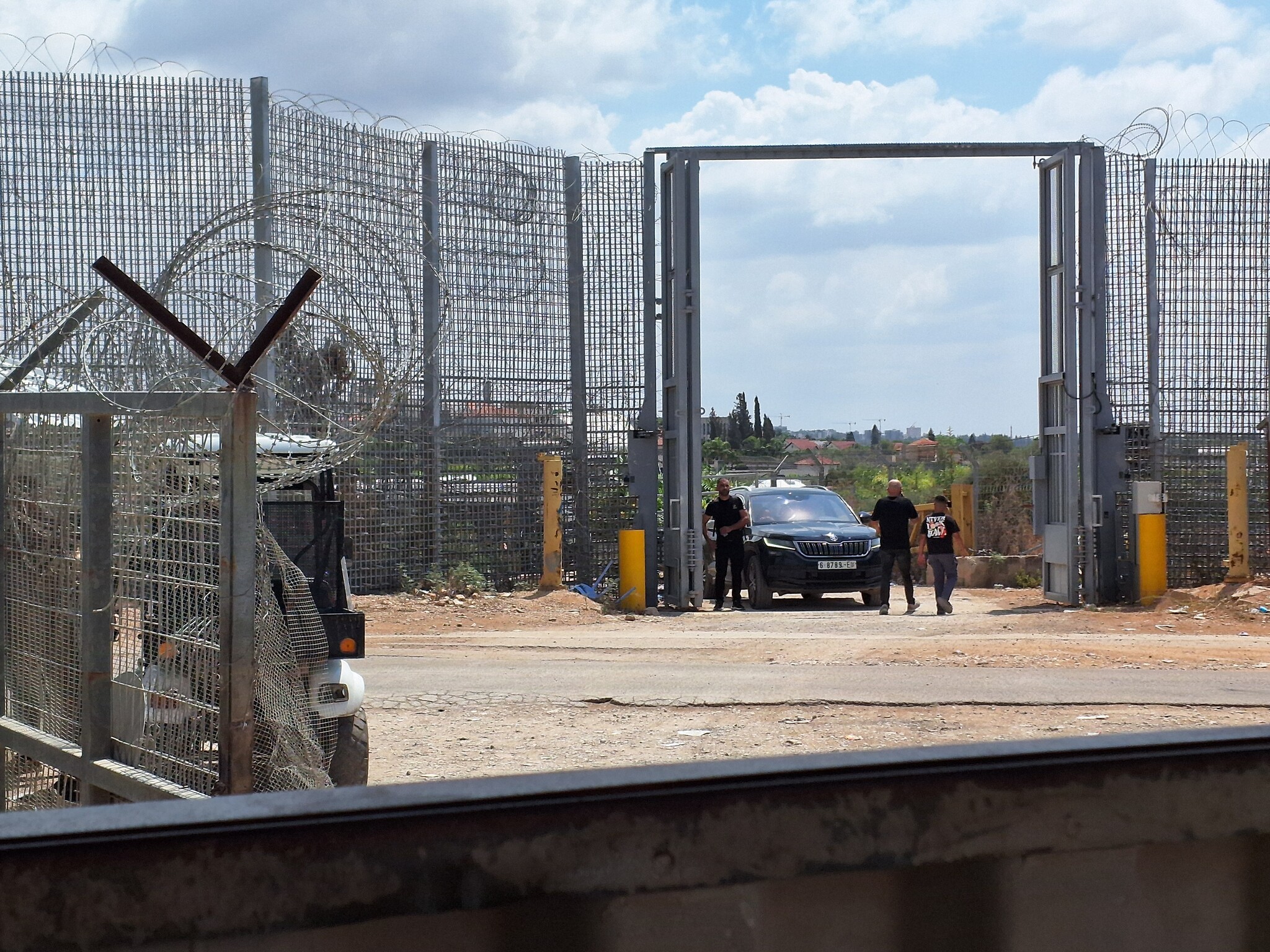 Ronit Dahan-RamatiAug-31-2026Habla. The gate is open
-
Ras 'Atiya
See all reports for this place-
The checkpoint is presently on the Separation Barrier roadway, manned and open 12 hours a day, from 6:30 to 18:30. West of it is the large Seam Line village whose school is attended by children from the nearby villages east of the Barrier and many of whose inhabitants have permits to work in Israel. How long this checkpoint will remain in place is unknown, since construction of the Separation Wall, just by the settlement of Alfe Menashe, east of the present Separation Barrier, is endless, as is the creation of a new road and, obviously, a new checkpoint.
-
