
Hakvasim (sheep) Junction, Hebron
We drove along Route 60 – light traffic and no sign of the army. Upon entering the police station, you notice a small number of citizens waiting to get in. It turns out that you can make an appointment over the phone, thus saving pressure on the office.
At the Sheep Junction, the weekly sheep market has already been eliminated, the lot is empty and deserted, only plastic bags flying around.
Hebron
The last people return with dishes full of food (soup?) from the mosque.
On the lawn in front of the Cave of the Patriarchs, tents were set up, rows of plastic chairs were spread out. I was told that this is on the eve of a wedding – the first wedding after Tisha B’av.
There are many buses in the parking lot, and many ultra-Orthodox people visit the cave.
Givati soldiers now control the city. During the noon visit the heat drives the residents as well as the soldiers into the shade and Shuhada Street is almost deserted.
Also the construction in the new outposts in the city – Beit Rachel and Leah, Beit Hatekuma – seems to be on hold.
On Shuhada Street, the construction of the new Jewish neighborhood that was built above the army camp that was there is progressing very well – a dense construction of two to three large buildings. Along the street you can see houses that are still occupied by Palestinians. Protective shields have been put up on the balconies, a sign of settler attacks.
At the grocery store at the top of the street, the disabled boy, son of the grocery store owner, tells us that during Operation Dawn, the army suddenly closed all the barriers between the two parts of the city, and thus people who work on the H1 side found themselves cut off from their homes and forced to sleep on the other side of the city. Some young men jumped over the checkpoint in the Kafisha neighborhood The army chased them and they were taken for questioning and returned a few hours later.
Hakvasim (sheep) Junction
See all reports for this place-
One of the roadblocks (earthworks, rocks, concrete blocks or iron gates) that prevent transit of vehicles to Route 60 in the southern West Bank and block the southern entrance to Hebron. A manned pillbox supervises the place.
-
Hebron
See all reports for this place-
According to Wye Plantation Accords (1997), Hebron is divided in two: H1 is under Palestinian Authority control, H2 is under Israeli control. In Hebron there are 170,000 Palestinian citizens, 60,000 of them in H2. Between the two areas are permanent checkpoints, manned at all hours, preventing Palestinian movement between them and controlling passage of permit holders such as teachers and schoolchildren. Some 800 Jews live in Avraham Avinu Quarter and Tel Rumeida, on Givat HaAvot and in the wholesale market.
Checkpoints observed in H2:
- Bet Hameriva CP- manned with a pillbox
- Kapisha quarter CP (the northern side of Zion axis) - manned with a pillbox
- The 160 turn CP (the southern side of Zion axis) - manned with a pillbox
- Avraham Avinu quarter - watch station
- The pharmacy CP - checking inside a caravan with a magnometer
- Tarpat (1929) CP - checking inside a caravan with a magnometer
- Tel Rumeida CP - guarding station
- Beit Hadassah CP - guarding station
Three checkpoints around the Tomb of the Patriarchs
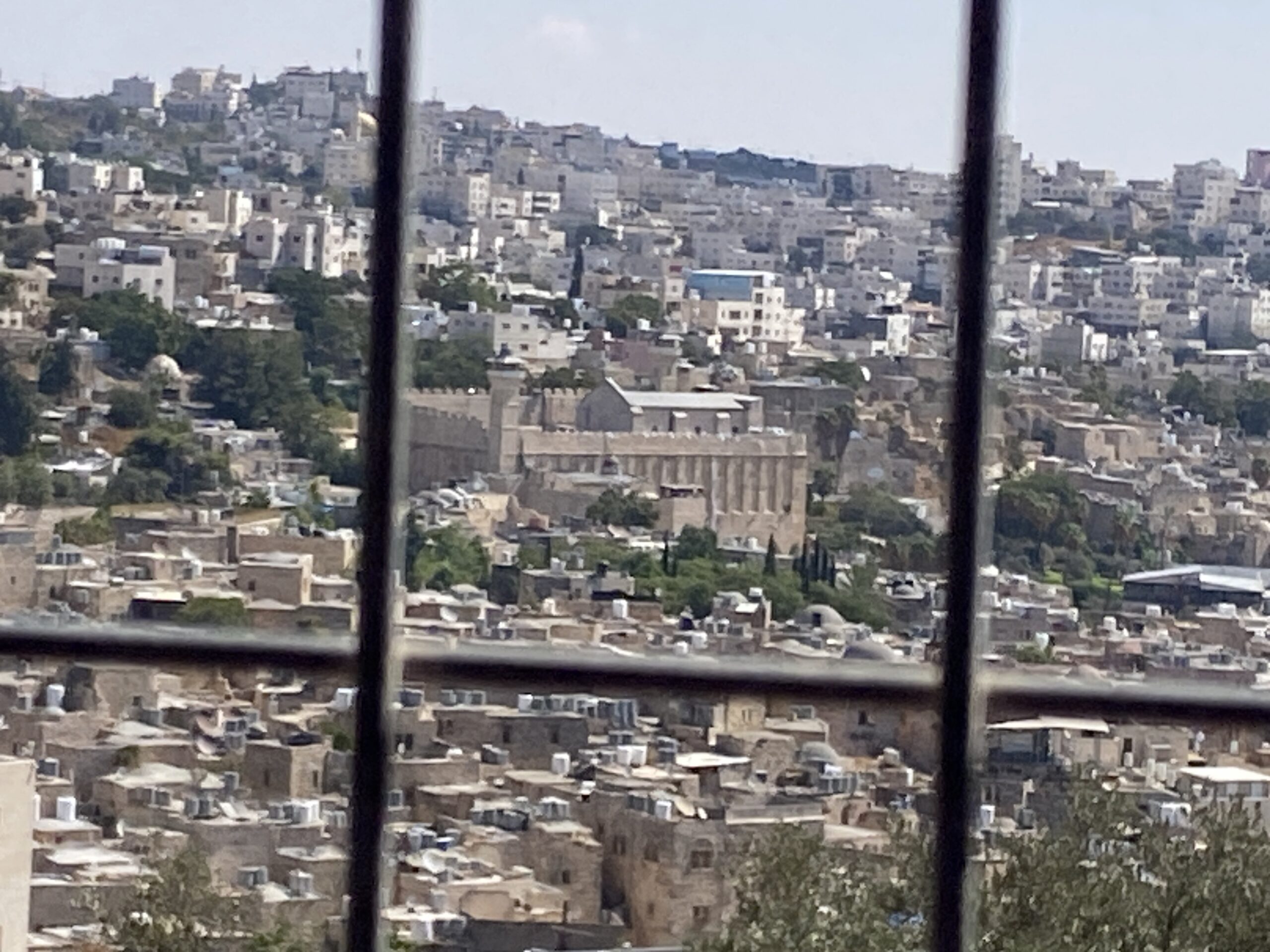 Yael ZoranSep-24-2026Hebron and the Cave of the Patriarchs from Beit Hashalom
-
