
Hamra (Beqaot), Ma’ale Efrayim, Tayasir, Tue 18.6.13, Afternoon
Translator: Charles K.
In Khameyr, near Mehola, there’s a small community of people living in tents who make a living from agriculture and grazing flocks; they own the lands they cultivate. About a week ago they received orders instructing them to leave the land permanently within 15 days, with no reference to where they’ll live or what they’ll live on. It’s one more step, like preceding ones, in the dispossession and expulsion of the Bedouin population in the northern Jordan Valley.
Two days ago settlers from Aish Kodesh again attacked the residents of Qusra, damaged their guard shack and cut down approximately ten olive trees.
13:30 Tapuach-Za’tara junction
Traffic jams in every direction. The cause isn’t clear. We saw no soldiers or police. It may be connected to the traffic jam we encountered on our way back (see below). Dafna, who accompanied a film crew the same day, wrote about the checkpoints at the Za’tara junction.
13:45 Ma’aleh Efrayim checkpoint
No soldiers.
When we returned at 18:00 soldiers were inspecting vehicles coming from the west.
14:20 Hamra checkpoint
Light traffic at this hour. People traveling in both directions aren’t asked to get out of their cars. The pedestrian checkpoint isn’t operating. Inspections are rapid in both directions.
15:45 Tayasir checkpoint
A bus with a yellow license plate crosses from west to east (from Area A to Area C) without being inspected.
The same kind of inspection is conducted in both directions – each car waits for a signal to advance. The IDs of all passengers are checked, a few questions are asked. Sometimes they also check the trunk. It isn’t necessary to get out of the vehicle when it goes through. The pedestrian checkpoint here isn’t operating either.
No traffic jams because traffic is very light. There are no cars at the checkpoint for long periods of time.
Hamam el Malih – Five months ago an encampment was demolished which contained some tents belonging to an elderly couple living with their granddaughter, and their small flock. We see that the couple erected two new tents in their compound. Till now they feared returning lest their meager belongings would be looted again. As far as we know the Red Cross assisted them and also provided the new tents.
The army issued expulsion orders to approximately five families living in the Bedouin encampment of Khameyr, near Mehola, despite the fact they own the lands they cultivate. They turned to the Palestinian Authority which is providing legal assistance through an attorney it employs. We were given the information בעברית כתוב “עדויות”by Fathi Kudirat, from Jordan Valley Solidarity, and from K., who lives in the area.
A tale of a settler’s lost sheep
A sheep ran away from the Maskiyot settlement and reached A.K.’s nearby tent encampment. He notified the army or the police. They arrived immediately and took him (the honest finder) to the Ma’aleh Efrayim police station where they fined him (it’s not clear why) NIS1500!
We learned from past experience with the Ma’aleh Efrayim police station that they don’t come when the situation is reversed – when settlers from Maskiyot had, more than once, stolen livestock from Bedouin living nearby. The most they do is telephone the settlement’s military security coordinator and accept his denials without verifying them. Even in cases where the thefts were confirmed, no one was ever punished. At most they had to return what had been stolen.
Moreover, they quickly impose heavy fines on the Palestinians, and it’s difficult to understand where they find the clauses to justify them (for example, crossing the road with a flock of sheep- more than NIS 1000). That’s a huge sum for Bedouin in the Jordan Valley, given they earn NIS 70-90 a day.
Settlers from Aish Kodesh again attacked residents of the village of Qusra and damaged their property.
We picked up a hitchhiker from Qusra who told us that at night, two days ago, settlers cut down approximately ten olive trees and damaged a small building standing in the field. The army regularly patrols between Qusra and Aish Kodesh to prevent damage and provocations but they didn’t notice the hoodlums. The police and the DCO came but did nothing.
On our way back we were stuck in a huge traffic jam near the village of Aqraba. Soldiers stopped traffic in both directions; they said the reason was a rumor that a soldier had been kidnapped. We waited 25 minutes until the road was opened, and then went through two checkpoints where passing vehicles were inspected.
Hamra (Beqaot)
See all reports for this place-
One of the Jordan Rift Valley checkpoints that prevent direct transit between the West Bank and the Jordan Valley, in addition to Tayasir Checkpoint. Located next to Hamra settlement, on Route 57 and the Allon Road.
Read about the peple of the Jordan Valley and the quiet transfer happening there.
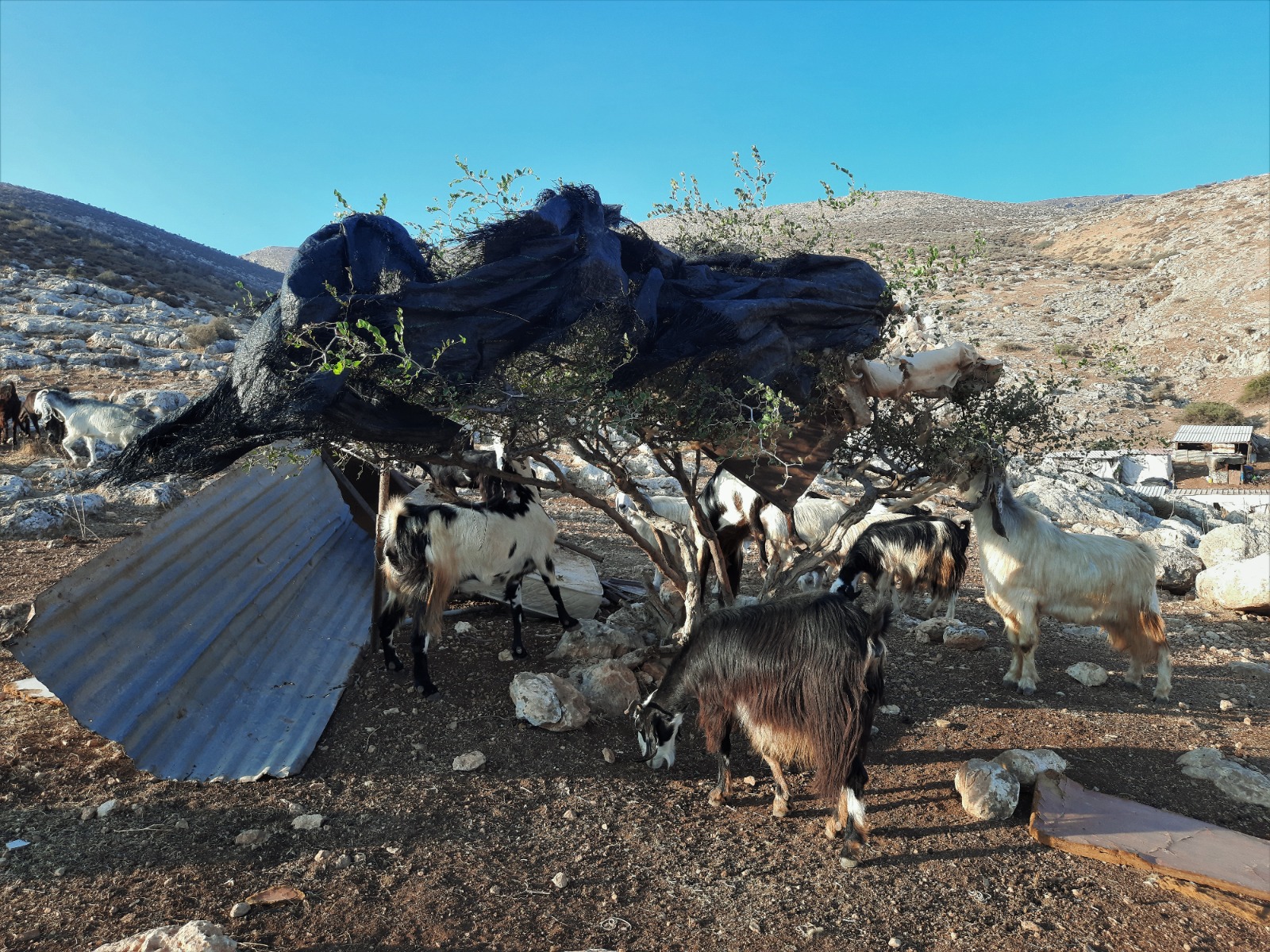 Shahar ShilohNov-3-2021Ein Shibli: grazing begins close to home
-
Ma'ale Efrayim
See all reports for this place-
Ma'ale Efrayim On the road connecting Route 90 (the Jordan Valley road) to the Allon Road.
-
Qusra
See all reports for this place-
Qusra
This village is located in the Nablus district, about 28 kilometers south-east of the city. Its population numbers 4,310 as of 2007 (according to the Palestinian census). After the Oslo Accords, 50% - most of the village’s built-up area – was categorized Area B, and about 70 homes as well as the rest of its land are inside Area C.
In 1983, 177 dunams of the village lands were confiscated by Israel to build a ‘Nahal’ stronghold, turned civilian in 1985 and named Migdalim settler-colony, east of the village itself. To the north-east is a gas station and a leather plant, as well as a studio producing wood ware, all of which are a branch of the settler-colony. Dozens of additional farmland were confiscated from Qussra and Jaloud in order to erect the settler-colonies Esh Qodesh and Ahiya.
“The villagers point to the settler-colonists of Esh Qodesh as the source of their problem. Qussra villagers were forbidden to tend their lands located a kilometer away from the Esh Qodesh fence, and about 20 meters from the area declared military zone. What about the ‘legitimate’ plots? Their crops are regularly destroyed by the settler-colonists. Fires break out in wheat fields, olive trees are cut down, wells are destroyed – these have all become routine events. In spite of all of this, the head of the local council sees the Israeli army as the main source. He says that the settler-colonists could not have harassed the villagers without the army backing them up…”
(From a MW report, August 3, 2015)
In 2001, the Israeli army evacuated its intelligence base “Kida”. In 2003, the settler outpost Kida was established, a quick attempt was made to evict the newcomers, but they were eventually allowed to remain.
For further information: http://vprofile.arij.org/nablus/pdfs/vprofile/Qusra_vp_en.pdf
-
Tayasir CP
See all reports for this place-
Located on road 5799, It is one of the checkpoints control the passage between the northern West Bank and the Jordan Valley. For a long time, it stood empty and open, with only a sign next to it warning against entering Area A. It was adjacent to an old military camp - now everything is neglected. How much money was invested here, and how much brainwashing was done to the soldiers of Netzah Yehuda and Kfir.
Today, it is very difficult to pass there. Many delays. Often, teachers from Tubas are not allowed to pass into the Valley to villages like Ein al-Bida where the local schools are located, and there are no classes. There are additional days when the checkpoint is closed. In general, there is a wait there of about two to four hours to go towards the Valley and also to return. Many times the Palestinians are forced to use the Hamra checkpoint, which also leads into Tubas and the West Bank, but there is also a huge queue there and a long wait.
Following a deadly attack on soldiers at the nearby base in February 2025, the checkpoint was completely closed for the time being. (Updated March 2025)
-
