
Hamra (Beqaot), Ma’ale Efrayim, Tayasir, Za’tara (Tapuah), Sun 3.3.13, Afternoon
Translator: Charles K.
Photos from the archives:
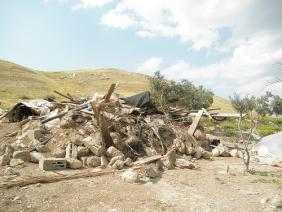 1. The remnants of an encampment belonging to a family with five children that the IDF demolished, October, 2012.
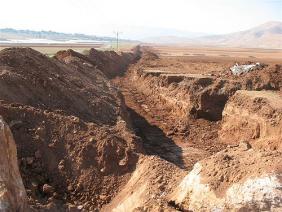
2. An earthen berm blocking Jordan Valley Bedouin from moving westward.
3. The Gochia checkpoint – a locked iron gate in the middle of nowhere blocking a dirt road used by Jordan Valley Bedouin.
 Tomorrow (4.3.13) the arm
 y will conduct maneuvers in the Hamam el-Malih area. All the residents were ordered to evacuate their encampments for 24 hours with their children, the elderly and their flocks. In other words – they were sent to spend the night outdoors. It’s very cold in the Jordan Valley during this time of year. This is a new phenomenon in recent months in the northern Jordan Valley. It happened to the residents of Hamam el-Malih about a month ago; tomorrow will be the second time.
**
Only 3% of the complaints submitted by Palestinians to the police eventually come to court. The remaining 97% of the cases are closed, even when there is incontrovertible evidence. Thus the State’s Attorney collaborates with the police, backing the racist policies as part of what’s known as “justice for all” and “equality before the law.” That’s what we learned from “Yesh Din,” which has been following up on the vicious beating last year of M., a member of the D family, last year by D., the military security coordinator of the Rotam settlement.
**
11:15 Za’tara checkpoint – Tapuach junction
Two loaded trucks detained in the plaza. Another commercial vehicle has been detained and is being checked by a dog. ID cards are taken for inspection. The driver of the commercial vehicle has (apparently) been sent for interrogation by the Shabak on the other side of the white wall at the northwest side of the plaza. An additional car was detained while we were there.
We’ve already seen delays and interrogations of young men at this junction a few times, and heard from those interrogated that the Shabak tried to recruit them.
We gave a ride to a hitchhiker who was born in the Gitit settlement (established in 1975). He said his parents, secular people from Tel Aviv, were sent by state institutions to settle there, were given a house and land at no cost, along with all they needed to farm. He doesn’t view himself as a settler, and it’s clear to him that the Jordan Valley must remain part of Israel forever, for security reasons. We asked about the price of water: NIS 6 /cubic meter for household use, NIS 2 for agriculture. For comparison: K., the Bedouin, pays NIS 20 per cubic meter for water which he gets from water tankers, not via pipes. In Israel we pay more than NIS 9 per cubic meter for household use.
The fields of Gitit settlement, which are worked by two Israelis (one from Tel Aviv and one from Tayibeh) are covered with plastic sheeting. A spectacular sight.
12:30 Hamra checkpoint
A settler from Hamra followed us to the checkpoint, photographed us from every angle and cursed us rudely. Two reservists from the checkpoint came over to see what the trouble was and he disappeared.
13:00 Tayasir checkpoint
Reservists here as well. Very sparse traffic.
The K. family
The four families from Hama el-Malih whose encampments were demolished last month are still living out in the open or in improvised sheds far from their previous place of residence.
About a year ago M., one of the family members, was terribly beaten by D., the Rotem settlement’s military security coordinator, and was hospitalized for two days. A complaint was submitted to the police, with the help of Yesh Din. It now transpired that the police closed the case even though there were witnesses to the beating.
A few months later that same military security coordinator shot and killed three of K’s cows and buried them. They called the police, which found the slaughtered cows. There were witnesses to this incident as well, and this case was also closed.
Yesh Din told us that’s what usually happens, that only 3% of the complaints submitted by Palestinians to the Israeli police reach the courts. The police and the State’s Attorney collaborate to ignore Palestinian complaints against Jews. Racism has penetrated every organ of the Israeli regime. Jurists are also part of the rot. Yesh Din plans to appeal the closing of the case involving the beating. It will take two years for the appeal to come before a judge.
We gave a ride to a laborer who’d finished working for the day in the Ro’i settlement. He earns NIS 85 for an 8-hour day (about half of the Israeli minimum wage), with no benefits. NIS 10 goes for transportation. Since the residents of the settlements are Israeli citizens, Israeli labor laws apply to them, including minimum wage laws, but who’ll enforce them? And so the Israbluff about the only democracy in the Middle East continues. It’s not surprising that the settlers hold on to what they’ve got – where else could they get such wonderful conditions? Even workers from Thailand are paid more.
16:00 Ma’aleh Efrayim checkpoint
No soldiers here at this hour either.
Hamra (Beqaot)
See all reports for this place-
One of the Jordan Rift Valley checkpoints that prevent direct transit between the West Bank and the Jordan Valley, in addition to Tayasir Checkpoint. Located next to Hamra settlement, on Route 57 and the Allon Road.
Read about the peple of the Jordan Valley and the quiet transfer happening there.
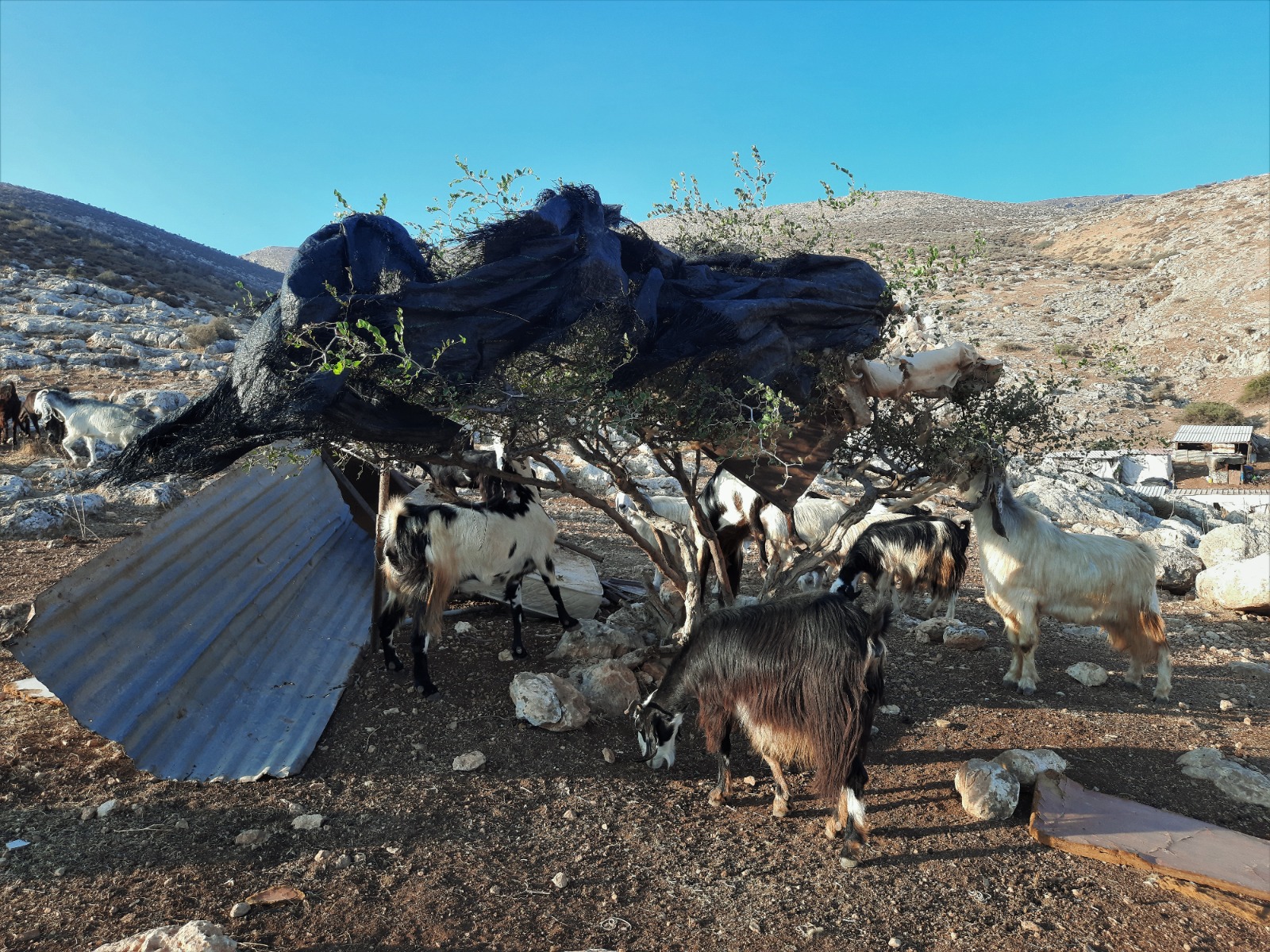 Shahar ShilohNov-3-2021Ein Shibli: grazing begins close to home
-
Ma'ale Efrayim
See all reports for this place-
Ma'ale Efrayim On the road connecting Route 90 (the Jordan Valley road) to the Allon Road.
-
Tayasir CP
See all reports for this place-
Located on road 5799, It is one of the checkpoints control the passage between the northern West Bank and the Jordan Valley. For a long time, it stood empty and open, with only a sign next to it warning against entering Area A. It was adjacent to an old military camp - now everything is neglected. How much money was invested here, and how much brainwashing was done to the soldiers of Netzah Yehuda and Kfir.
Today, it is very difficult to pass there. Many delays. Often, teachers from Tubas are not allowed to pass into the Valley to villages like Ein al-Bida where the local schools are located, and there are no classes. There are additional days when the checkpoint is closed. In general, there is a wait there of about two to four hours to go towards the Valley and also to return. Many times the Palestinians are forced to use the Hamra checkpoint, which also leads into Tubas and the West Bank, but there is also a huge queue there and a long wait.
Following a deadly attack on soldiers at the nearby base in February 2025, the checkpoint was completely closed for the time being. (Updated March 2025)
-
Za'tara (Tapuah)
See all reports for this place-
Za'tara (Tapuah) Za'tara is an internal checkpoint in the heart of the West Bank, at the intersection of Road 60 and Road 505 (Trans-Samaria), east of the Tapuah settlement. This checkpoint is the "border" marked by the IDF between the north and south of the West Bank, in accordance with the policy of separation between the two parts of the West Bank that has been in place since December 2005. At the Za'tara checkpoint, there are separate routes for Israelis and Palestinians. In the route for Israelis, there are no inspections and the route for Palestinians inspects. The queue lengthens and shortens suits. The checkpoint is open 24 hours a day. The checkpoint is partially staffed and the people who pass through it are checked at random.
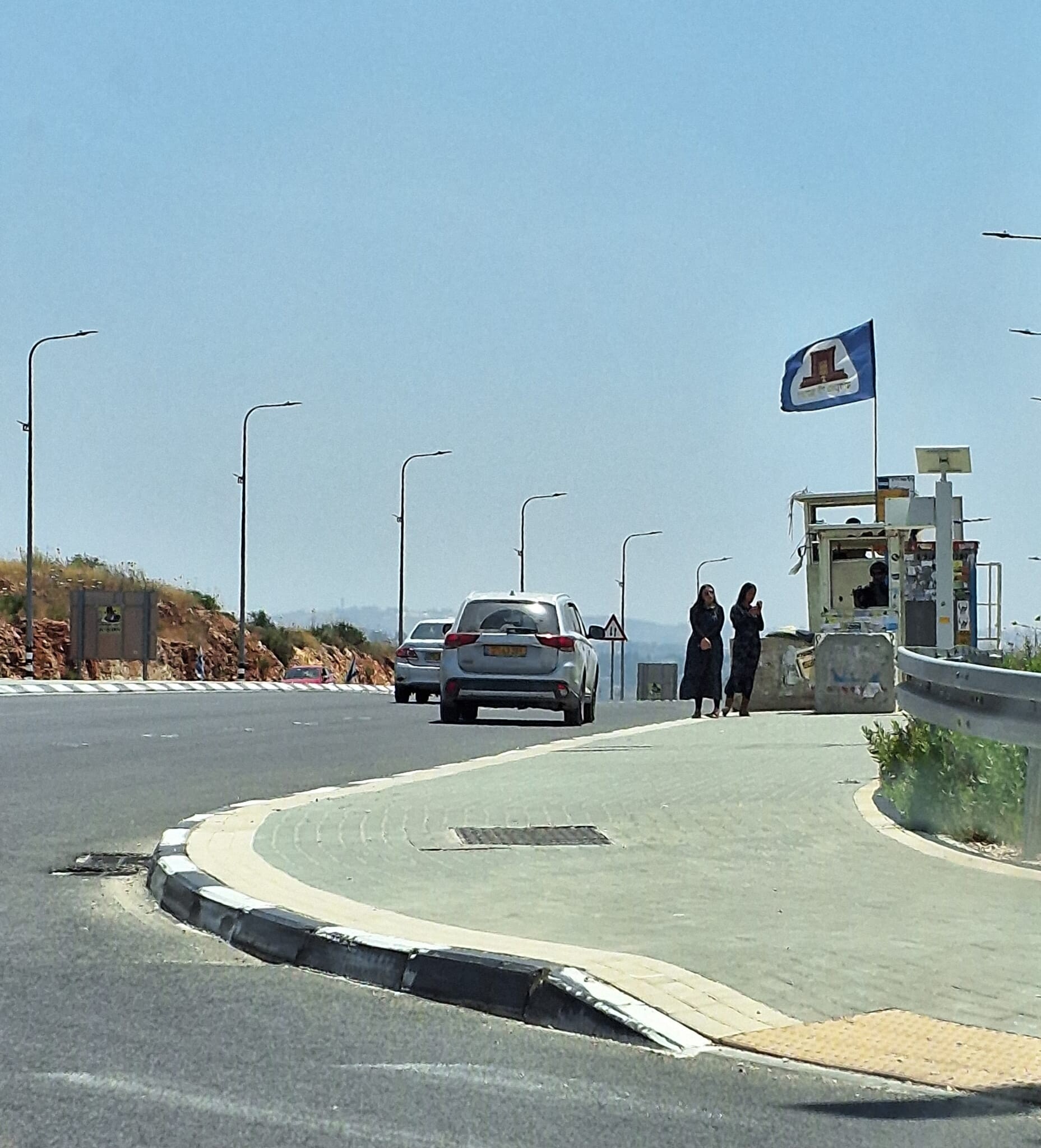 Ronit Dahan-RamatiJun-9-2026Za'atara (Tapuach Junction). The Temple Flag Above a Station
-
