
Hamra (Beqaot), Ma’ale Efrayim, Tayasir, Za’tara (Tapuah), Tue 2.10.12, Afternoon
Translator: Charles K.
Photos:
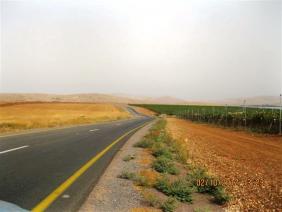
1. Green, well-watered crops at the Ro’i settlement, across from the Palestinians’ yellowing fields and a barrier wall.
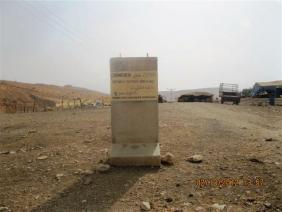
2. Signs planted amid the Bedouin encampments announcing they’re on a firing range.
3. A local farmer who tried to transport his produce across the earthen berm was caught and arrested.
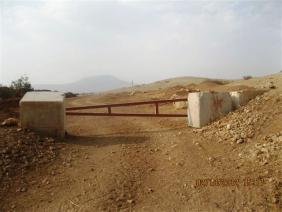
4. The Gochia gate is deserted – soldiers don’t come to open it.
Later I realized I should have photographed all the large concrete water reservoirs on the hilltops, built by Mekorot, the Israeli company, that supply only the settlers. The Palestinians, on the other hand, are forbidden to pump water and Israel has sealed their wells. The injustice is obvious to everyone: water is being plundered.
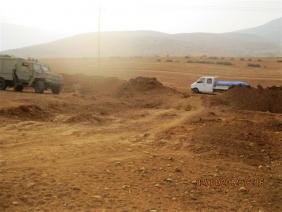
Along one side of the road dozens of dunums of green fields that the settlers irrigate regularly; parched, dry ground on the other side and a steep earthen berm which the army continually rebuilds to cut Palestinians off from other Palestinians and from their lands.
12:20 Za’tara checkpoint (Tapuach junction) – A soldier in the guard tower. No soldiers in the inspection booths. The area
near the booths has been fenced. On holidays there’s an information stand in the parking lot, for travelers – some stand there.
12:40 Ma’aleh Efrayim checkpoint – Three soldiers at the checkpoint, pointing their weapons at those who arrive, stopping every Palestinian vehicle. A settler shows up, gives them two bags of chips,tells them “You’re doing a great job.” Says to us, “Don’t you have anything better to do?” Photographs us and our car.
The soldiers don’t answer when Dafna asks who’s permitted to cross. But we didn’t see any vehicles turned back. We pass a large water reservoir, built by Mekorot, the Israeli company, on the way to the Hamra checkpoint – we saw a few like it in the Jordan Valley – next to it an open pool providing drinking water to the area’s flocks. They can quench their thirst from what’s left after Mekorot pumps the water, but three months ago Mekorot shut the faucet and the Palestinians must now fill the pool with water from water wagons they tow by tractor from Akraba, which is far away.
Hamra settlement – Greenhouses and wide, green cultivated fields, for only 28 families. Opposite, to the east: the Jiftlik, where Mekorot is drilling deep wells , taking water used by the Palestinians (who aren’t allowed to deepen their wells), drying up their orchards.
13:10 Hamra checkpoint – It wasn’t congested. We continued to Tayasir; we’ll stop here on our way back.
13:25 A Palestinian encampment on one side of the road; directly across on the other side, very close by, army tents and soldiers. What must a little boy in the family encampment feel upon waking in the morning and seeing an armed soldier right in front of him? I wasn’t able to get a good photo. Too bad. Seeing it is more powerful than any description could be.
Continuing along the road: On one side the products of the Ro’i settlement: fish ponds, organic spices, vineyards; on the other side, concrete posts announce: “Firing range – No entry.” That’s where the local residents live, who’ve been effectively expelled.
We visited the encampment where 16 cows were confiscated because they grazed in what had been declared a nature preserve, which is also a firing range. They told us the army returned only 13 cows and their owners were fined NIS 5000. That’s the encampment in the photo, in front of which is the post with the sign “Firing range – no entry”…not far from the settlement of Maskiyot whose built-up area is expanding toward the encampment.
14:20 Tayasir checkpoint – A vehicle driving west (toward Area A) is carefully inspected, along with its passengers, at one inspection booth. A vehicle driving east – the passengers get out and walk to where they’re inspected. The soldiers tell us that any pedestrian or vehicle can cross here without needing a permit. The Palestinians, on the other hand, say that pedestrians can usually go through without needing a permit, but a car whose driver isn’t registered as a resident of the Jordan Valley won’t receive a permit to enter.
The Palestinians also tell us about many instances in which some of the laborers waiting at dawn at the checkpoint have been pulled aside for an hour or an hour and a half, making them miss their ride and lose a day of work. For families which depend on the few pennies the father earns working in the settlement’s fields, the lost workday is a severe blow.
15:00 Gochia gate – No representative of the army has arrived to open the gate, despite the promises it made.
We met a young Palestinian shepherd who risked crossing the road with his flock, but said that there’s nothing on the other side for the sheep to eat, as we also could see. He asked who we are; when Dafna answered, explaining we’re against the checkpoints and the occupation, he placed his hand on his heart, then raised his hands high and shouted “God is great,” as if he didn’t believe what he’d heard…
15:50 Hot peppers – P., a Palestinian from one of the villages, farms and markets produce. He lives west of the road but tried nevertheless to cross the earthen berm erected by the army to prevent normal traffic across the road by compatriots whose land has been occupied by Israel. He was caught by a security patrol of the Beqa’ot settlement, which summoned the army. He’s already been detained for two hours, waiting for the police. A truck driver and another passenger said that because they’re not residents of the Jordan Valley and are therefore forbidden to cross through the Hamra checkpoint, and because there’s not enough of a market for their peppers on the West Bank, they tried their luck here – and why shouldn’t a merchant from Tamoun be allowed to sell peppers in the Jiftlik? How will that undermine security? We waited with them for about half an hour. They were very thirsty in the heat of the Valley, and feared their entire crop was rotting on the truck. [At 16:45, P. informed us that the police came and let him off with a reprimand.]
16:10 Hamra checkpoint – Vehicles and passengers travelling west aren’t inspected. But they must wait for the soldier’s signal to go through the checkpoint. On the other side, people coming from the west to the Jordan Valley must get out of the vehicle, be inspected one by one and then wait for their vehicle to go through the checkpoint. Again, only a vehicle whose owner lives in the Jordan Valley is allowed through the checkpoint.
16:45 Ma’aleh Efrayim checkpoint – The inspection booths aren’t manned. A soldier in the observation tower.
The shifts change, the soldiers go to the guard tower in the parking lot. The inspection booths aren’t manned.
Hamra (Beqaot)
See all reports for this place-
One of the Jordan Rift Valley checkpoints that prevent direct transit between the West Bank and the Jordan Valley, in addition to Tayasir Checkpoint. Located next to Hamra settlement, on Route 57 and the Allon Road.
Read about the peple of the Jordan Valley and the quiet transfer happening there.
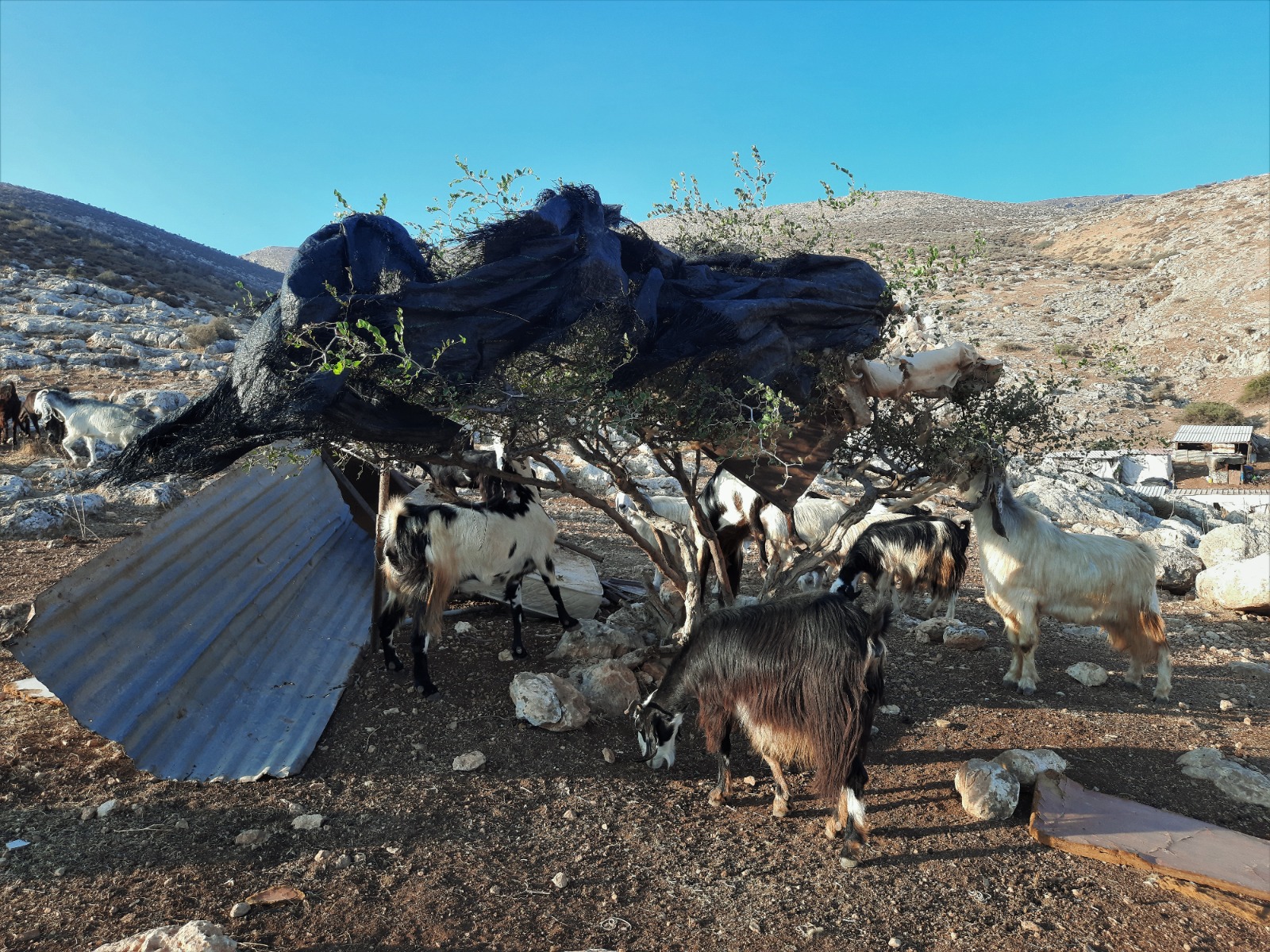 Shahar ShilohNov-3-2021Ein Shibli: grazing begins close to home
-
Ma'ale Efrayim
See all reports for this place-
Ma'ale Efrayim On the road connecting Route 90 (the Jordan Valley road) to the Allon Road.
-
Tayasir CP
See all reports for this place-
Located on road 5799, It is one of the checkpoints control the passage between the northern West Bank and the Jordan Valley. For a long time, it stood empty and open, with only a sign next to it warning against entering Area A. It was adjacent to an old military camp - now everything is neglected. How much money was invested here, and how much brainwashing was done to the soldiers of Netzah Yehuda and Kfir.
Today, it is very difficult to pass there. Many delays. Often, teachers from Tubas are not allowed to pass into the Valley to villages like Ein al-Bida where the local schools are located, and there are no classes. There are additional days when the checkpoint is closed. In general, there is a wait there of about two to four hours to go towards the Valley and also to return. Many times the Palestinians are forced to use the Hamra checkpoint, which also leads into Tubas and the West Bank, but there is also a huge queue there and a long wait.
Following a deadly attack on soldiers at the nearby base in February 2025, the checkpoint was completely closed for the time being. (Updated March 2025)
-
Za'tara (Tapuah)
See all reports for this place-
Za'tara (Tapuah) Za'tara is an internal checkpoint in the heart of the West Bank, at the intersection of Road 60 and Road 505 (Trans-Samaria), east of the Tapuah settlement. This checkpoint is the "border" marked by the IDF between the north and south of the West Bank, in accordance with the policy of separation between the two parts of the West Bank that has been in place since December 2005. At the Za'tara checkpoint, there are separate routes for Israelis and Palestinians. In the route for Israelis, there are no inspections and the route for Palestinians inspects. The queue lengthens and shortens suits. The checkpoint is open 24 hours a day. The checkpoint is partially staffed and the people who pass through it are checked at random.
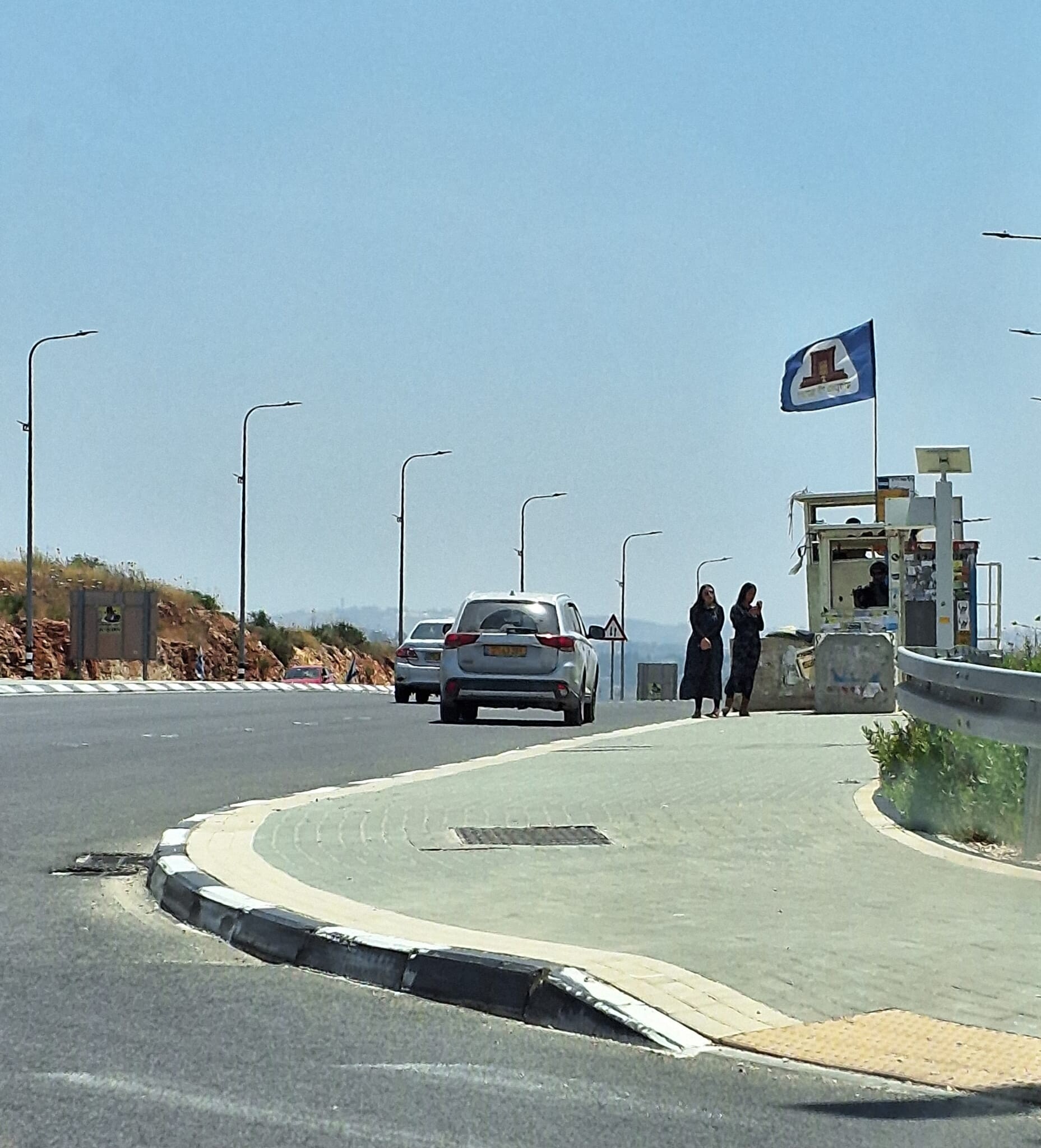 Ronit Dahan-RamatiJun-9-2026Za'atara (Tapuach Junction). The Temple Flag Above a Station
-
