
Hamra (Beqaot), Tayasir
13:20 Bezeq checkpoint
The weather is pleasant. Most of the land is dry and brown, except for the cheerful agricultural lands of the settlements.
Driving up to the Tayasir checkpoint
Life has been renewed at the Hamam-el-Malih encampment. The military training areas on both sides of the road are empty.
13:35 Tayasir
Cows graze near the fence of the deserted army base. Heavy traffic. Two soldiers in the emplacement on the road. We can’t see them, but every so often a waiting car drives off and we assume they’ve waved the car through. Ruthie walked down to tell them one of the trucks has been waiting a (relatively) long time. The soldiers emerged, began inspecting the cars (the ones heading west, toward Tayasir!). They said they carefully inspect every fifth car. Perhaps because of us, and for the officer who arrived in a jeep from the Barak battalion, they began checking more frequently. They detained one of the cars and called someone on the phone about it, which took a long time. The soldier finally told me the people in the truck lacked permits and politely asked us to stop bothering him.
14:20 We left.
14:25 We saw a jeep driving up to the Tayasir checkpoint. We turned around to follow it, thinking it was connected to the detained vehicle. The major who was driving said he was an officer in the engineering corps who’s been sent to see about moving the checkpoint farther east. He doesn’t know to where, but the army will have to repair the damage caused by the existing checkpoint and restore the area to its previous condition. He didn’t stay to tell us where it would be moved to.
14:40 We left (the detained vehicle still stood by the roadside).
The Alon Road: Netting covers a large portion of the new vineyard west of the road. The earthen berm has been made higher in preparation for winter.
15:00 Hamra checkpoint
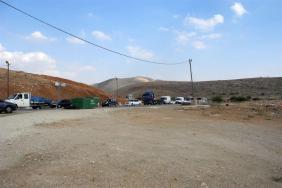
25(!!) cars wait east of the checkpoint. A long line of vehicles is visible to the west; we’re not able to count them. A soldier stands facing a group of about ten youths, then releases them (they go up to the encampment to the north of the checkpoint). The driver of one of the cars says he’s been waiting three hours, and that they’re letting only one car through every half hour. He came from the bridge, and was glad we were there because “now they’d begin working.” We saw six soldiers at the checkpoint. A bulldozer was parked in the plaza. We asked a soldier standing at the pedestrian lane whether anything had happened. He said no. And that a line of 30 cars isn’t so bad. They’ll go through eventually.
An officer and four soldiers wearing bulletproof vests, who'd arrived to train or to help, let two cars through simultaneously in two lanes, carefully inspecting almost every car. The last car on line at 15:00 crossed 25 minutes later. Eleven more cars followed. At 15:40 the road had emptied. We met two more laborers from Jenin, construction workers in Ma’ale Efrayim who’d been driven to the checkpoint by their Jewish employer.
15:40 We left.
We drove to the village of Al Jiftlik in the wake of an announcement published by the International Solidarity Movement:

21st October 2014 | International Solidarity Movement, Nablus team | Jordan Valley, Occupied Palestine On October 20th, the Israeli military destroyed six structures belonging to a family in the village of al Jiftlik, in the Jordan Valley. At approximately 6:00 am, Israeli soldiers destroyed the family home of Mohammed Mousa Mohammed Abohernam, as well as five other buildings, including his family's storage unit …"
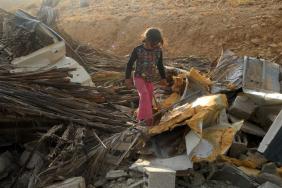
People we met showed us the way to the house (the photo on the right shows the rubble). It’s located in the neighborhood southeast of Highway 57, the road from Damya Bridge to the Hamra checkpoint (and from there, via Nablus, to Netanya). They demolished the house with the aid of two bulldozers. A 14-year-old girl who'd escorted us with her mother said the demolition was carried out early in the morning. Soldiers in ten jeeps provided security; they didn’t allow the family to remove belongings other than school bags and a few clothes. They demolished a house with two rooms and a kitchen, a separate bathroom, an additional house belonging to one of the sons, and
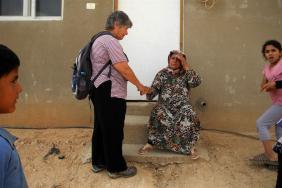
also a large sheepfold. The animals weren’t injured. The family is now living with neighbors (we saw two tents, not very big). The mother cried because they’ll have nowhere to live during the winter. They’d lived in the house for three years. They said they’d spent NIS 200,000 on it.
17:00 We parted from the family. (Bottom right-hand photo: Racheleh saying goodby to the woman whose home was destroyed). Because it was late we didn’t return to Tayasir to see whether the detained truck had been released.
17:20 Bezeq
They asked how we were and let us through.
Al-Jiftlik
See all reports for this place-
A large Palestinian area in the Jordan Valley (in Israeli-controlled Area C), which includes a town located on two main roads: Highway 57 leading from Nablus to Adam Bridge and Highway 90, Israel's eastern longitudinal highway. Some of its residents are Bedouin who were expelled from the Negev in the 1950s. MachsomWatch women have been in regular contact with the Bedouin communities in the area for many years.
A special connection was formed with the Kaabna family, who, following the demolition of their home in 2017, fled to the village of Hadidiya, and experienced a terrible tragedy along the way. In 2019, they were expelled again from Hadidiya under threat of demolition and returned to Jiftalik.
Jiftalik is the only village in the Jordan Valley for which Israel prepared and approved master outline plans in 2005. All of them were prepared without the participation of the residents and restricted construction and development in the village to a limited part of its area, thus many demolitions are being carried out there.
Because of an inadequate water system, residents are forced to purchase water in tankers, and all requests for the construction of a reservoir have been denied.
-
Hamra (Beqaot)
See all reports for this place-
One of the Jordan Rift Valley checkpoints that prevent direct transit between the West Bank and the Jordan Valley, in addition to Tayasir Checkpoint. Located next to Hamra settlement, on Route 57 and the Allon Road.
Read about the peple of the Jordan Valley and the quiet transfer happening there.
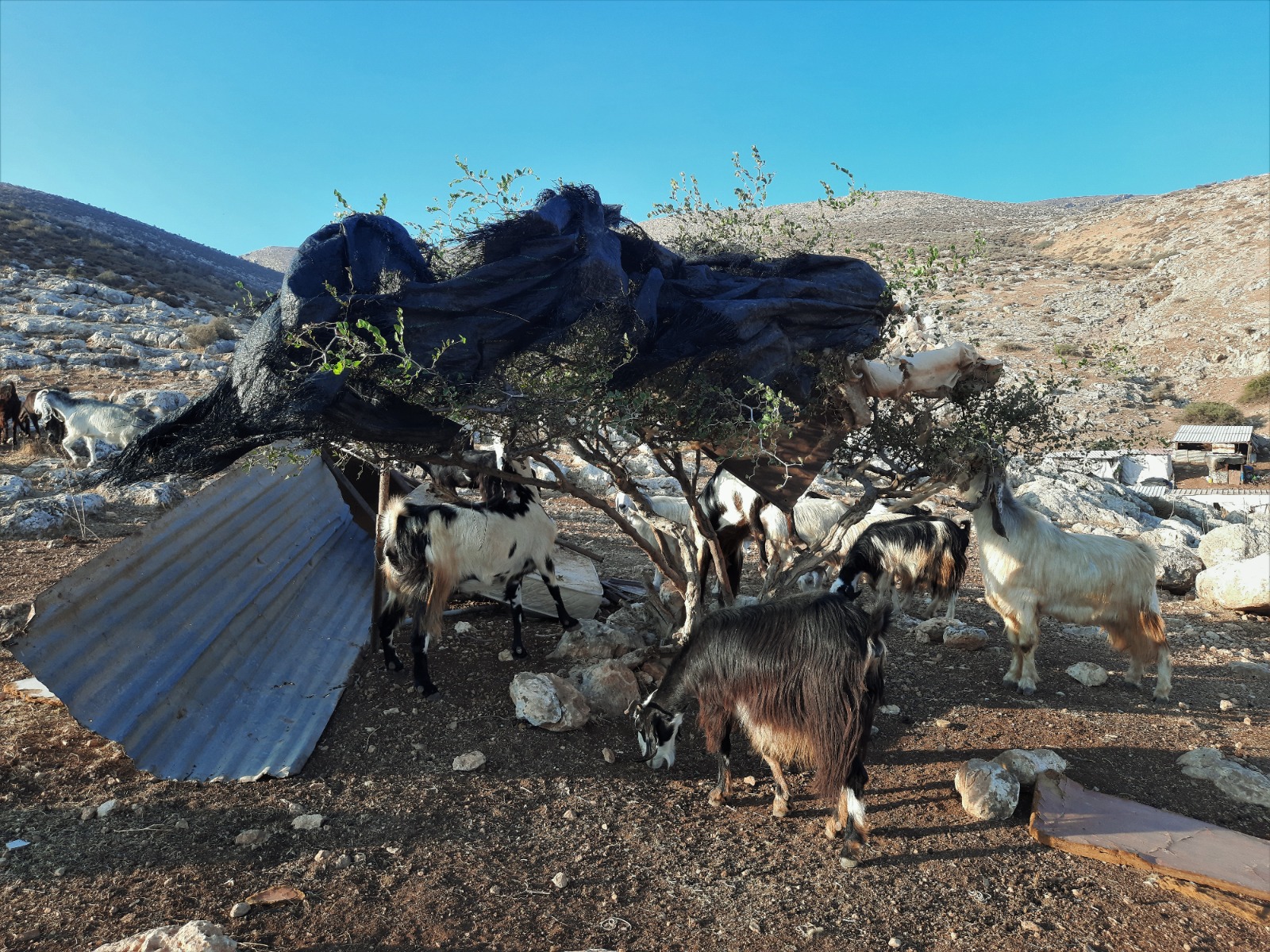 Shahar ShilohNov-3-2021Ein Shibli: grazing begins close to home
-
Tayasir CP
See all reports for this place-
Located on road 5799, It is one of the checkpoints control the passage between the northern West Bank and the Jordan Valley. For a long time, it stood empty and open, with only a sign next to it warning against entering Area A. It was adjacent to an old military camp - now everything is neglected. How much money was invested here, and how much brainwashing was done to the soldiers of Netzah Yehuda and Kfir.
Today, it is very difficult to pass there. Many delays. Often, teachers from Tubas are not allowed to pass into the Valley to villages like Ein al-Bida where the local schools are located, and there are no classes. There are additional days when the checkpoint is closed. In general, there is a wait there of about two to four hours to go towards the Valley and also to return. Many times the Palestinians are forced to use the Hamra checkpoint, which also leads into Tubas and the West Bank, but there is also a huge queue there and a long wait.
Following a deadly attack on soldiers at the nearby base in February 2025, the checkpoint was completely closed for the time being. (Updated March 2025)
-
