
Hamra (Beqaot), Tayasir, Za’tara (Tapuah)
Raja Shehadeh writes in the introduction to his book, Palestinian Walks: Notes on a Vanishing Landscape[1]that before the settlements were established near his home he used to leave his house and immediately begin hiking through the surrounding hills. But the Israeli occupation, which over the years has continued to narrow the space in which Palestinians may live their lives, no longer permits Shehadeh his solitary walks in the region without his risking detention or injury by the Israeli army and/or the settlers.
Are limitations on the ability of Palestinians to go on hikes at will equivalent to expulsions, dispossessions, demolition of homes, and restrictions on earning a living in the Jordan Valley, where we’re bound for today’s shift? Perhaps the answer is no, but limitations on Palestinians’ freedom of movement,t which consequently restrict their fundamental right to leisure and to enjoy the country’s beauty are strikingly obvious, when it goes without saying that young settlers start hiking as soon as the Passover holiday arrives, behaving as if they are lords of the land, protected by the army.
Za’tara checkpoint 10:20
Inspection stations not manned, parking lot blocked, an observation post on a dirt hill opposite the plaza.
We noted the above-mentioned difference when, at the Za’tara checkpoint on Highway 505, after the turn to the Jordan Valley, we picked up two young settlers from a settlement located east of Rosh Ha’ayin. Both were carrying camping equipment. They told us they were heading for Beit She’an. We left them at the Ptzael junction.
Ma’ale Efrayim checkpoint, 10:35
Not manned.
Who owns the land, or – to be exact – who are the lords and who their subjects, who rules and who does their bidding, became increasingly clear as we drove on.
Hamra checkpoint
10:45 Two men sit by the roadside beyond the Gitit settlement, joined by a third. One is a shepherd from Aqraba, the second works in a nearby field of basil. The shepherd describes a circular business deal: the settlement of Gitit, to which the government has granted rights to the land, leases it to a person who lives in Tel Aviv – in other words, not only those living in the territory occupied in 1967 are settlers. The resident of Tel Aviv employs a Palestinian from ‘Aqraba who works the field. Remember – this land had been owned by Palestinians before 1967. And so Palestinian land returns to Palestinian hands while a few Jews clip coupons along the way.[2]
The shepherd also tells us that about 20 days ago soldiers grabbed his brother, blindfolded him, tied him up and brought him to the Hamra checkpoint where he was held for six hours. Then they let him go. From what we understood he was detained because he’d grazed his flock in a nature preserve. Such illegal detentions happen repeatedly in the northern Jordan Valley.
The shepherd told us that four years ago settlers slaughtered much of his flock. The Palestinian and Israeli DCL and the Israeli police were involved, but didn’t do anything. We gave him the phone number of Yesh Din (legal aid).
11:15 Hamra checkpoint. A few cars inspected in turn – one from the east, one from the west. Not every driver is asked to show ID. The waiting time is very short. We left after 10 minutes.
11:35 Gochia checkpoint
Closed (it had been open at this hour during other Machsom Watch shifts).
11:50 Further on, slightly past Ro’I, near the new vineyard west of the road (where the trance party had been held a few weeks ago), dozens of festively-dressed Palestinians filled the area stretching from the vineyard to the Kfir Brigade’s military base. Military and police vehicles were also there, including a vehicle for dispersing demonstrations; we’d seen and heard it from Hamra checkpoint – racing along the road, filling the air with a warning siren.
The gathering was a non-violent, popular protest to prevent the settlement of Ro’i from taking over the land adjoining the vineyard,[3] which belongs to a Palestinian living in Tubas (it’s registered in his name). The vineyard which had been planted a year or two ago is also on that man’s land (the matter is under adjudication). People from throughout the Jordan Valley came to support the land’s owner. We asked people how they knew; they’d read it on Facebook. The only non-Palestinians were a few EAPPI activists, some soldiers and Israeli police, and us. The soldiers stood without intervening. People were glad to see us, welcomed the presence of Israelis, spoke about coexistence and Rina was honored by being asked to plant a tree.
One of the EAPPI volunteers told us that last week 200 people were removed from Ibziq, a locality that doesn’t appear on Israeli maps that show only Mt. Bezeq. Two days before the removal residents were ordered to vacate the site from 6 AM to 4 PM. The same occurred the next day. The locality suffered considerable damage during those two days. She also said that last Thursday the army fired rockets over ‘Aqraba (her Facebook page includes many photos of the incident).
We left the checkpoint for Khalet Makhul; they told us the army had stopped showing up.
13:54 Tayasir checkpoint
Few cars; they stop at the inspection post and continue.
14:15 We left.
On our way back we visited K.’s encampment. His sons tell us that the settlers at Maskiyot won’t hire them; their construction workers come from Tubas. Building continues at Maskiyot, which keeps expanding.
Hamra checkpoint
Five cars heading west crossed after a brief inspection. The inspection posts at the Ma’ale Efrayim and Za’tara checkpoints aren’t manned.
Hamra (Beqaot)
See all reports for this place-
One of the Jordan Rift Valley checkpoints that prevent direct transit between the West Bank and the Jordan Valley, in addition to Tayasir Checkpoint. Located next to Hamra settlement, on Route 57 and the Allon Road.
Read about the peple of the Jordan Valley and the quiet transfer happening there.
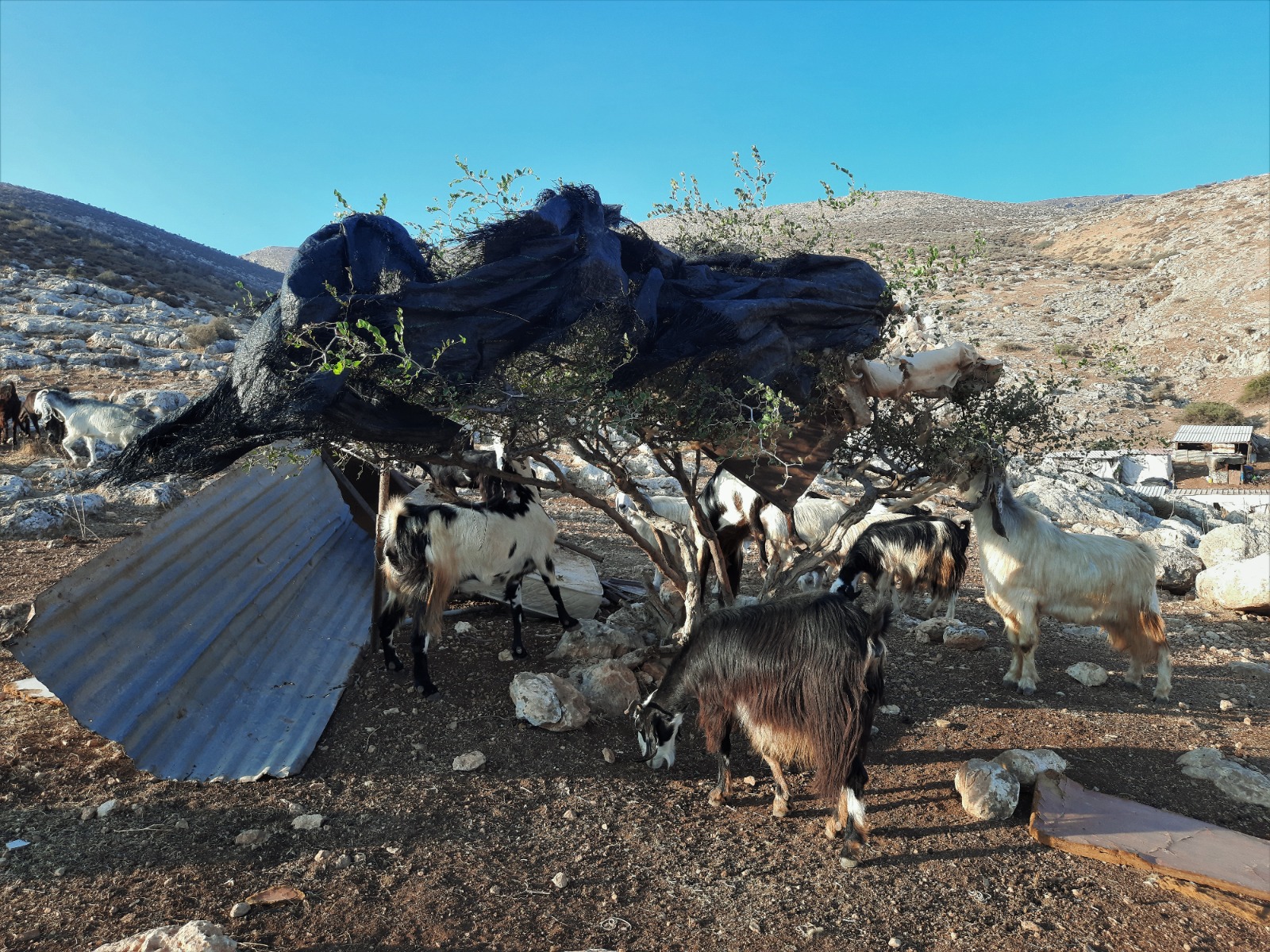 Shahar ShilohNov-3-2021Ein Shibli: grazing begins close to home
-
Tayasir CP
See all reports for this place-
Located on road 5799, It is one of the checkpoints control the passage between the northern West Bank and the Jordan Valley. For a long time, it stood empty and open, with only a sign next to it warning against entering Area A. It was adjacent to an old military camp - now everything is neglected. How much money was invested here, and how much brainwashing was done to the soldiers of Netzah Yehuda and Kfir.
Today, it is very difficult to pass there. Many delays. Often, teachers from Tubas are not allowed to pass into the Valley to villages like Ein al-Bida where the local schools are located, and there are no classes. There are additional days when the checkpoint is closed. In general, there is a wait there of about two to four hours to go towards the Valley and also to return. Many times the Palestinians are forced to use the Hamra checkpoint, which also leads into Tubas and the West Bank, but there is also a huge queue there and a long wait.
Following a deadly attack on soldiers at the nearby base in February 2025, the checkpoint was completely closed for the time being. (Updated March 2025)
-
Za'tara (Tapuah)
See all reports for this place-
Za'tara (Tapuah) Za'tara is an internal checkpoint in the heart of the West Bank, at the intersection of Road 60 and Road 505 (Trans-Samaria), east of the Tapuah settlement. This checkpoint is the "border" marked by the IDF between the north and south of the West Bank, in accordance with the policy of separation between the two parts of the West Bank that has been in place since December 2005. At the Za'tara checkpoint, there are separate routes for Israelis and Palestinians. In the route for Israelis, there are no inspections and the route for Palestinians inspects. The queue lengthens and shortens suits. The checkpoint is open 24 hours a day. The checkpoint is partially staffed and the people who pass through it are checked at random.
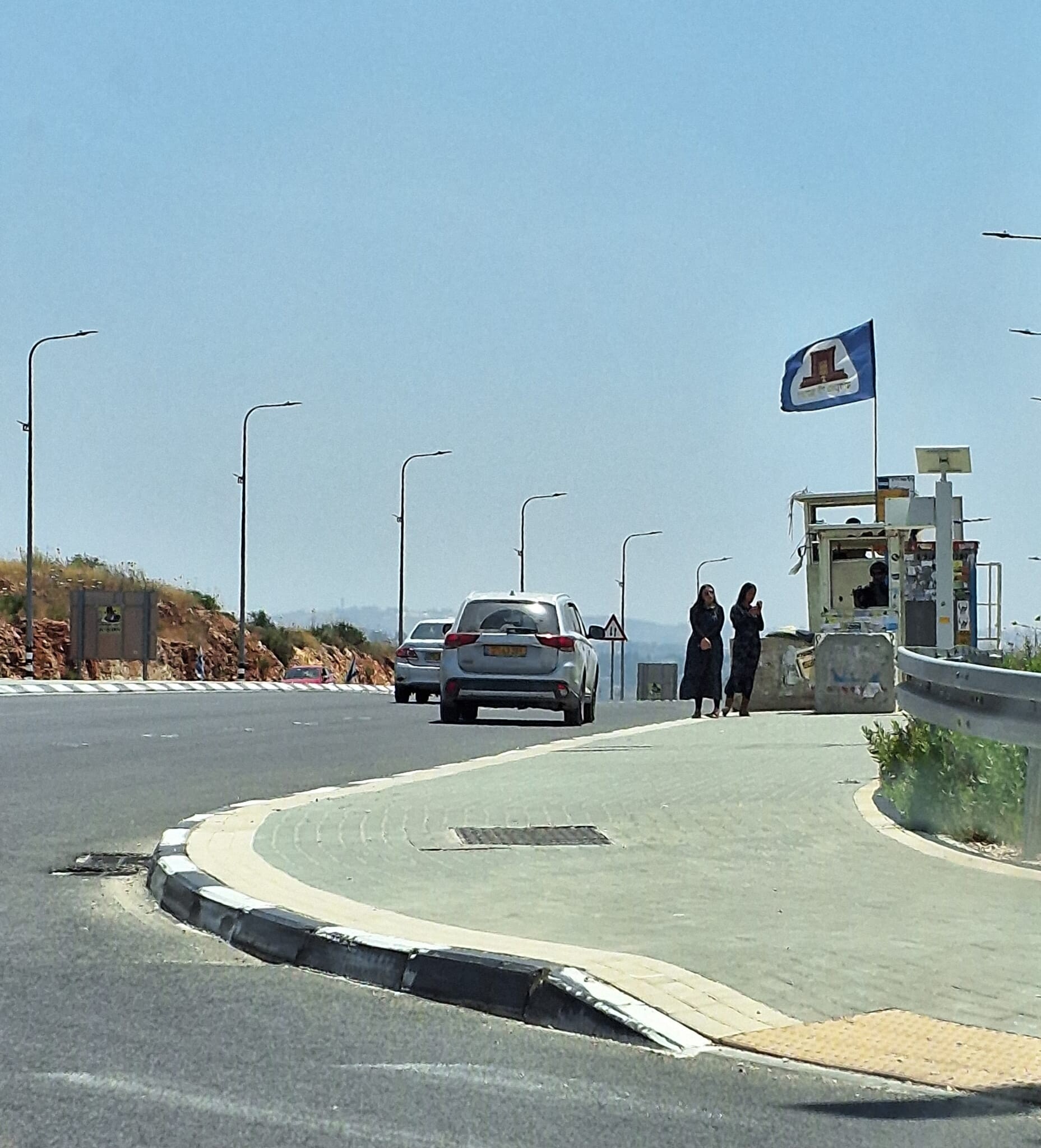 Ronit Dahan-RamatiJun-9-2026Za'atara (Tapuach Junction). The Temple Flag Above a Station
-
