
Haris, Jurish, Za’tara (Tapuah)
Jurish
13.40 We set out in the direction of Jurish on road no. 5.
In the opposite direction to Haris we saw a Palestinian family walking about the olive grove, probably collecting the last olives which remained on the trees.
At the Za’tara junction we saw border-policemen in both directions (Ramallah and Nablus), standing at the hitch-hiking stations.
Five minutes before we turned from road no. 505 toQusra an ambulance with its siren on passed us at high speed.
We arrive at the “Central” building in Jurish at 14.30 and S., the leader-girl welcomed us warmly.
At 16.20 Nadim asked us to leave earlier as a IDF military vehicle was seen driving on the main road ofQusra, the village near Jurish. Nadim heard from the locals that a settler had been run over, five kilometers from the exit from Qusra in the direction of Ma’ale Ephraim, and seemingly the ambulance we saw was intended to assist this settler.
We didn’t see IDF vehicles in the two villages, Jurish and Qusra, , but we felt the tension in the village, because the local men were seen crowding together in Jurish.
16.50 At the Za’tara junctions we saw settlers standing at the hitch-hikers’ station in the direction of Nablus. Two special patrolling units of the police were seen parked at the vehicle parking lot frof the security services.
16.55 A military jeep was see standing near the Ariel square.
17.05 We arrived at the Salphit CP. No soldiers were to be seen, but a driver of a Palestinian taxi was seen waiting (probably) for Palestinian workmen after finishing their work.
17.10 At the Haris junction we saw a military jeep standing among the olive trees on the hill.
English lesson: S. Hen reports
We left with Nadim from the Rosh Ha’Ayin train station and arrived at 13:30. The class convened at 13:45 with less students than usual. As usual Cirine assumed responsibility and took care of the arrangements. Hadas oversaw the distribution of the folders, in which the participants were to file the study material. At the beginning we held a free conversation. Then we practiced vocabulary and a story, with the help of dolls. All the participants were active and animated.
The yoga lesson proceeded in order, Sara and Anna instructed together; each girl was given intensive personal instruction.
Haris
See all reports for this place-
Haris
The village has 4,500 people and they have 5,000 dunams of land. The entrance to the village is blocked and opened arbitrarily, without informing the residents.The village has a seasonal checkpoint that blocks the road to the agricultural land and this checkpoint opens once a year! 2,500-3,000 dunams were stolen from the village in order to build the settlements of Revava and Netafim, which are located west of Haris.
The center of the village is Area B and around Area C. The population grows but the occupation does not permit new construction in Area C.
-
Jurish
See all reports for this place-
Jurish
An ancient village, of which 62% of the lands were defined after the 1995 agreements as Area B, while the remaining 38% Area C. Israel confiscated 17 dunams of the village's land for the construction of the Israeli Migdalim settlement, in addition to expropriating land for Road 505. In mid-2016, a road was blocked by the IDF (partly paved by the Palestinian Authority) that connected Jurish to Road 505. This is the shortest way to get to Jurish from the main road, without bypassing another 6.5 km through Qusra.
From 2014 to mid-2016, volunteers from the Watch checkpoint in the village held English, yoga and Hebrew classes for girls.
-
Qusra
See all reports for this place-
Qusra
This village is located in the Nablus district, about 28 kilometers south-east of the city. Its population numbers 4,310 as of 2007 (according to the Palestinian census). After the Oslo Accords, 50% - most of the village’s built-up area – was categorized Area B, and about 70 homes as well as the rest of its land are inside Area C.
In 1983, 177 dunams of the village lands were confiscated by Israel to build a ‘Nahal’ stronghold, turned civilian in 1985 and named Migdalim settler-colony, east of the village itself. To the north-east is a gas station and a leather plant, as well as a studio producing wood ware, all of which are a branch of the settler-colony. Dozens of additional farmland were confiscated from Qussra and Jaloud in order to erect the settler-colonies Esh Qodesh and Ahiya.
“The villagers point to the settler-colonists of Esh Qodesh as the source of their problem. Qussra villagers were forbidden to tend their lands located a kilometer away from the Esh Qodesh fence, and about 20 meters from the area declared military zone. What about the ‘legitimate’ plots? Their crops are regularly destroyed by the settler-colonists. Fires break out in wheat fields, olive trees are cut down, wells are destroyed – these have all become routine events. In spite of all of this, the head of the local council sees the Israeli army as the main source. He says that the settler-colonists could not have harassed the villagers without the army backing them up…”
(From a MW report, August 3, 2015)
In 2001, the Israeli army evacuated its intelligence base “Kida”. In 2003, the settler outpost Kida was established, a quick attempt was made to evict the newcomers, but they were eventually allowed to remain.
For further information: http://vprofile.arij.org/nablus/pdfs/vprofile/Qusra_vp_en.pdf
-
Za'tara (Tapuah)
See all reports for this place-
Za'tara (Tapuah) Za'tara is an internal checkpoint in the heart of the West Bank, at the intersection of Road 60 and Road 505 (Trans-Samaria), east of the Tapuah settlement. This checkpoint is the "border" marked by the IDF between the north and south of the West Bank, in accordance with the policy of separation between the two parts of the West Bank that has been in place since December 2005. At the Za'tara checkpoint, there are separate routes for Israelis and Palestinians. In the route for Israelis, there are no inspections and the route for Palestinians inspects. The queue lengthens and shortens suits. The checkpoint is open 24 hours a day. The checkpoint is partially staffed and the people who pass through it are checked at random.
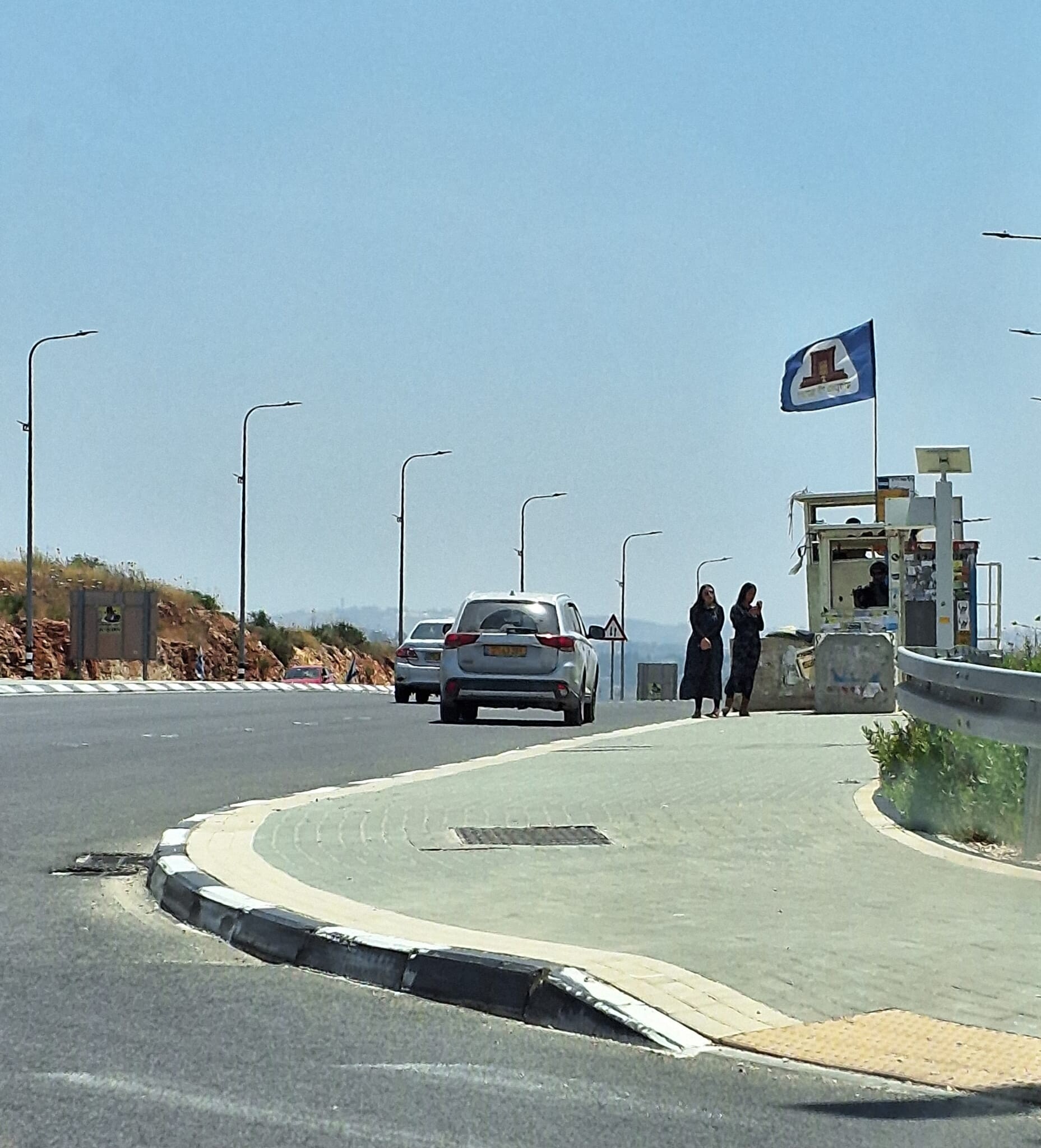 Ronit Dahan-RamatiJun-9-2026Za'atara (Tapuach Junction). The Temple Flag Above a Station
-
