
Hebron
After a journey through fog and white fields, we reached a white city bathed in snow.
We arrived after a rather stormy week. A. said that there was a strike against the PA, which in Hebron was full and 20,000 people took to the streets. The strike also took place in other parts of the West Bank, but it was not as full as in Hebron. The strike broke out due to the Authority’s decision to change the terms of the pension and against the workers’ committee, which had cooperated with it. It was decided to set up new committees that would work on a voluntary basis and would not receive a salary from the Authority so that they would not be tempted to cooperate with them. An impressive response of a society under occupation, and to a culture built mostly on the interests of clans.
Our friend Issa said that in the absence of lawyers’ support during the detention phase and sometimes even during the first interrogation phase, they decided to teach youth their rights so that they would not be afraid or helpless. The activity is carried out by Youth Against the Settlements, who advocate nonviolent resistance.
M. said that the settlers come to the center every day to harass and throw stones. They frighten the youth because they, the settlers, are not subject to the law, the army always intervenes in favor of the settlers, and the hand on the trigger is light. He put it in his exact way: one law for settlers and a lawlessness for Palestinians. The children of the settlers come to harass the children of the Cortoba school in Tel Rumeida, some of the Palestinians children have to come back from school through the stairs descending from Tel Rumeida to Beit Hadassah. The settlers’ children start harassing and attacking, and then the army comes and separates them and arrests the (only) Palestinian children. Children aged 10-12 are taken into custody.
Attached Link:
https://www.youtube.com/watch?v=N_BwDCWVd9A&feature=youtu.be
And other news from Hebron, which was given to us by the father of the family we visited with, who had opened Tel Rumeida to Palestinians who do not live in the area. Up to now only those who lived in the area were allowed in according to a list which the army held. While we were there a friend who lives in another village in the West Bank came to visit them. The local residents will now be able to celebrate their holidays with their extended family who, they can host in their homes, a basic human right which has been stolen from them up to now.
On Wednesday the Hebron area was covered with snow which whitened my face with its background of my sins and shame.
We rode along the roads of Tel Rumeida in puddles of snow and water.
Hebron
See all reports for this place-
According to Wye Plantation Accords (1997), Hebron is divided in two: H1 is under Palestinian Authority control, H2 is under Israeli control. In Hebron there are 170,000 Palestinian citizens, 60,000 of them in H2. Between the two areas are permanent checkpoints, manned at all hours, preventing Palestinian movement between them and controlling passage of permit holders such as teachers and schoolchildren. Some 800 Jews live in Avraham Avinu Quarter and Tel Rumeida, on Givat HaAvot and in the wholesale market.
Checkpoints observed in H2:
- Bet Hameriva CP- manned with a pillbox
- Kapisha quarter CP (the northern side of Zion axis) - manned with a pillbox
- The 160 turn CP (the southern side of Zion axis) - manned with a pillbox
- Avraham Avinu quarter - watch station
- The pharmacy CP - checking inside a caravan with a magnometer
- Tarpat (1929) CP - checking inside a caravan with a magnometer
- Tel Rumeida CP - guarding station
- Beit Hadassah CP - guarding station
Three checkpoints around the Tomb of the Patriarchs
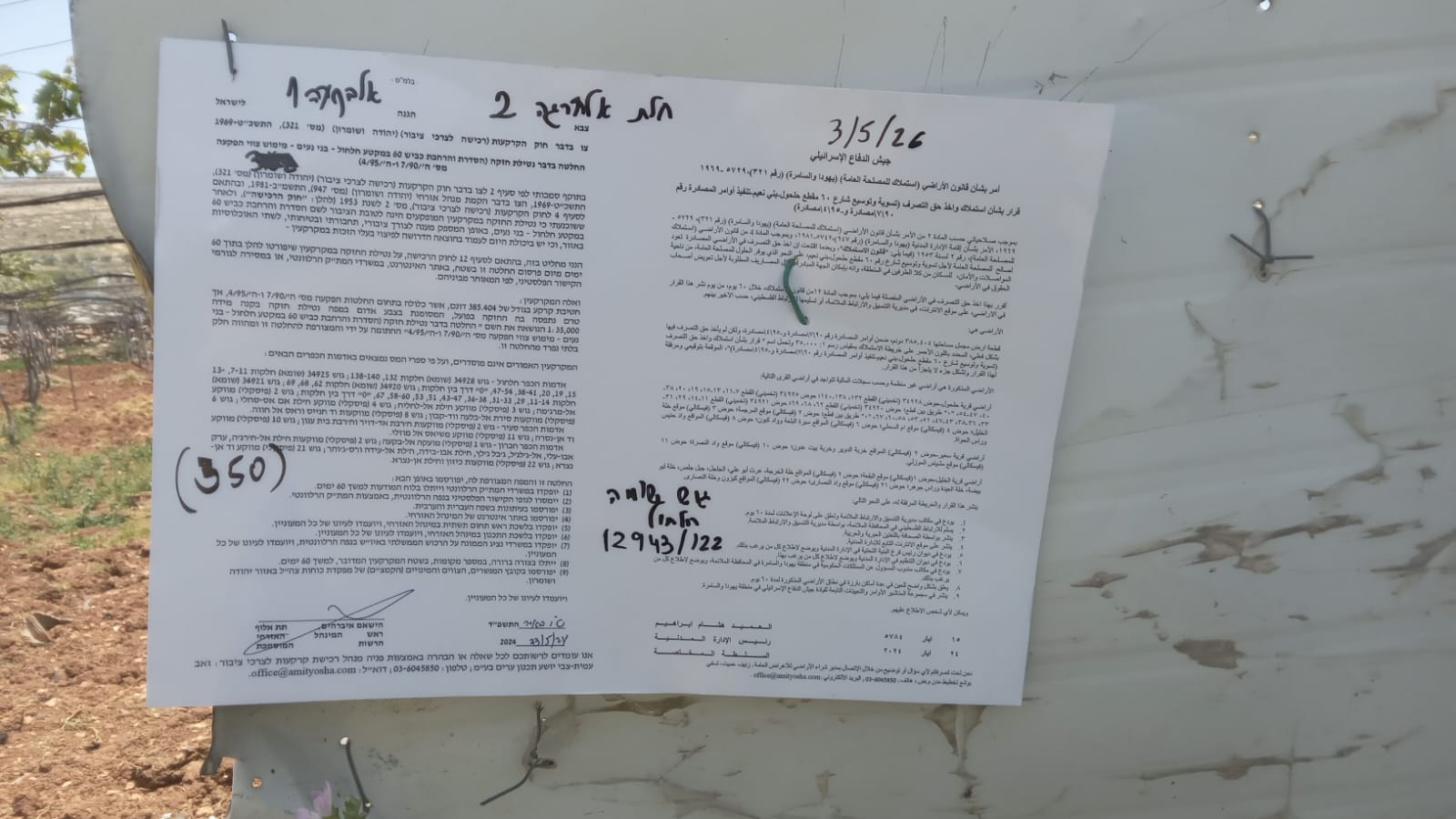 Muhammad D.May-13-2026Hebron - Request for compensation for land expropriation
-