
Hebron and South Hebron Hills
9:00 Meitar Crossing – empty of workers, the shed has already been cleaned and anyone who arrives goes directly for a security clearance and quickly exits. In the parking area, there is only one food stall with the remains of food thrown on the ground.
We (also Mira B) met with Hamed, who is part of the Village Group and also works for UNRWA, to discuss our idea of expanding our preschool art, music, social skills activities at Hashem el-Daraj to other preschools in the Southern Hebron Hills. Mira and Judy led the discussion. It was decided:
a. To cease our activities with Huda at the Hashem el-Daraj preschool because she has shown little if any interest in building on our work with her or continuing the activities between our visits. If a new teacher comes to the preschool, our decision will be reconsidered.
b. An alternative preschool is located at Tuwani, and according to Hamed, the preschool teacher is very interested in such activities. He is not sure of the situation at Zif but will check.
c. We mentioned that we would like to produce an illustrated workbook in Arabic of our activities. Hamed is ready to assist with its printing, on the condition that the workbook is in a format that can be printed. Figures need to be added to the text in order to illustrate the step-by-step sequence of each stage of the art activities. The workbook should also include pictures or illustrations of completed art projects; pictures can be taken from the albums Judy created.
After the meeting, we visited the preschool in Tuwani and met the preschool teacher Intisar.
The preschool is a new building built for that purpose (see picture) although the interior gives the impression that it was originally built for another purpose and had been converted into a preschool. The play/class rooms are smaller than one would expect in a preschool. To date, there is almost no equipment – furniture, toys, other preschool materials. There is a large covered sandbox but no outdoor play equipment. There is the beginning of a garden. The preschool building was completed in June, and according to the preschool teacher, it has just opened and the children are there from 8:00-11:00.
International activists, including a woman from Ramallah and another from Bethlehem, were using the preschool for their Playback rehearsals. Intisar and several older children were participating in the rehearsal. We took Intisar’s telephone number so we could arrange a further meeting with her late next month to continue our discussion about working together.
Routes 317 and 60 were empty of traffic; the fields are dry, waiting for the first rainfall. The sky was clear except for the observation balloon.
Hebron
The paratroopers are manning the security posts. We had a conversation with one of the soldiers who is a lone soldier from New York. The other soldiers ignored us. New: A list of residents of the neighborhood near Patriarch Cave is posted in the security booth in front of the neighborhood. Those residents whose names and details appear on the list are free to enter the neighborhood once their ID cards are quickly checked against the list.
Tarpat crossing – the skeleton of the burned caravan stands next to Beit Ramano and in its place is a new magnometer caravan so the security check routine continues. When we arrived, a group of Irish tourists were visiting Hebron and then going on to East Jerusalem and other towns in the West Bank. When they passed through the Tarpat checkpoint, a Breaking the Silence guide was waiting for them. One of the women wanted us to talk to the group about what we do once she understood who we were – perhaps another time. We did send her the link to our website.
Abed has opened his store and told us that the city is beginning to recover after being almost empty of tourists during the summer because of the fighting. Let’s hope it continues.
Hebron
See all reports for this place-
According to Wye Plantation Accords (1997), Hebron is divided in two: H1 is under Palestinian Authority control, H2 is under Israeli control. In Hebron there are 170,000 Palestinian citizens, 60,000 of them in H2. Between the two areas are permanent checkpoints, manned at all hours, preventing Palestinian movement between them and controlling passage of permit holders such as teachers and schoolchildren. Some 800 Jews live in Avraham Avinu Quarter and Tel Rumeida, on Givat HaAvot and in the wholesale market.
Checkpoints observed in H2:
- Bet Hameriva CP- manned with a pillbox
- Kapisha quarter CP (the northern side of Zion axis) - manned with a pillbox
- The 160 turn CP (the southern side of Zion axis) - manned with a pillbox
- Avraham Avinu quarter - watch station
- The pharmacy CP - checking inside a caravan with a magnometer
- Tarpat (1929) CP - checking inside a caravan with a magnometer
- Tel Rumeida CP - guarding station
- Beit Hadassah CP - guarding station
Three checkpoints around the Tomb of the Patriarchs
 Raya YeorDec-18-2025Hebron - Yusri Jaber and part of his family
-
South Hebron Hills
See all reports for this place-
South Hebron Hills
South Hebron Hills is a large area in the West Bank's southern part.
Yatta is a major city in this area: right in the border zone between the fertile region of Hebron and its surroundings and the desert of the Hebron Hills. Yatta has about 64,000 inhabitants.
The surrounding villages are called Masafer Yatta (Yatta's daughter villages). Their inhabitants subsist on livestock and agriculture. Agriculture is possible only in small plots, especially near streams. Most of the area consists of rocky terraces.Since the beginning of the 1980s, many settlements have been established on the agricultural land cultivated by the Palestinians in the South Hebron Hills region: Carmel, Maon, Susia, Masadot Yehuda, Othniel, and more. Since the settlements were established and Palestinians cultivation areas have been reduced; the residents of the South Hebron Hills have been suffering from harassment by the settlers. Attempts to evict and demolish houses have continued, along with withholding water and electricity. The military and police usually refrain from intervening in violent incidents between settlers and Palestinians do not enforce the law when it comes to the investigation of extensive violent Jewish settlers. The harassment in the South Hebron Hills includes attacking and attempting to burn residential tents, harassing dogs, harming herds, and preventing access to pastures.
There are several checkpoints in the South Hebron Hills, on Routes 317 and 60. In most of them, no military presence is apparent, but rather an array of pillboxes monitor the villages. Roadblocks are frequently set up according to the settlers and the army's needs. These are located at the Zif Junction, the Dura-al Fawwar crossing, and the Sheep Junction at the southern entrance to Hebron.
Updated April 2022
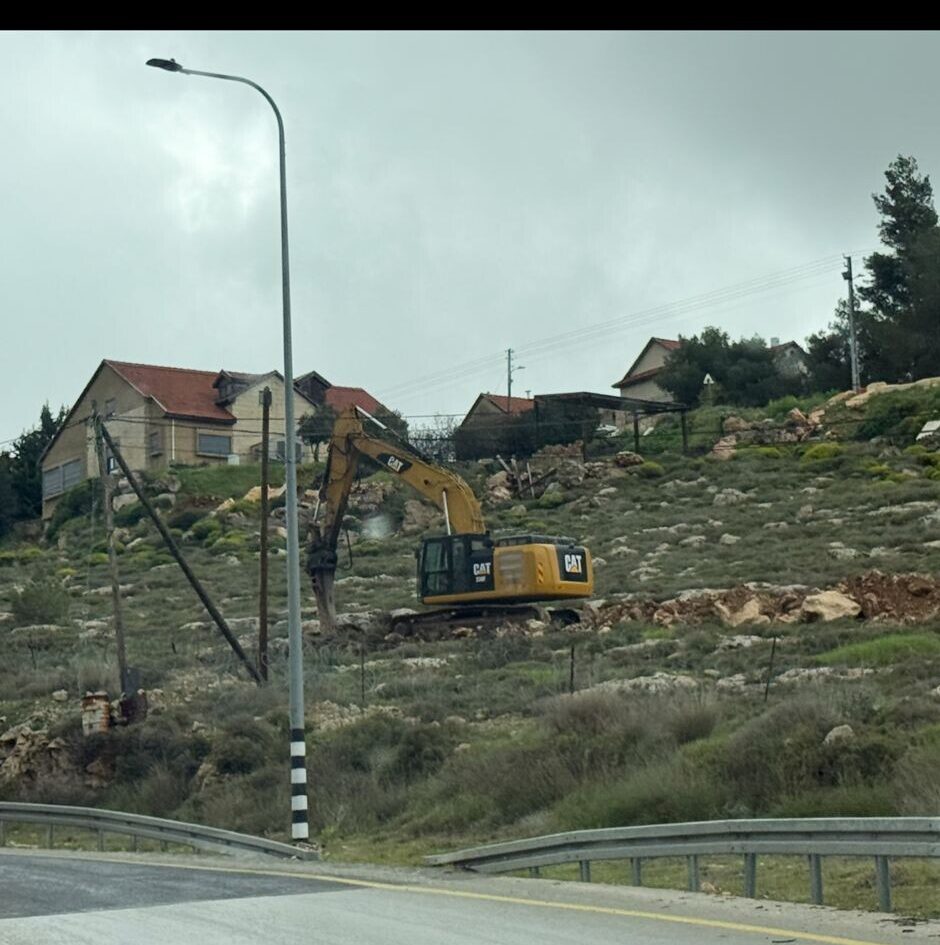 MuhammadFeb-24-2026South Hebron Hill, Beit Hagai: Paving an internal security road
-