
Hebron - many cases of Covid 19
Throughout the trip to Hebron I talked on the phone with the people of Hebron. The radio also reported that in one of the cities Corona is spreading. We decided to drive anyway to see what is happening.
Basel of Tuwani wanted us to see the destruction of the agricultural infrastructure the day before by the occupation forces but they are also in closure. We will go there next week if possible.
Hebron can be entered but we decided not to meet the people for health reasons. So I called M. He first sounded frightened and worried and said that there are hundreds of patients and a few dozen more have been added today (no exact names and numbers this time. The reason will be clarified as the report is read). M. says that he just finished being interviewed in the army radio staton. They called him and wanted to hear what the situation was in Hebron. He goes on to request that Israel would help and intervene and provide them with the medicines and equipment they need. The PA has no means to do so and everyone is dependent on Israel. He also says that the money they receive from Israel each month has not yet been transferred.
“We’re sitting at home, not letting the kids out, and we don’t have enough masks.” He repeats this and is very scared.
I promised to write about it.
I called I. He is also from the same area in Hebron. I asked how they are. “We’re fine”, he says.
It is true that there are many patients but he cites completely different numbers from those received before.
“Do you have enough alcogel and masks and food?” I’m asking
Yes there are everything in the stores.
I asked him why. M. is scared.
And he answers me in a way that makes it clear again how successful the “separation and rule” policy was.
Once again he tells about the funds transferred by the Authority which are supposed to be for the benefit of the entire neighborhood and remain with M. and his family. There are more stories about internal problems which these days must be aggravating. He, too, says they remain in compliance with the rules and hope for better days. He also invites us to visit him and we again convince him that this is not the time for meetings.
Hebron is almost desolate. The streets of the Patriarchs cave area are deserted, and in the absence of tourists, all the shops there are closed. The soldiers, of course, are on duty at every turn.
In the Cafisha neighborhood, the grocery store is almost bustling and there is nothing missing. Including masks and alcogel.
Kiryat Arba also looks more desolate than usual. In the new garden erected in Goldstein’s tomb, many new flowers and shrubs have been planted.
We returned via Route 317.
The gap between the beautiful and new neighborhoods in the settlements Susiya, Ma’on and Carmel and the poor conditions of nearby Palestinian communities cries out to the sky even from the road.
Close to the Meitar checkpoint, there are workers who apparently finished working or failed to get into Isreal..
Everyone wears masks.
Hebron
See all reports for this place-
According to Wye Plantation Accords (1997), Hebron is divided in two: H1 is under Palestinian Authority control, H2 is under Israeli control. In Hebron there are 170,000 Palestinian citizens, 60,000 of them in H2. Between the two areas are permanent checkpoints, manned at all hours, preventing Palestinian movement between them and controlling passage of permit holders such as teachers and schoolchildren. Some 800 Jews live in Avraham Avinu Quarter and Tel Rumeida, on Givat HaAvot and in the wholesale market.
Checkpoints observed in H2:
- Bet Hameriva CP- manned with a pillbox
- Kapisha quarter CP (the northern side of Zion axis) - manned with a pillbox
- The 160 turn CP (the southern side of Zion axis) - manned with a pillbox
- Avraham Avinu quarter - watch station
- The pharmacy CP - checking inside a caravan with a magnometer
- Tarpat (1929) CP - checking inside a caravan with a magnometer
- Tel Rumeida CP - guarding station
- Beit Hadassah CP - guarding station
Three checkpoints around the Tomb of the Patriarchs
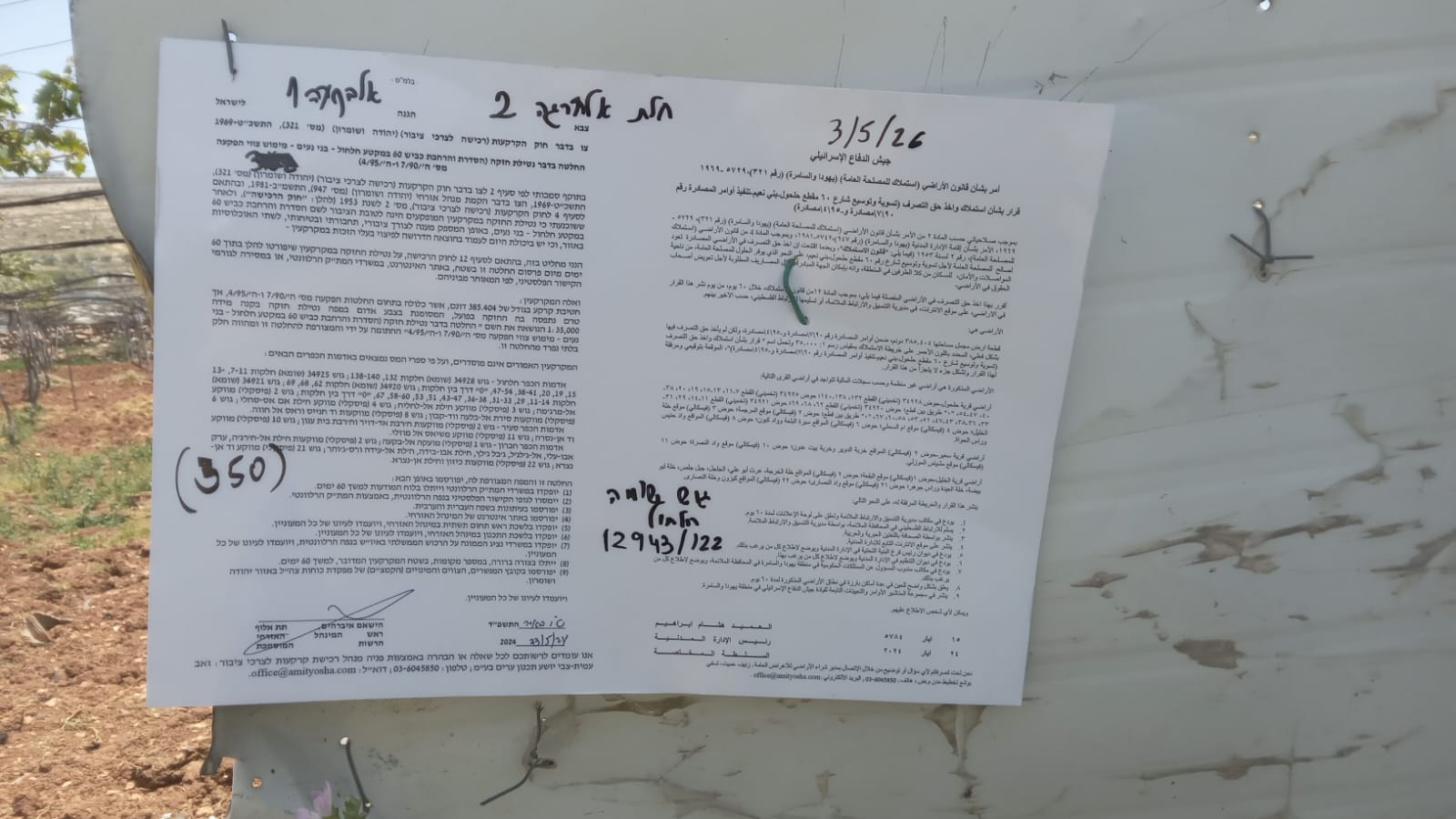 Muhammad D.May-13-2026Hebron - Request for compensation for land expropriation
-
South Hebron Hills
See all reports for this place-
South Hebron Hills
South Hebron Hills is a large area in the West Bank's southern part.
Yatta is a major city in this area: right in the border zone between the fertile region of Hebron and its surroundings and the desert of the Hebron Hills. Yatta has about 64,000 inhabitants.
The surrounding villages are called Masafer Yatta (Yatta's daughter villages). Their inhabitants subsist on livestock and agriculture. Agriculture is possible only in small plots, especially near streams. Most of the area consists of rocky terraces.Since the beginning of the 1980s, many settlements have been established on the agricultural land cultivated by the Palestinians in the South Hebron Hills region: Carmel, Maon, Susia, Masadot Yehuda, Othniel, and more. Since the settlements were established and Palestinians cultivation areas have been reduced; the residents of the South Hebron Hills have been suffering from harassment by the settlers. Attempts to evict and demolish houses have continued, along with withholding water and electricity. The military and police usually refrain from intervening in violent incidents between settlers and Palestinians do not enforce the law when it comes to the investigation of extensive violent Jewish settlers. The harassment in the South Hebron Hills includes attacking and attempting to burn residential tents, harassing dogs, harming herds, and preventing access to pastures.
There are several checkpoints in the South Hebron Hills, on Routes 317 and 60. In most of them, no military presence is apparent, but rather an array of pillboxes monitor the villages. Roadblocks are frequently set up according to the settlers and the army's needs. These are located at the Zif Junction, the Dura-al Fawwar crossing, and the Sheep Junction at the southern entrance to Hebron.
Updated April 2022
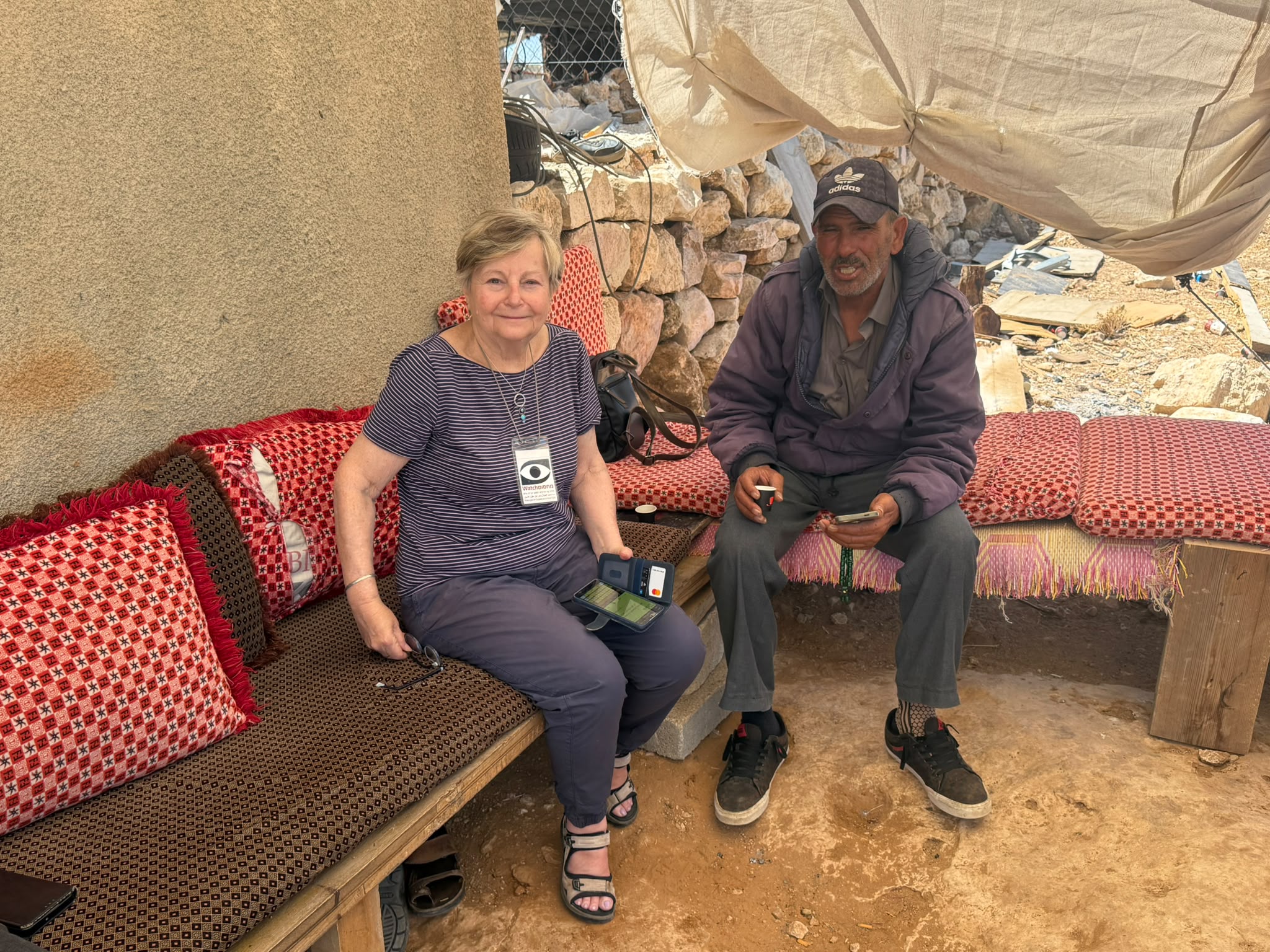 Muhammad D.Jul-12-2026Smadar with Taleb on duty at Qawawis
-