
Hebron, Mon 16.1.12, Morning
Translator: Charles K.
It’s now semester break so we left later. We thought to see the noonday routine.
M., our driver, tells us that early in the morning he picked up laborers at the Meitar crossing and drove them to their construction jobs in Gedera and Ramat Hasharon. “Why didn’t you go through Tarqumiyya if you were driving north?,” we asked. “Because crossing through Meitar is much easier, more pleasant and faster,” he told us the laborers had said.
Hebron
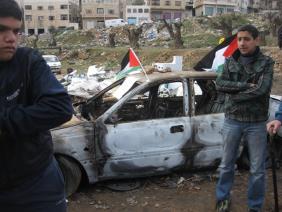
In this morning’s paper [Yediot] there was a long article about a Hebron woman whose car settlers are suspected of having set on fire for the fifth time. She lives near Tel Rumeida and has begun a hunger strike, because she no longer knows what to do. So we drove to see her.
Hana Abu Heikhal sits next to her burned car, surrounded by people, journalists and photographers from around the world. Red Crescent personnel have erected a protest tent. A sign in English and Arabic is pasted on the burned car: “We’re not here to annoy anyone, or to make anyone happy; we’re here because we’re here…”
She sits, a heavy elderly woman with swollen legs, and recounts her story.
 Were Hana Abu Heikhal Jewish she would have been entitled to a tax-free car and a handicapped sticker so she could park close to her home, but she’s not Jewish, and she lives too close to the settlers of Tel Rumeida so her car isn’t allowed to park next to her house. Every day she has to go up and down the hill and walk half a kilometer to her car and back.
[To our group] Her car and that of her neighbors park in a wadi to the right of the road to the house where Michael lived. But that’s where the path runs that’s marked as restricted to settlers. In fact, parking isn’t allowed there either, and you have to pay someone a lot of money to guard the vehicle…so how can someone live there?
In response to requests from the photographers and journalists, she struggles to her feet and shows them the trip she must make every day.
And we – what will we do about this disgrace?
We told her how it pained and shamed us; we’ll return as part of every shift, for as long as she’s there.
And the Israeli police? When [if at all] will they identify the offenders and deal with them appropriately?
Hebron
See all reports for this place-
According to Wye Plantation Accords (1997), Hebron is divided in two: H1 is under Palestinian Authority control, H2 is under Israeli control. In Hebron there are 170,000 Palestinian citizens, 60,000 of them in H2. Between the two areas are permanent checkpoints, manned at all hours, preventing Palestinian movement between them and controlling passage of permit holders such as teachers and schoolchildren. Some 800 Jews live in Avraham Avinu Quarter and Tel Rumeida, on Givat HaAvot and in the wholesale market.
Checkpoints observed in H2:
- Bet Hameriva CP- manned with a pillbox
- Kapisha quarter CP (the northern side of Zion axis) - manned with a pillbox
- The 160 turn CP (the southern side of Zion axis) - manned with a pillbox
- Avraham Avinu quarter - watch station
- The pharmacy CP - checking inside a caravan with a magnometer
- Tarpat (1929) CP - checking inside a caravan with a magnometer
- Tel Rumeida CP - guarding station
- Beit Hadassah CP - guarding station
Three checkpoints around the Tomb of the Patriarchs
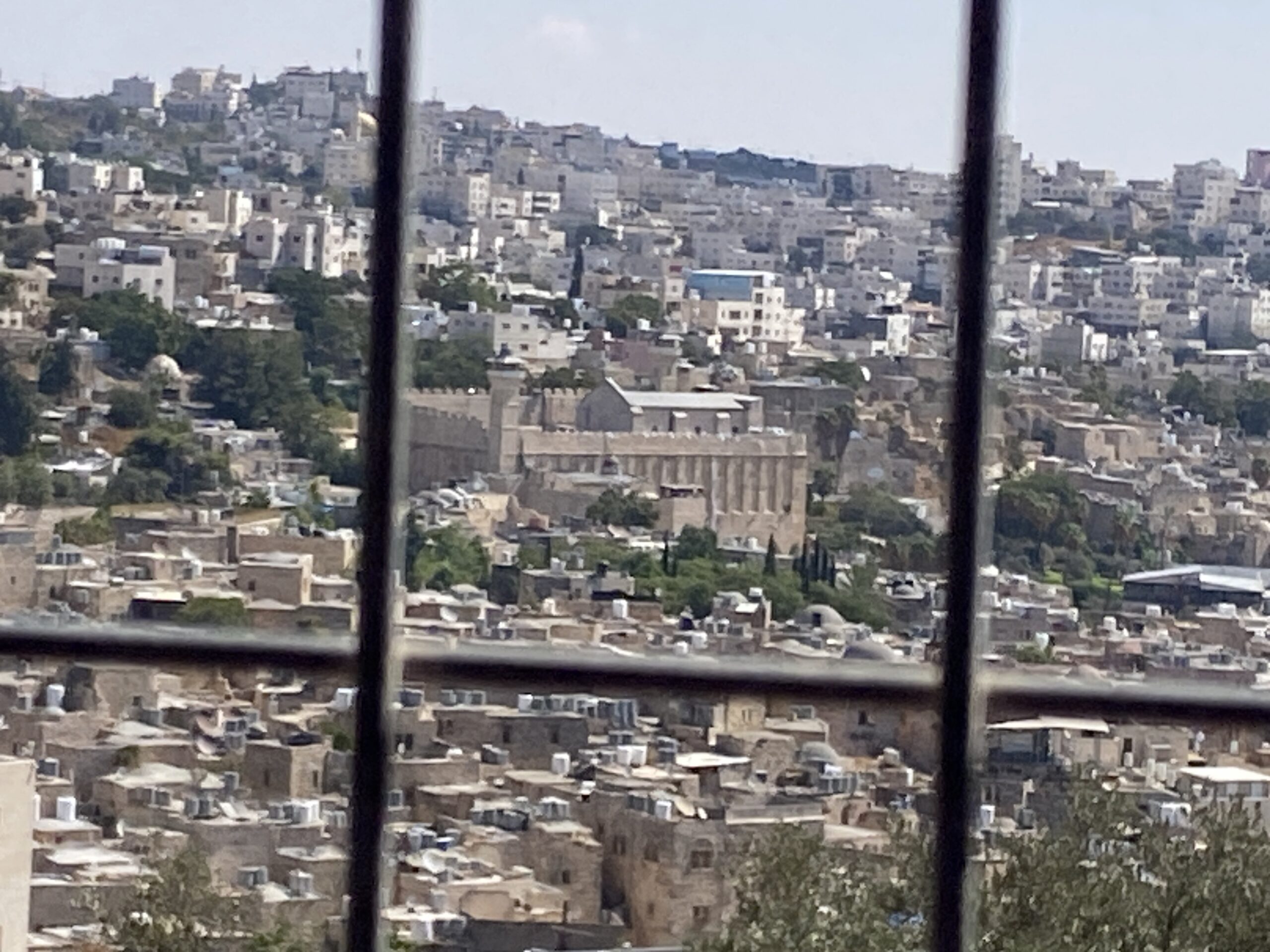 Yael ZoranSep-24-2026Hebron and the Cave of the Patriarchs from Beit Hashalom
-
