
Hebron, Sansana (Meitar Crossing), South Hebron Hills
Preparations for the “Jewish exception” – Israelis will arrive en-masse to pray at the Cave of the Patriarchs during Passover.
09:00-12:00
Quiet and green on the way to Hebron.
This year even the arid hills on the edge of the desert are flushed with green.
The wheat fields are dotted with red poppies and daisies. Flocks of sheep everywhere. A pastoral illusion.
The observation balloon floats over Beit Haggai.
At the entrance to Kiryat Arba, signs offer apartments for sale, an opportunity that shouldn’t be missed, in Mishkenot Mamre. Uri Ariel – the excellent minister for the settlers and their supporters.
Beit Hameriva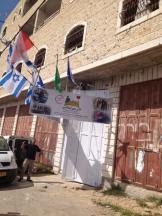
Ofer Ohana “welcomes” us at the entrance to a shop on the ground floor of the building.
A large sign: A warm welcome for you and your soldiers in Hebron, the city of the Patriarchs, open every day, Beit Hashalom, Kiryat Arba. That’s apparently how they’ll obtain permission to turn the building into a civilian location, and move people in.
That’s how it will remain a military site, sort of – Israelbluff at its worst.
Ofer, a lovely smile contradicting the words emerging from his lips, “blessings” on traitors, photographs us, I photograph him photographing me, like we always do when we meet, a regular ritual about which, under other circumstances, we could laugh.
Beit Hamachpela
Many soldiers getting organized in the parking area across the street, and a crane which brought concrete barriers.
TIPH staffers tell us about the security arrangements in preparation for the intermediate days of Passover, which will be a “Jewish exception,” of course. An officer from the regional brigade headquarters agreed to talk to me (even though she’d never heard of us). She said they’re getting ready to prevent what happened last Passover on Highway 35. I remind her it’s also necessary to prevent an incident like the massacre carried out by Baruch Goldstein. She grins and says, “Yes, but that happened a long time ago, twenty years ago, I’m talking to you about a recent incident, one year ago…” and turns to go. Apparently those on tomorrow’s shift will see better what’s planned there.
At the entrance to Shuhadeh Street, at a location where this doesn’t usually occur, Golani soldiers detain two men to inspect IDs. All the other checkpoints and roadblocks are quiet; we see nothing unusual happening.
We returned on Highway 317.
Rifawiyya, at the foot of the military position overlooking the road to Yatta. Two months ago, four buildings were demolished.
UNRWA provided large tents, for now. Today they’re also forbidden. One small tent remains, in which people are still living.
Meitar checkpoint.
Traffic flows. Gil’ad, the checkpoint manager, oversees what’s going on.
Given the circumstances, he continues to behave humanely and is open to hear about any problem we raise.
We thanked him for his behavior. Because of him, this checkpoint operates in a manner that most resembles a normal border crossing.
Hebron
See all reports for this place-
According to Wye Plantation Accords (1997), Hebron is divided in two: H1 is under Palestinian Authority control, H2 is under Israeli control. In Hebron there are 170,000 Palestinian citizens, 60,000 of them in H2. Between the two areas are permanent checkpoints, manned at all hours, preventing Palestinian movement between them and controlling passage of permit holders such as teachers and schoolchildren. Some 800 Jews live in Avraham Avinu Quarter and Tel Rumeida, on Givat HaAvot and in the wholesale market.
Checkpoints observed in H2:
- Bet Hameriva CP- manned with a pillbox
- Kapisha quarter CP (the northern side of Zion axis) - manned with a pillbox
- The 160 turn CP (the southern side of Zion axis) - manned with a pillbox
- Avraham Avinu quarter - watch station
- The pharmacy CP - checking inside a caravan with a magnometer
- Tarpat (1929) CP - checking inside a caravan with a magnometer
- Tel Rumeida CP - guarding station
- Beit Hadassah CP - guarding station
Three checkpoints around the Tomb of the Patriarchs
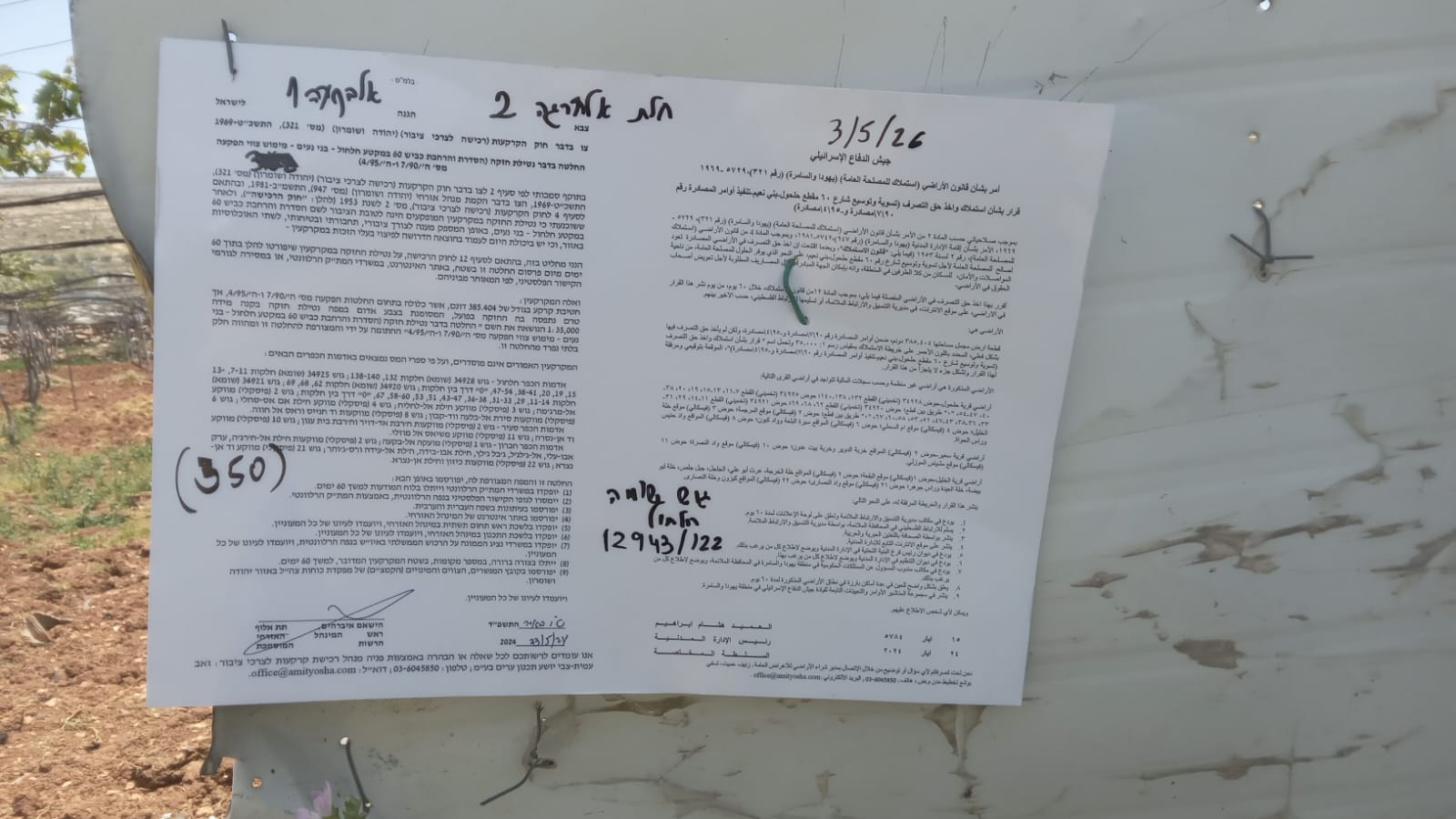 Muhammad D.May-13-2026Hebron - Request for compensation for land expropriation
-
Meitar checkpoint / Sansana
See all reports for this place-
Meitar Checkpoint / Sansana The checkpoint is located on the Green Line and serves as a border crossing between Israel and the West Bank. It is managed by the Border Crossing Authority of the Defense Ministry. It is comprised of sections for the transfer of goods as well as a vehicle checkpoint (intended for holders of blue identity cards, foreign nationals or diplomats and international organizations). Passing of Palestinians is prohibited, except for those with entry permits to Israel. Palestinians are permitted to cross on foot only. The crossing has a DCO / DCL / DCL / DCL (District Coordination Office), a customs unit, supervision, and a police unit. In the last year, a breach has been opened in the fence, not far from the crossing. This breach is known to all, including the army. There does not appear to be any interest in blocking it, probably as it permits needed Palestinian workers without the bureaucratic permits to get to work in Israel. Food stalls and a parking area economy have been created, but incidents of violent abuse by border police have also been recorded. Updated April 2022
-
South Hebron Hills
See all reports for this place-
South Hebron Hills
South Hebron Hills is a large area in the West Bank's southern part.
Yatta is a major city in this area: right in the border zone between the fertile region of Hebron and its surroundings and the desert of the Hebron Hills. Yatta has about 64,000 inhabitants.
The surrounding villages are called Masafer Yatta (Yatta's daughter villages). Their inhabitants subsist on livestock and agriculture. Agriculture is possible only in small plots, especially near streams. Most of the area consists of rocky terraces.Since the beginning of the 1980s, many settlements have been established on the agricultural land cultivated by the Palestinians in the South Hebron Hills region: Carmel, Maon, Susia, Masadot Yehuda, Othniel, and more. Since the settlements were established and Palestinians cultivation areas have been reduced; the residents of the South Hebron Hills have been suffering from harassment by the settlers. Attempts to evict and demolish houses have continued, along with withholding water and electricity. The military and police usually refrain from intervening in violent incidents between settlers and Palestinians do not enforce the law when it comes to the investigation of extensive violent Jewish settlers. The harassment in the South Hebron Hills includes attacking and attempting to burn residential tents, harassing dogs, harming herds, and preventing access to pastures.
There are several checkpoints in the South Hebron Hills, on Routes 317 and 60. In most of them, no military presence is apparent, but rather an array of pillboxes monitor the villages. Roadblocks are frequently set up according to the settlers and the army's needs. These are located at the Zif Junction, the Dura-al Fawwar crossing, and the Sheep Junction at the southern entrance to Hebron.
Updated April 2022
 Muhammad D.Sep-8-2026Closed Samu' checkpoint
-
