
Hebron, Sansana (Meitar Crossing), South Hebron Hills
09:00-13:00
All the laborers had gone through when we crossed the Meitar checkpoint and two buses waiting in the parking lot for the prisoners’ relatives to return.
We were told that work permits were confiscated here as well, with no explanation.
At Sham’a, it’s as if they haven’t heard about construction in the settlements being stopped. Construction continues in the new neighborhood and staff of the Southern Hebron Hills Regional Council are hanging Israeli flags on all the streetlights.
Near Samu’a we see four young Palestinians, three women and a man, standing by the roadside next to a large camera, photographing to the west. We were curious and stopped. They’re studying photography at Hebron University. Once in a while there can be pleasant, normal activity here. Here’s what they photographed:
At the turn to the Negohot settlement – the military base the Palestinians used to call “Majnuna” – we meet M. to do the good deed Ronit requested of us.
N., from the Al Fawwar grocery, says it’s been quiet recently.
Considerable roadwork at the entrance to Palestinian villages. We have the impression the Palestinians are doing all they can to calm things down, and are succeeding.
All the roadblocks and gates are open, except at Beit Anun junction – even the one below the Tamimi family’s home next to Kiryat Arba.
On the other hand, there are still flying checkpoints – this time at the Zayit crossing near the Al Jora neighborhood in Hebron.

The Border Police soldiers ask us to photograph the graffiti in Arabic at the roadblock:
“Liberation”
“Step on the gas,” which, in spoken Arabic, means “Run them over.”
Many military vehicles in Hebron today and many diplomats, and embassy security vehicles.
Apparently the United States ambassador, but the security people won’t tell us. They’re parked at Gross Plaza, where we saw this on the pavement:
Gross Plaza:
“End the Occupation!”
A group of people sit at ‘Abed’s, and today there were three buses of Moslems from Indonesia or Malaysia on organized tours.
The settlers’ children have vacation for Passover and their main activity is trying to steal from ‘Abed.
One of the people at ‘Abed’s says there was a lot of military activity yesterday in the H1 area; they heard explosions and shooting. We couldn’t confirm the report.
TIP volunteers are apparently updating their replacements today. Too bad they’re not more active, rather than simply observing.
All the major checkpoints between H1 and H2 are being upgraded, so soldiers won’t come into physical contact with the occupied population. Everything operates with turnstiles and bullet-proof glas.
Razor wire has been added to all the roadblocks. This photo was taken near Beit Hamachpela and the Al Fahiyya girls’ school.
Hasam HaShoter – Tarpa”t checkpoint
Here’s Shuhadah Street, next to Beit Hadassah. Palestinians are not allowed to go through.
The Chabad cemetery at Tel Rumeida is still off limits.
Happy holiday.
Hebron
See all reports for this place-
According to Wye Plantation Accords (1997), Hebron is divided in two: H1 is under Palestinian Authority control, H2 is under Israeli control. In Hebron there are 170,000 Palestinian citizens, 60,000 of them in H2. Between the two areas are permanent checkpoints, manned at all hours, preventing Palestinian movement between them and controlling passage of permit holders such as teachers and schoolchildren. Some 800 Jews live in Avraham Avinu Quarter and Tel Rumeida, on Givat HaAvot and in the wholesale market.
Checkpoints observed in H2:
- Bet Hameriva CP- manned with a pillbox
- Kapisha quarter CP (the northern side of Zion axis) - manned with a pillbox
- The 160 turn CP (the southern side of Zion axis) - manned with a pillbox
- Avraham Avinu quarter - watch station
- The pharmacy CP - checking inside a caravan with a magnometer
- Tarpat (1929) CP - checking inside a caravan with a magnometer
- Tel Rumeida CP - guarding station
- Beit Hadassah CP - guarding station
Three checkpoints around the Tomb of the Patriarchs
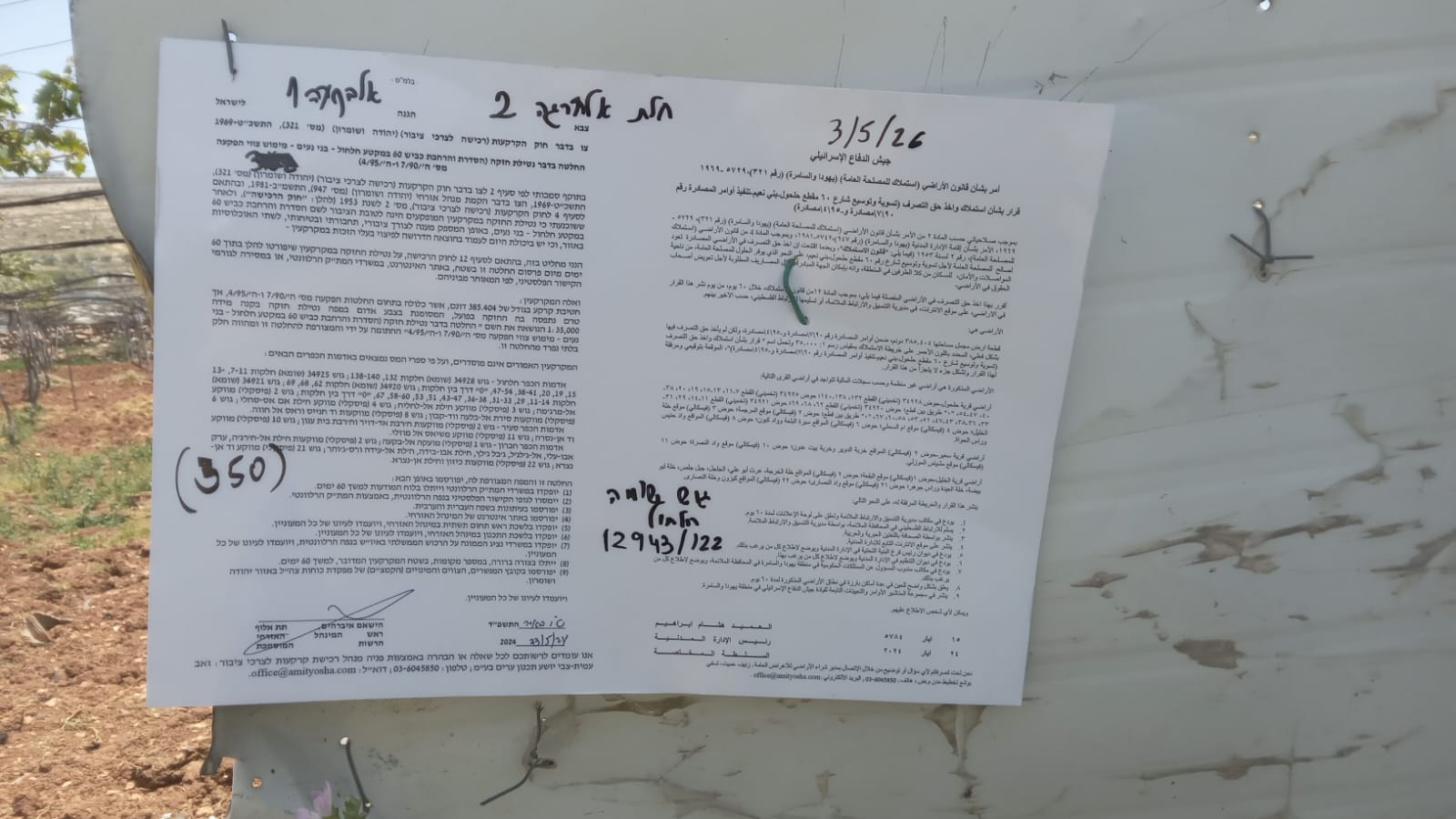 Muhammad D.May-13-2026Hebron - Request for compensation for land expropriation
-
Meitar checkpoint / Sansana
See all reports for this place-
Meitar Checkpoint / Sansana The checkpoint is located on the Green Line and serves as a border crossing between Israel and the West Bank. It is managed by the Border Crossing Authority of the Defense Ministry. It is comprised of sections for the transfer of goods as well as a vehicle checkpoint (intended for holders of blue identity cards, foreign nationals or diplomats and international organizations). Passing of Palestinians is prohibited, except for those with entry permits to Israel. Palestinians are permitted to cross on foot only. The crossing has a DCO / DCL / DCL / DCL (District Coordination Office), a customs unit, supervision, and a police unit. In the last year, a breach has been opened in the fence, not far from the crossing. This breach is known to all, including the army. There does not appear to be any interest in blocking it, probably as it permits needed Palestinian workers without the bureaucratic permits to get to work in Israel. Food stalls and a parking area economy have been created, but incidents of violent abuse by border police have also been recorded. Updated April 2022
-
South Hebron Hills
See all reports for this place-
South Hebron Hills
South Hebron Hills is a large area in the West Bank's southern part.
Yatta is a major city in this area: right in the border zone between the fertile region of Hebron and its surroundings and the desert of the Hebron Hills. Yatta has about 64,000 inhabitants.
The surrounding villages are called Masafer Yatta (Yatta's daughter villages). Their inhabitants subsist on livestock and agriculture. Agriculture is possible only in small plots, especially near streams. Most of the area consists of rocky terraces.Since the beginning of the 1980s, many settlements have been established on the agricultural land cultivated by the Palestinians in the South Hebron Hills region: Carmel, Maon, Susia, Masadot Yehuda, Othniel, and more. Since the settlements were established and Palestinians cultivation areas have been reduced; the residents of the South Hebron Hills have been suffering from harassment by the settlers. Attempts to evict and demolish houses have continued, along with withholding water and electricity. The military and police usually refrain from intervening in violent incidents between settlers and Palestinians do not enforce the law when it comes to the investigation of extensive violent Jewish settlers. The harassment in the South Hebron Hills includes attacking and attempting to burn residential tents, harassing dogs, harming herds, and preventing access to pastures.
There are several checkpoints in the South Hebron Hills, on Routes 317 and 60. In most of them, no military presence is apparent, but rather an array of pillboxes monitor the villages. Roadblocks are frequently set up according to the settlers and the army's needs. These are located at the Zif Junction, the Dura-al Fawwar crossing, and the Sheep Junction at the southern entrance to Hebron.
Updated April 2022
 Muhammad D.Jul-13-2026Michal with O.
-