
Hebron, Sansana (Meitar Crossing), South Hebron Hills, Tarqumiya
A Palestinian Tu B’shvat
We reached Hebron at 10:00.
The Meitar checkpoint operated normally at this hour.
Driving on Highway 60 we saw children of settlers from the Southern Hebron Hills on a field trip in buses belonging to the Regional Council, along with guards.
On the road below Othniel a female settler is changing a tire, helped by a Palestinian who’d stopped to assist her.
It’s almost like “man bites dog.”
When we got to Hebron we saw at the Tarpat checkpoint many soldiers, Border Police and police officers. We waited because we understood something was going to happen. Soldiers were stationed on all the rooftops in the area and a polite, patient paratroop officer told us in response to our question that Palestinians plan to plant trees and they’re getting ready. We thought he was joking. Everything had been approved and arranged.

And, in fact, they were prepared for anything and we heard the commanders emphasizing to the soldiers the need to allow the activity to proceed peacefully and without any interference, although they’d prepared all the necessary equipment. The tree planting would take place on land next to the Cordova girls’ school which stands on the rise opposite Beit Hadassah, and on Tel Rumeida, where anything could happen. Foreign journalists arrived and we walked with them to where the young people were gathered next to the grocery at the entrance to Tel Rumeida.

Some one hundred pupils and activities marched in a quiet and orderly manner, wearing shirts bearing the words “They uproot trees; we replant them” in English and Arabic, and carried olive seedlings. No one stopped them as they climbed the stairs opposite Beit Hadassah to their destination and all planted the seedlings as local leaders made speeches. M., our acquaintance, tells me “You know, these olives have a different taste.” He reported on the president’s visit the previous day and said they’d been under curfew from 8 AM to 10 PM, and Palestinian journalists weren’t permitted to cover the event. The tree-planting had been planned a long time ago by Issa and his friends, unconnected to the president’s visit.
Everything was quiet until Ofer Ohana arrived and began photographing and cursing (us as well). The atmosphere was on the brink of exploding. Fortunately the army and the police surrounded him and demanded he leave. “This is the first time they’ve protected us like that,” M. says. We’re fed up; we want quiet and if he returns things will get out of hand. They finished and went to Tel Rumeida to plant there. We left because it was already late. Teachers from the school spoke to the activists, saying there should be guards at night because settlers may come to uproot everything.
Let’s hope it all goes peacefully.
When we walked back down to Shuhadeh Street, Ofer was there and photographed us repeatedly, cursing: “You’re the garbage runoff, a traitor, helping our enemies, soldiers get killed because of you. You should be ashamed,” etc. etc. A young settler joined him and added his own “pearls.” When I asked a soldier who was present to tell them to stop he looked at me threateningly and asked, “Why should I tell him to stop?”
Why, really?
We ran into some of the ecumenical women from Sweden who were happy to talk with us and learn about the complexity involved in our being loyal citizens protesting against the occupation’s injustice. The conversation seemed meaningful to them, coming as they do from countries whose populations take peace and quiet for granted.
They go every Sunday to the Tarqumiyya checkpoint. We arranged to meet them there on a future Sunday.
On our way back we saw again the fresh vegetables for sale at the Dura al-Fawwar junction, direct from the fields, especially the huge, yellow heads of cauliflower.
The owner of the field explains that they’re left to grow a year and a quarter without being irrigated.
They really do have a stronger, better taste. We recommend them to anyone who comes here.
Hebron
See all reports for this place-
According to Wye Plantation Accords (1997), Hebron is divided in two: H1 is under Palestinian Authority control, H2 is under Israeli control. In Hebron there are 170,000 Palestinian citizens, 60,000 of them in H2. Between the two areas are permanent checkpoints, manned at all hours, preventing Palestinian movement between them and controlling passage of permit holders such as teachers and schoolchildren. Some 800 Jews live in Avraham Avinu Quarter and Tel Rumeida, on Givat HaAvot and in the wholesale market.
Checkpoints observed in H2:
- Bet Hameriva CP- manned with a pillbox
- Kapisha quarter CP (the northern side of Zion axis) - manned with a pillbox
- The 160 turn CP (the southern side of Zion axis) - manned with a pillbox
- Avraham Avinu quarter - watch station
- The pharmacy CP - checking inside a caravan with a magnometer
- Tarpat (1929) CP - checking inside a caravan with a magnometer
- Tel Rumeida CP - guarding station
- Beit Hadassah CP - guarding station
Three checkpoints around the Tomb of the Patriarchs
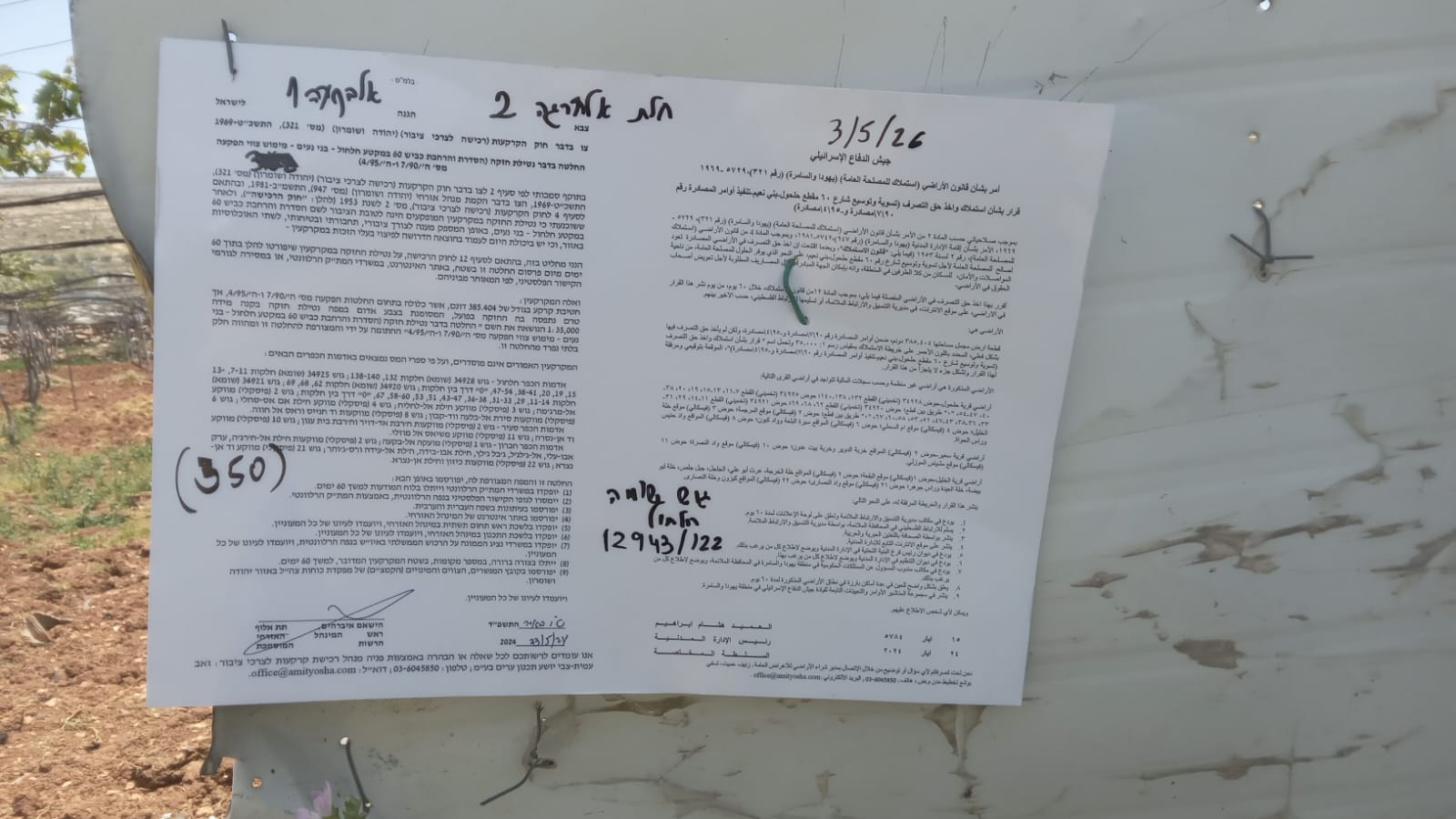 Muhammad D.May-13-2026Hebron - Request for compensation for land expropriation
-
Meitar checkpoint / Sansana
See all reports for this place-
Meitar Checkpoint / Sansana The checkpoint is located on the Green Line and serves as a border crossing between Israel and the West Bank. It is managed by the Border Crossing Authority of the Defense Ministry. It is comprised of sections for the transfer of goods as well as a vehicle checkpoint (intended for holders of blue identity cards, foreign nationals or diplomats and international organizations). Passing of Palestinians is prohibited, except for those with entry permits to Israel. Palestinians are permitted to cross on foot only. The crossing has a DCO / DCL / DCL / DCL (District Coordination Office), a customs unit, supervision, and a police unit. In the last year, a breach has been opened in the fence, not far from the crossing. This breach is known to all, including the army. There does not appear to be any interest in blocking it, probably as it permits needed Palestinian workers without the bureaucratic permits to get to work in Israel. Food stalls and a parking area economy have been created, but incidents of violent abuse by border police have also been recorded. Updated April 2022
-
South Hebron Hills
See all reports for this place-
South Hebron Hills
South Hebron Hills is a large area in the West Bank's southern part.
Yatta is a major city in this area: right in the border zone between the fertile region of Hebron and its surroundings and the desert of the Hebron Hills. Yatta has about 64,000 inhabitants.
The surrounding villages are called Masafer Yatta (Yatta's daughter villages). Their inhabitants subsist on livestock and agriculture. Agriculture is possible only in small plots, especially near streams. Most of the area consists of rocky terraces.Since the beginning of the 1980s, many settlements have been established on the agricultural land cultivated by the Palestinians in the South Hebron Hills region: Carmel, Maon, Susia, Masadot Yehuda, Othniel, and more. Since the settlements were established and Palestinians cultivation areas have been reduced; the residents of the South Hebron Hills have been suffering from harassment by the settlers. Attempts to evict and demolish houses have continued, along with withholding water and electricity. The military and police usually refrain from intervening in violent incidents between settlers and Palestinians do not enforce the law when it comes to the investigation of extensive violent Jewish settlers. The harassment in the South Hebron Hills includes attacking and attempting to burn residential tents, harassing dogs, harming herds, and preventing access to pastures.
There are several checkpoints in the South Hebron Hills, on Routes 317 and 60. In most of them, no military presence is apparent, but rather an array of pillboxes monitor the villages. Roadblocks are frequently set up according to the settlers and the army's needs. These are located at the Zif Junction, the Dura-al Fawwar crossing, and the Sheep Junction at the southern entrance to Hebron.
Updated April 2022
 Muhammad D.Jul-13-2026Michal with O.
-
Tarqumiya CP
See all reports for this place-
The Tarqumiya Checkpoint is one of the largest and busiest checkpoints where people and goods cross into Israel. It is located on the Separation Barrier close to the Green Line, on Road 35 (connecting Beer Sheva and Hebron). It is run by the Israel Defense Ministry’s Crossings Administration with civilian secuirty companies running the day to day operations. The checkpoint is indeed open to vehicles in both directions 24/7, but Palestinians are prevented from crossing in vehicles, except in special cases. MachsomWatch activists visit the checkpoint as it opens at 3:45 am, in order to observe the daily passage of nearly 10,000 Palestinian workers. The workers arrive from throughout the Southern West Bank. Our activists report on the tremendous overcrowding at this checkpoint; they have observed young men climbing and scrambling on the fences and roofs of the ‘access cages’. This is how the work day begins for those who ‘build the land of Israel’. updated November 2019
-