
Hebron, Sansana (Meitar Crossing), Tarqumiya
1. Muhammad reports on unusual military checkpoints near the Meiter crossing, near the Meiter complex, and also in Metzadot Yehuda. Increased presence of security forces.
2. This time I reached Kiryat Arba from the north, from the direction of the Tarkumiya crossing. At the square in front of Shuyukh, the entrance road to Hebron is blocked by a yellow iron barrier, and in addition a security vehicle is stationed across the road, and many soldiers are next to it. The reason becomes clear when I arrive at the parking lot near the Paz gas station at the entrance to Kiryat Arba: two soldiers (Givati’s Tzabar Battalion) are stationed beyond the entrance gate to the vineyards from the north. To my question, they explain that their job is to keep the gate locked and not to allow settlers to enter Givat HaMevaser, since the intention is to establish a new settlement there. They apologize; they have no authority to stop the establishment of the settlement but only to limit entry from this point. Indeed, in the small garden there are gathered teenagers who look like a youth movement with a slightly older “guide”. They don’t answer my questions (even though I’m dressed like a settler today), Obviously they have instructions to keep quiet. An exciting activity for the boring vacation days, although even on school days they are engaged in such activities; there is an easy release from school. Where are our youth? Why do we recruit them?
3. In the same parking lot there is also an accumulation of police forces, including senior commanders. They refuse to answer our questions. The forces include a large group of police trainees (yellow ribbons on their shoulders) who get off a bus and receive extended training. (They were still there when we returned from a tour in Hebron). We once encountered such a group who were being addressed by settlers near Beit Ha-Makhpela.
4. Hebron, Kafisha neighborhood. At the entrance barrier to the neighborhood we are allowed to pass easily as we were taken for settlers, who like to repair their vehicles here in the Arab garages cheaply.
5. Upon exiting the neighborhood we turn right, go up to the checkpoint at the entrance to the Hill of the Fathers, a flourishing and prosperous neighborhood, and greetings to Itamar Ben Gvir, a resident of the neighborhood….
6. On the way to the Cave of the Patriarchs, at the junction of the “Prayer Axis”, in addition to the fixed position on the right, has been added an army post on the left. They also added a permanent soldier position on the left.
7. There is congestion near the Cave of the Patriarchs, the soldier claims that there is no parking and therefore does not allow us to enter with the vehicle and does not know why there is congestion.
8. On the way back from the direction of Tel Rumeida, near the Pharmacy checkpoint, many Hammer vehicles are parked but it is not clear why. And in the square in front of the market, a new poster, connecting the anti-LGBTQ agenda to the settler agenda.
Hebron
See all reports for this place-
According to Wye Plantation Accords (1997), Hebron is divided in two: H1 is under Palestinian Authority control, H2 is under Israeli control. In Hebron there are 170,000 Palestinian citizens, 60,000 of them in H2. Between the two areas are permanent checkpoints, manned at all hours, preventing Palestinian movement between them and controlling passage of permit holders such as teachers and schoolchildren. Some 800 Jews live in Avraham Avinu Quarter and Tel Rumeida, on Givat HaAvot and in the wholesale market.
Checkpoints observed in H2:
- Bet Hameriva CP- manned with a pillbox
- Kapisha quarter CP (the northern side of Zion axis) - manned with a pillbox
- The 160 turn CP (the southern side of Zion axis) - manned with a pillbox
- Avraham Avinu quarter - watch station
- The pharmacy CP - checking inside a caravan with a magnometer
- Tarpat (1929) CP - checking inside a caravan with a magnometer
- Tel Rumeida CP - guarding station
- Beit Hadassah CP - guarding station
Three checkpoints around the Tomb of the Patriarchs
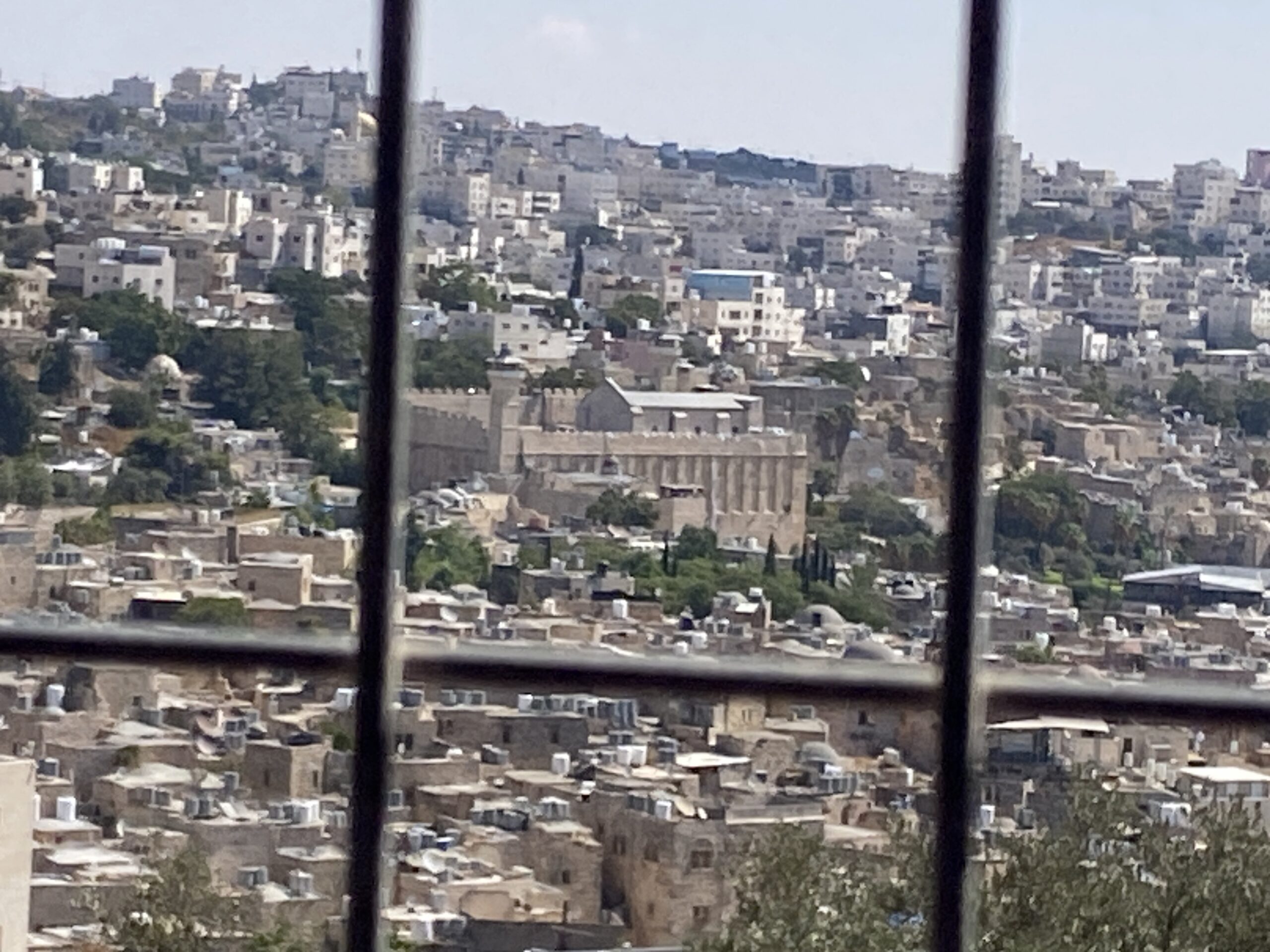 Yael ZoranSep-24-2026Hebron and the Cave of the Patriarchs from Beit Hashalom
-
Meitar checkpoint / Sansana
See all reports for this place-
Meitar Checkpoint / Sansana The checkpoint is located on the Green Line and serves as a border crossing between Israel and the West Bank. It is managed by the Border Crossing Authority of the Defense Ministry. It is comprised of sections for the transfer of goods as well as a vehicle checkpoint (intended for holders of blue identity cards, foreign nationals or diplomats and international organizations). Passing of Palestinians is prohibited, except for those with entry permits to Israel. Palestinians are permitted to cross on foot only. The crossing has a DCO / DCL / DCL / DCL (District Coordination Office), a customs unit, supervision, and a police unit. In the last year, a breach has been opened in the fence, not far from the crossing. This breach is known to all, including the army. There does not appear to be any interest in blocking it, probably as it permits needed Palestinian workers without the bureaucratic permits to get to work in Israel. Food stalls and a parking area economy have been created, but incidents of violent abuse by border police have also been recorded. Updated April 2022
-
Tarqumiya CP
See all reports for this place-
The Tarqumiya Checkpoint is one of the largest and busiest checkpoints where people and goods cross into Israel. It is located on the Separation Barrier close to the Green Line, on Road 35 (connecting Beer Sheva and Hebron). It is run by the Israel Defense Ministry’s Crossings Administration with civilian secuirty companies running the day to day operations. The checkpoint is indeed open to vehicles in both directions 24/7, but Palestinians are prevented from crossing in vehicles, except in special cases. MachsomWatch activists visit the checkpoint as it opens at 3:45 am, in order to observe the daily passage of nearly 10,000 Palestinian workers. The workers arrive from throughout the Southern West Bank. Our activists report on the tremendous overcrowding at this checkpoint; they have observed young men climbing and scrambling on the fences and roofs of the ‘access cages’. This is how the work day begins for those who ‘build the land of Israel’. updated November 2019
-
