
Hebron, Sansana, South Hebron Hills, Mon 24.3.08, Morning
This report was written by Susan, a guest of MachsomWatch.
Today I rode with Ziva BP and Ye’ela L. of Machsomwatch on their trip to observe the territories (West Bank) and entered a land of apartheid. Machsomwatch is an organization of women who observe border crossing points between Israel and the territories, and checkpoints within the territories and report back to Israelis and anyone else who will listen. My limited experience with segregation in the United States was nothing compared with this. What follows is my observations, explanations I was given by Ziva and Ye’ela, and direct conversations with some Hebron residents.
Sansana/Meitar Checkpoint
We crossed the border near Be’er Sheva at Sansana/Meitar. As we approached from Israel at about 07:00 we saw numerous cars and vans on the Israeli side waiting, with a handful of Palestinians. I was told that the drivers were waiting to pick up the Palestinian laborers who were trickling through the crossing. We crossed to the Palestinian side and learned that the crossing point had opened late and that many of the day laborers had left because the processing was so slow that they did not think they would make it through in time to get a day’s work. As soon as we got there and Ye’ela made our presence known, the Palestinians began being processed through the border crossing much more quickly. When we first arrived everyone was simply standing around waiting and it appeared that almost no one was getting through.
After hearing the complaint about the late opening, we returned to the Israeli side of the crossing where Ye’ela and Ziva went inside to speak to the processors while I waited outside. What I observed was a stream of men coming out with their possessions in their hands. In some cases the men were pulling up their trousers and putting belts back on. My assumption is that they had been partially strip searched.
When Ye’ela and Ziva returned, they reported that the first official they spoke to was not only very rude to them, but, when a Palestinian started going in the wrong direction, rather than showing him where to go, the official simply shoved him. Ye’ela said she finally spoke with a senior official who first denied that the facility opened late, then made other excuses for the processing delays.
The Palestinians are not permitted to remain in Israel overnight, so they must go through these inspections everyday in order to work. They are paid daily for the amount of time they work. If they are held up at the crossing, they lose time and therefore income. In order to get through the procedure at a reasonable time, I was informed that they have to be at the border crossing at 0430 or 0500 in order to get through by 0630 to get in a reasonable day’s work. By the time we arrived, most of the laborers should have been processed, instead of just starting.
Route 60
The Palestinian’s day must start much earlier to get to the border by 0430. We traveled along the main highway to Hebron. This is a lovely road on which Palestinians are not permitted to travel. The roads on which they are permitted to travel are blocked with boulders where they cross the highway so that a Palestinian can drive up to the highway but can’t enter it. We saw such blockages everywhere we traveled along this highway.
Some places Palestinian main crossroads intersected the highway. All of these had checkpoints and Palestinians could not drive across the highway. Rather, they had to leave their cars or taxis on one side, go through the checkpoint and search, walk across the highway, and then get a taxi or other transportation on the other side. And these checkpoints were not at the highway intersection, but were set back about ¼ mile on each side, leaving the Palestinians a walk of at least a half mile with whatever they needed to bring to their destination. It appeared that at the border crossing some Palestinian cars were permitted to park on the Palestinian side. The only other way for the laborers to get there, as far as I know, was to walk or ride animals.
Hebron
We drove through Qiryat Arba, a Jewish Settlement, to enter Hebron. As we entered Hebron there was an Army post.
Shohada street – The street we were on was deserted for the most part. Businesses were shuttered, many windows were broken and people were clearly no longer living in the homes above the businesses. Graffiti covered the doors and shutters except where it had been painted over. Further along the street was a Palestinian cemetery that was blocked with cement blocks and razor wire so that people could not visit the gravesites. A portion of the area had been taken over by Jewish settlers totally about 200. I was told that the area had been cleared of Palestinians to protect these settlers. Those Palestinians who remained covered their doors, stairways and windows with wire to protect themselves from stoning by these settlers. In order to walk along this street (driving by Palestinians is forbidden) they must pass through a checkpoint. A Palestinian boys school and a girls school still exist in this area so everyday these children and their teachers are subjected to the checkpoint that can include various levels of searches and humiliation.
Tarpat Checkpoint – Outside the checkpoint we had the opportunity to speak with three English speaking Moslem residents of the Palestinian section. One couple related an incident that had occurred the previous evening. They were walking down the street when they were accosted by young Jewish men. Words were exchanged and one of the Jewish men spat on the woman and assaulted. There were both police officers and members of the Army who witnessed the incident and did nothing. When the woman’s husband said he wanted to file a complaint, he said he was told he would have to go to the police station in Qiryat Arba on the following day to file the complaint and name the people involved and only then could the police take action. This required the man and woman to identify their assailants from pictures after the fact, when the attackers were present and could have been apprehended and identified immediately at the scene.
I understand that the Jewish people occupying this section of Hebron claim a right of ownership and occupancy based on the massacre of Jewish families living in this same area by Palestinians in 1929 before the Palestinians took over the neighborhood. As with so much in the struggle between the Palestinians and the Jews over much disputed territory, each side has a justifiable claim. But the law of might makes right only diminishes the mighty – and sooner or later the positions get reversed. Trying to wall off one people from another and treating the two disparately has never worked. The American southerners needed the black slaves and now the Latinos to run their economy. They cannot ask people to come into their country, work their fields, clean their homes, raise their children and care for their elderly and expect them to return each night to substandard living conditions and inhumane treatment. Sooner or later they will rebel. South Africa has similarly learned the destructiveness of Apartheid to its country and Israel will suffer the same fate if the Israelis cannot accept the Palestinians as fellow human beings with dreams and desires who have the right to be treated decently and with respect. Similarly, Palestinians must recognize that Israeli’s also have a right to live in this part of world in a Jewish country. As long as one group is subjugated by the other, there can be no meaningful talks, leaving each side to resort to greater and greater violence.
Hebron
See all reports for this place-
According to Wye Plantation Accords (1997), Hebron is divided in two: H1 is under Palestinian Authority control, H2 is under Israeli control. In Hebron there are 170,000 Palestinian citizens, 60,000 of them in H2. Between the two areas are permanent checkpoints, manned at all hours, preventing Palestinian movement between them and controlling passage of permit holders such as teachers and schoolchildren. Some 800 Jews live in Avraham Avinu Quarter and Tel Rumeida, on Givat HaAvot and in the wholesale market.
Checkpoints observed in H2:
- Bet Hameriva CP- manned with a pillbox
- Kapisha quarter CP (the northern side of Zion axis) - manned with a pillbox
- The 160 turn CP (the southern side of Zion axis) - manned with a pillbox
- Avraham Avinu quarter - watch station
- The pharmacy CP - checking inside a caravan with a magnometer
- Tarpat (1929) CP - checking inside a caravan with a magnometer
- Tel Rumeida CP - guarding station
- Beit Hadassah CP - guarding station
Three checkpoints around the Tomb of the Patriarchs
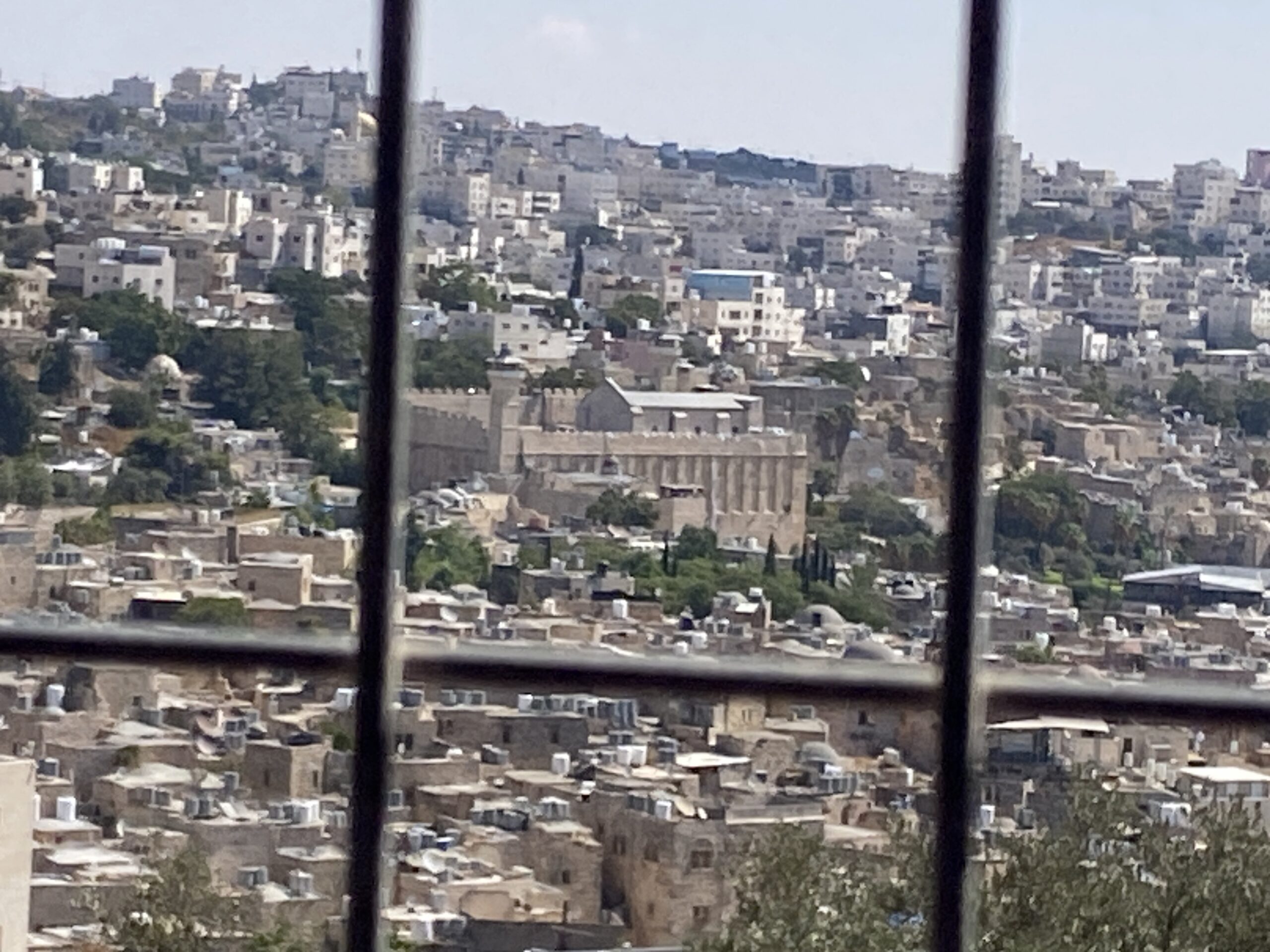 Yael ZoranSep-24-2026Hebron and the Cave of the Patriarchs from Beit Hashalom
-
Meitar checkpoint / Sansana
See all reports for this place-
Meitar Checkpoint / Sansana The checkpoint is located on the Green Line and serves as a border crossing between Israel and the West Bank. It is managed by the Border Crossing Authority of the Defense Ministry. It is comprised of sections for the transfer of goods as well as a vehicle checkpoint (intended for holders of blue identity cards, foreign nationals or diplomats and international organizations). Passing of Palestinians is prohibited, except for those with entry permits to Israel. Palestinians are permitted to cross on foot only. The crossing has a DCO / DCL / DCL / DCL (District Coordination Office), a customs unit, supervision, and a police unit. In the last year, a breach has been opened in the fence, not far from the crossing. This breach is known to all, including the army. There does not appear to be any interest in blocking it, probably as it permits needed Palestinian workers without the bureaucratic permits to get to work in Israel. Food stalls and a parking area economy have been created, but incidents of violent abuse by border police have also been recorded. Updated April 2022
-
South Hebron Hills
See all reports for this place-
South Hebron Hills
South Hebron Hills is a large area in the West Bank's southern part.
Yatta is a major city in this area: right in the border zone between the fertile region of Hebron and its surroundings and the desert of the Hebron Hills. Yatta has about 64,000 inhabitants.
The surrounding villages are called Masafer Yatta (Yatta's daughter villages). Their inhabitants subsist on livestock and agriculture. Agriculture is possible only in small plots, especially near streams. Most of the area consists of rocky terraces.Since the beginning of the 1980s, many settlements have been established on the agricultural land cultivated by the Palestinians in the South Hebron Hills region: Carmel, Maon, Susia, Masadot Yehuda, Othniel, and more. Since the settlements were established and Palestinians cultivation areas have been reduced; the residents of the South Hebron Hills have been suffering from harassment by the settlers. Attempts to evict and demolish houses have continued, along with withholding water and electricity. The military and police usually refrain from intervening in violent incidents between settlers and Palestinians do not enforce the law when it comes to the investigation of extensive violent Jewish settlers. The harassment in the South Hebron Hills includes attacking and attempting to burn residential tents, harassing dogs, harming herds, and preventing access to pastures.
There are several checkpoints in the South Hebron Hills, on Routes 317 and 60. In most of them, no military presence is apparent, but rather an array of pillboxes monitor the villages. Roadblocks are frequently set up according to the settlers and the army's needs. These are located at the Zif Junction, the Dura-al Fawwar crossing, and the Sheep Junction at the southern entrance to Hebron.
Updated April 2022
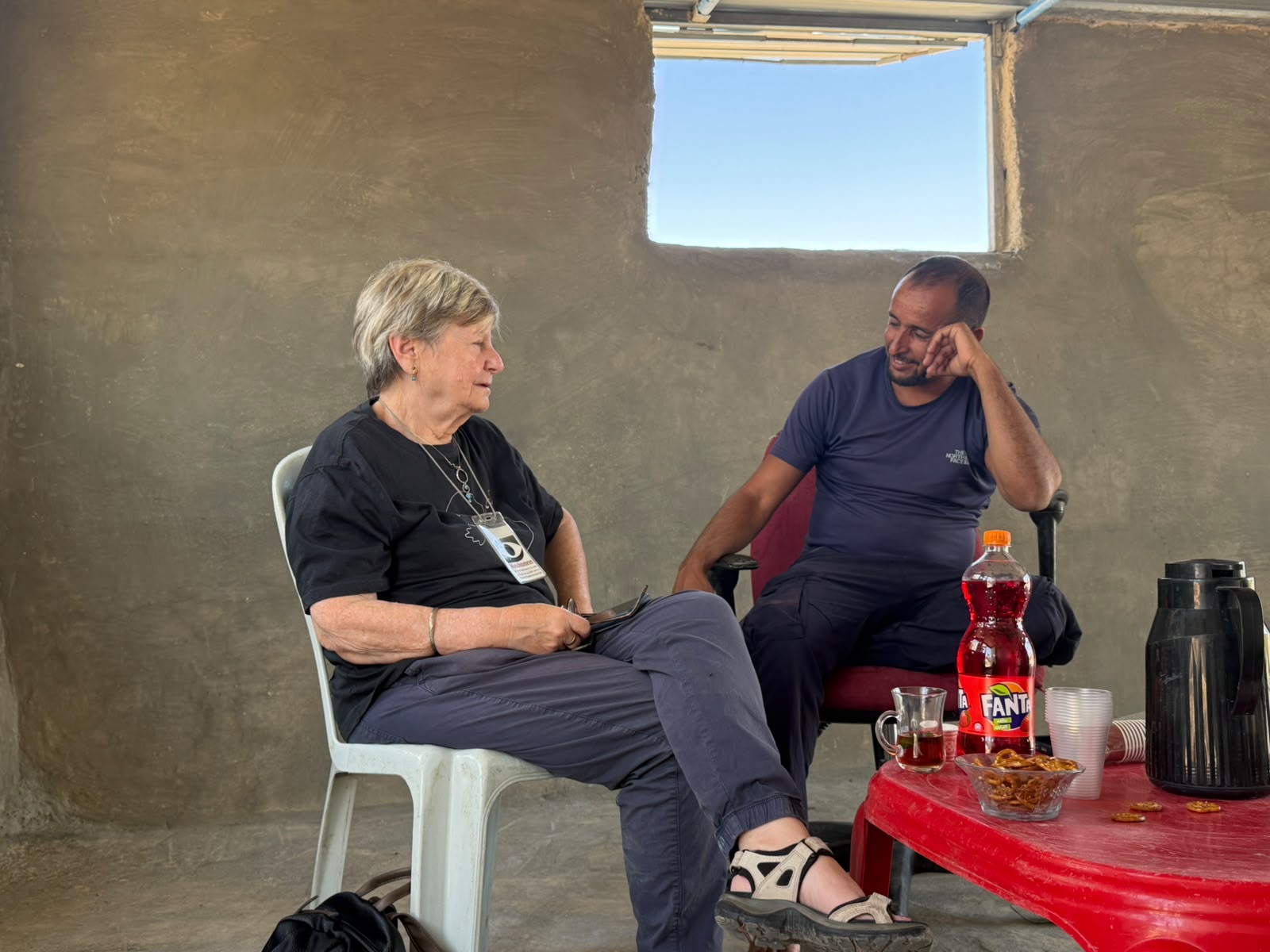 Muhammad D.Oct-10-2026Smadar with Najeh in Umm Qusa
-
