
Hebron, Sansana, South Hebron Hills, Thu 11.12.08, Morning
We went to visit Hebron, following the events of the past two weeks — namely, the events immediately preceding, and subsequent to, the contested occupation/evacuation of the House of Dispute in Hebron.
We were about ten people, most of them visiting Hebron for the first time.
Meytar CP
A military training is in full swing when we arrive. Many security people wearing phosphoric vests are positioned all over the place.
Road 60
The Sheep's Crossing: The pedestrian path, which is a short-cut, is still closed off, so pedestrians have to circumvent, walking on the road where cars keep driving past.
Hebron
The damage caused by the settlers' riots is evident throughout. Burnt up containers, garbage, broken glass, and many, many more graffiti everywhere.
Ohel Hazon David: (temporary synagogue set up following evacuation/riots) located midway between kiryat Arba and Hebron, is open and running. A car is parked next to it, and some people can be seen inside. Toward evening, as we leave the area, we notice that the place is connected to the electricity and so, is now lit.
The Ohel (literally, a tent) was set up on land belonging to the Jabri family, a big and prominent Hebron hamula (Arabic: clan), that owns many of the houses in the vicinity of the House of Dispute.
Consequently, the hamula was especially harmed by the riots.
We enter the first house on this visit:
The women sit down in one of the rooms; the men, in another.
The women relate the difficulties: Since the riots begun, they don't leave the house out of fear. Over the last period, however, fear and anxiety have significantly intensified. The younger children were carried to school in the women's arms. Procession was organized as a sort of "fleeing" (this was the term used by the women): They would leave the house with the children already in their arms and, as soon as they stepped out, would start running, to get out of "danger's eye" as quickly as possible. You can't just leave the house. There are no family visits. No shopping. Nothing. The fear of what's "without" forced everyone to stay "within": inside the house, locked up/protected by its four walls. Yet, over the past few weeks, condition has deteriorated so, that the children stopped going to school: the burden became intolerable and the women could no longer carry them in their arms.
This (Muslim, religious) holiday is sad. External threat and their anxiety have harmed the family's earnings significantly, as a consequence of which they have no money to buy clothes or food for the holiday with. Meet is entirely out of reach, financially speaking.
The family's matron tells us that her family lives rather close by but that, because she's so anxious to move on the road connecting Kiryat Arba and Hebron, she hasn't been to her home for a long time already. When she wants to meet her family, they set up an appointment elsewhere. This way, she can avoid using the road controlled by the settlers.
Sue'ha (the family's eldest daughter) is a university graduate in engineering. She would have very much liked to continue her studies, but is too afraid to keep walking on the road; she is also very much needed in the house, where she helps her mother with the children who are now there all the time. Being an exceptional student, she was awarded an old computer. Yet, the computer faltered pretty quickly after that and she now needs a replacement – which of course, she is unable to obtain (we might be able to help out here).
The women are kind and warm, and treat us to various food offerings and hot drinks.We brought some sweets with us, too – so it's now with great pleasure that we watch little ones savor them.
Having stayed in this house for over 45min., we now leave and go on to another house of the Jaberi's, located nearby.
Again, the same stories, relating the difficulties of earning a living, of being locked up in the house. The atmosphere is harsh and heavy, dominated by long silences.
I feel very frustrated and powerless, ashamed.
The third house we visit is located in the wadi (valley) between Kiryat Arba and Hebron.
It is here, in this house, that the shooting event, following which a settler was detained (but then, of course, released), took place.
The Kiryat Arba wired fence is cut to pieces all along.
The extent of the damage caused by those youngsters (settlers' youth) is just astounding.
The house itself — which stands rather alone, right under the settlement's housings — accommodates several families. Many children run around, in its courtyard.
We sit down on a large terrace overlooking the wadi, and one can readily imagine how peaceful life could be here. The men relate the events. The oldest and most respectable of them reveals his banded arm. He was shot by the settler. His arm was apparently smashed and it is therefore held together with various screws and other instruments (I have no idea what these are, but it looks decidedly unpleasant). In the excitement caused by this storytelling, one of the men takes his shirt off, exhibiting a wound in his chest. Knowledgeable people around me say that it is a bullet's entry wound. Is the judge, who just released the shooting settler, claiming that he does not pose any danger to the public, aware that he shot a man who was only a few meters away from him? But perhaps this doesn't count for anything, because all he shot was a "mere" Palestinian?
People's rage and frustration can readily be sensed. Its main causes, if I understand correctly, is that the army required the family to stay in the house and not get out, promising to protect them. And yet, what happened, happened and no one came to their rescue.
I reflect on what those children, tens of them, keep hearing around them all the time, and on their parents' anger which they witness daily, and wonder how that will effect them and what they might do with it, when they grow up and are less dependent.
As evening sets in, we walk along Hebron's main street. On the road leading from the House of Dispute towards Hebron's exit, and the entrance to Kiryat Arba, in the direction of the Harsina Hill.
Tens of new concrete blockades have been placed next to the House of Dispute, blocking its entries.
Military tractors work ferociously; the generator is still there, and still running.
How much money has the army spent on the protection of the settlers, occupying the House? How much money does it spend now, erecting those new blocks? How much more money will be thrown away like this, for nothing?
And how disconcerting this expenditure is, considering the hardship and poverty surrounding it all?!
Hebron
See all reports for this place-
According to Wye Plantation Accords (1997), Hebron is divided in two: H1 is under Palestinian Authority control, H2 is under Israeli control. In Hebron there are 170,000 Palestinian citizens, 60,000 of them in H2. Between the two areas are permanent checkpoints, manned at all hours, preventing Palestinian movement between them and controlling passage of permit holders such as teachers and schoolchildren. Some 800 Jews live in Avraham Avinu Quarter and Tel Rumeida, on Givat HaAvot and in the wholesale market.
Checkpoints observed in H2:
- Bet Hameriva CP- manned with a pillbox
- Kapisha quarter CP (the northern side of Zion axis) - manned with a pillbox
- The 160 turn CP (the southern side of Zion axis) - manned with a pillbox
- Avraham Avinu quarter - watch station
- The pharmacy CP - checking inside a caravan with a magnometer
- Tarpat (1929) CP - checking inside a caravan with a magnometer
- Tel Rumeida CP - guarding station
- Beit Hadassah CP - guarding station
Three checkpoints around the Tomb of the Patriarchs
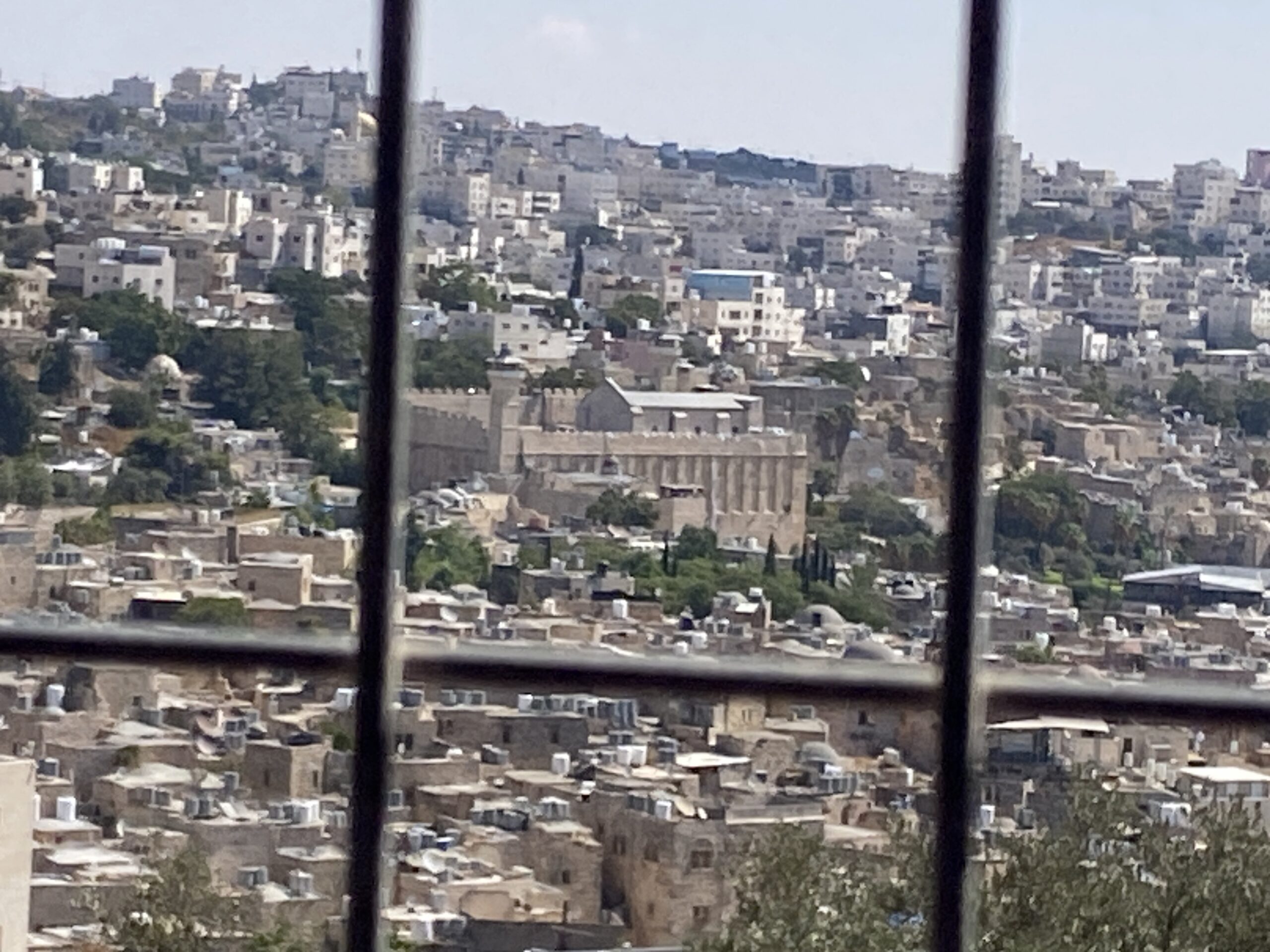 Yael ZoranSep-24-2026Hebron and the Cave of the Patriarchs from Beit Hashalom
-
Meitar checkpoint / Sansana
See all reports for this place-
Meitar Checkpoint / Sansana The checkpoint is located on the Green Line and serves as a border crossing between Israel and the West Bank. It is managed by the Border Crossing Authority of the Defense Ministry. It is comprised of sections for the transfer of goods as well as a vehicle checkpoint (intended for holders of blue identity cards, foreign nationals or diplomats and international organizations). Passing of Palestinians is prohibited, except for those with entry permits to Israel. Palestinians are permitted to cross on foot only. The crossing has a DCO / DCL / DCL / DCL (District Coordination Office), a customs unit, supervision, and a police unit. In the last year, a breach has been opened in the fence, not far from the crossing. This breach is known to all, including the army. There does not appear to be any interest in blocking it, probably as it permits needed Palestinian workers without the bureaucratic permits to get to work in Israel. Food stalls and a parking area economy have been created, but incidents of violent abuse by border police have also been recorded. Updated April 2022
-
South Hebron Hills
See all reports for this place-
South Hebron Hills
South Hebron Hills is a large area in the West Bank's southern part.
Yatta is a major city in this area: right in the border zone between the fertile region of Hebron and its surroundings and the desert of the Hebron Hills. Yatta has about 64,000 inhabitants.
The surrounding villages are called Masafer Yatta (Yatta's daughter villages). Their inhabitants subsist on livestock and agriculture. Agriculture is possible only in small plots, especially near streams. Most of the area consists of rocky terraces.Since the beginning of the 1980s, many settlements have been established on the agricultural land cultivated by the Palestinians in the South Hebron Hills region: Carmel, Maon, Susia, Masadot Yehuda, Othniel, and more. Since the settlements were established and Palestinians cultivation areas have been reduced; the residents of the South Hebron Hills have been suffering from harassment by the settlers. Attempts to evict and demolish houses have continued, along with withholding water and electricity. The military and police usually refrain from intervening in violent incidents between settlers and Palestinians do not enforce the law when it comes to the investigation of extensive violent Jewish settlers. The harassment in the South Hebron Hills includes attacking and attempting to burn residential tents, harassing dogs, harming herds, and preventing access to pastures.
There are several checkpoints in the South Hebron Hills, on Routes 317 and 60. In most of them, no military presence is apparent, but rather an array of pillboxes monitor the villages. Roadblocks are frequently set up according to the settlers and the army's needs. These are located at the Zif Junction, the Dura-al Fawwar crossing, and the Sheep Junction at the southern entrance to Hebron.
Updated April 2022
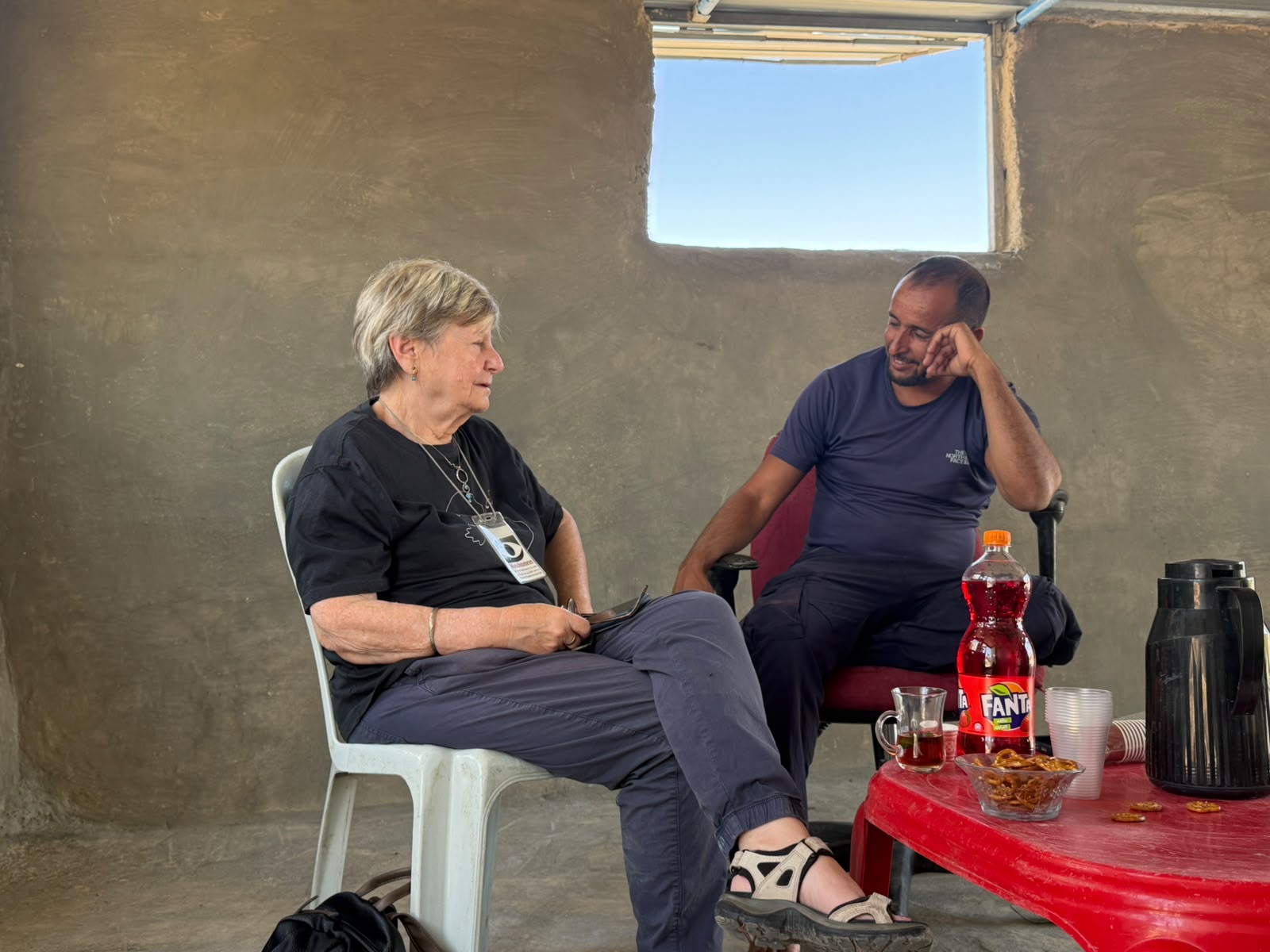 Muhammad D.Oct-10-2026Smadar with Najeh in Umm Qusa
-
