
Hebron, Sansana, South Hebron Hills, Thu 27.11.08, Morning
Metar-Sansana CP
6:30: On the Israeli side of the parking lot, many workers await transportation. The Palestinian side is empty.
Road 60
Samoa'h, Abado, Karme – open. Daharia – still closed. Why? This is so arbitrary — just to make it (still!) more difficult.
Dura Alfawwar – open. Lively traffic of people and vehicles at the junction. Many pupils, among them very young, walk alongside the roads to school: the distances are often very long and it is so dangerous.
Hebron
Many children and still more military forces. A military Jeep at the Pharmacy CP. When we arrive, with the car, at Shuhada St., opposite Hadassah House, a police vehicle instructs us to stop. The policeman claims that the place is closed by military edict, authorized by a major-general. We ask to be shown the edict. He orders us to head on to the police station next to the Patriarchs' Tombs Cave and says that he will show it to us there. He insists that A., our driver, turn around on the spot, on this narrow street, which is hardly wide enough to accommodate two cars – what's more, his police van is parked on the side, and the sun is blazing behind. Absolute horror. We ask him to allow us to turn around at the Tarpat CP, close by, but he's adamant.
On the landing, just in front of the Patriarchs' Tomb Cave, the policeman presents us with 16 different edicts issued on 2.11.08, and authorizing the application of a closed military zone edict to various routes throughout Hebron; none of them specifies any time limit. The edicts apply an order issued on October 2006 and expiring, May 2009. It goes without saying that while we were in the area, a public bus was allowed in – into a 'closed military zone'!! – without being checked at all.
All attempts to communicate with the two policemen positioned there proved futile. They were extremely aggressive and rude (their names are on record). An attempt to communicate with the officer in charge failed as well (rejected with endless, different excuses).
The gist of our complaints:
- A "closed military zone" edict must be accompanied by clear reference to the dates of its application. Otherwise, it is implied that the entire area is closed from 02.11.08, indefinitely.
- If this is the case, though, how can so many visitors be allowed in on the weekends (re. the Sabbath of "Hayei Sarah" – "the life of Sarah) – moreover, how do public buses get in (as we've witnessed!)?
In the course of our conversation, one of the policemen casually disclosed the truth: "left-activists are not allowed – people with tags." If the legal standing of those edicts, and their validity, could be examined, it might be helpful to future (MW) shifts.
The House of Dispute: A multitude of police and borders' police in situ. They are actually quite polite and pleasant. There is no military presence (although there may be some on the roof). The matter of the area being a closed military zone is not mentioned at all. The policeman insists on accompanying us downhill, apparently wishing to protect us against the House's residents who swarm ahead of him. Erased graffiti scribbling on the Mosque near-by, and the star of David drawn on some of the tomb stones in the Muslim cemetery across the road. One is left pondering how reactions would have been if it were the other way round — with Muslim symbols scribbled on tombstones in a Jewish cemetery…
We didn't go to Basm's grocery, not wanting to arrive there under police escort.
Hebron
See all reports for this place-
According to Wye Plantation Accords (1997), Hebron is divided in two: H1 is under Palestinian Authority control, H2 is under Israeli control. In Hebron there are 170,000 Palestinian citizens, 60,000 of them in H2. Between the two areas are permanent checkpoints, manned at all hours, preventing Palestinian movement between them and controlling passage of permit holders such as teachers and schoolchildren. Some 800 Jews live in Avraham Avinu Quarter and Tel Rumeida, on Givat HaAvot and in the wholesale market.
Checkpoints observed in H2:
- Bet Hameriva CP- manned with a pillbox
- Kapisha quarter CP (the northern side of Zion axis) - manned with a pillbox
- The 160 turn CP (the southern side of Zion axis) - manned with a pillbox
- Avraham Avinu quarter - watch station
- The pharmacy CP - checking inside a caravan with a magnometer
- Tarpat (1929) CP - checking inside a caravan with a magnometer
- Tel Rumeida CP - guarding station
- Beit Hadassah CP - guarding station
Three checkpoints around the Tomb of the Patriarchs
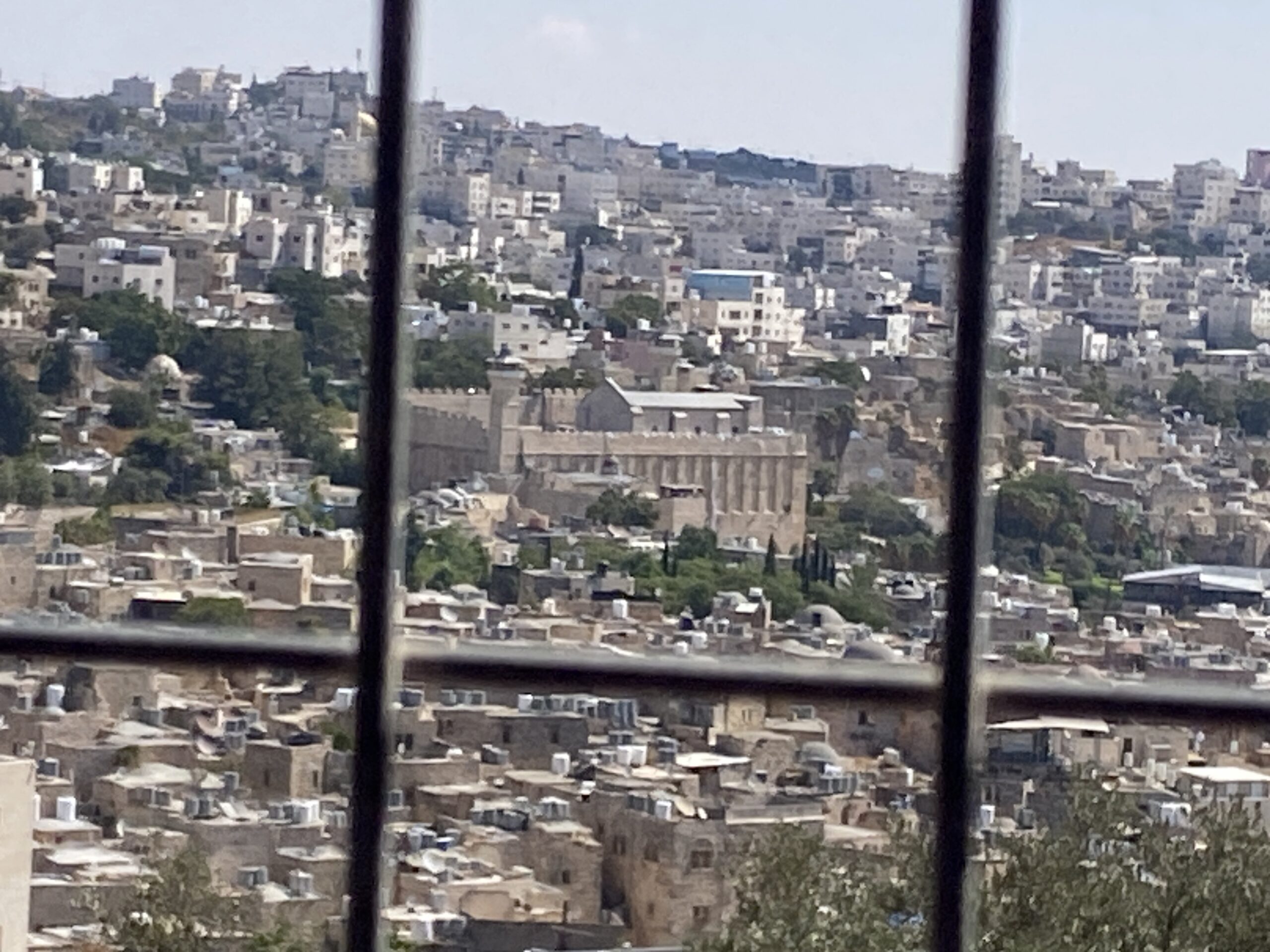 Yael ZoranSep-24-2026Hebron and the Cave of the Patriarchs from Beit Hashalom
-
Meitar checkpoint / Sansana
See all reports for this place-
Meitar Checkpoint / Sansana The checkpoint is located on the Green Line and serves as a border crossing between Israel and the West Bank. It is managed by the Border Crossing Authority of the Defense Ministry. It is comprised of sections for the transfer of goods as well as a vehicle checkpoint (intended for holders of blue identity cards, foreign nationals or diplomats and international organizations). Passing of Palestinians is prohibited, except for those with entry permits to Israel. Palestinians are permitted to cross on foot only. The crossing has a DCO / DCL / DCL / DCL (District Coordination Office), a customs unit, supervision, and a police unit. In the last year, a breach has been opened in the fence, not far from the crossing. This breach is known to all, including the army. There does not appear to be any interest in blocking it, probably as it permits needed Palestinian workers without the bureaucratic permits to get to work in Israel. Food stalls and a parking area economy have been created, but incidents of violent abuse by border police have also been recorded. Updated April 2022
-
South Hebron Hills
See all reports for this place-
South Hebron Hills
South Hebron Hills is a large area in the West Bank's southern part.
Yatta is a major city in this area: right in the border zone between the fertile region of Hebron and its surroundings and the desert of the Hebron Hills. Yatta has about 64,000 inhabitants.
The surrounding villages are called Masafer Yatta (Yatta's daughter villages). Their inhabitants subsist on livestock and agriculture. Agriculture is possible only in small plots, especially near streams. Most of the area consists of rocky terraces.Since the beginning of the 1980s, many settlements have been established on the agricultural land cultivated by the Palestinians in the South Hebron Hills region: Carmel, Maon, Susia, Masadot Yehuda, Othniel, and more. Since the settlements were established and Palestinians cultivation areas have been reduced; the residents of the South Hebron Hills have been suffering from harassment by the settlers. Attempts to evict and demolish houses have continued, along with withholding water and electricity. The military and police usually refrain from intervening in violent incidents between settlers and Palestinians do not enforce the law when it comes to the investigation of extensive violent Jewish settlers. The harassment in the South Hebron Hills includes attacking and attempting to burn residential tents, harassing dogs, harming herds, and preventing access to pastures.
There are several checkpoints in the South Hebron Hills, on Routes 317 and 60. In most of them, no military presence is apparent, but rather an array of pillboxes monitor the villages. Roadblocks are frequently set up according to the settlers and the army's needs. These are located at the Zif Junction, the Dura-al Fawwar crossing, and the Sheep Junction at the southern entrance to Hebron.
Updated April 2022
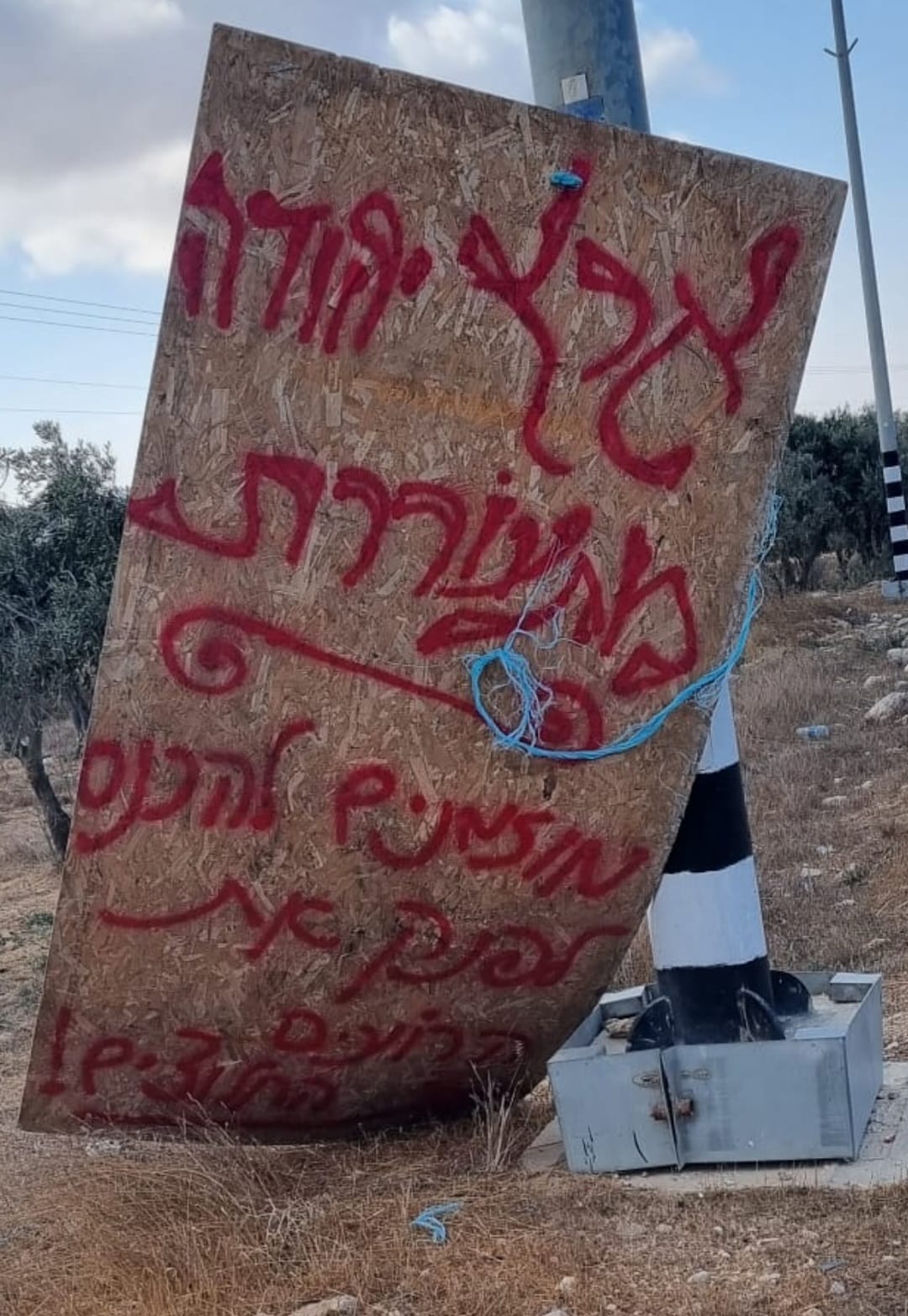 Smadar BeckerOct-17-2026A sign placed by those who call themselves the Pioneer Shepherds, at the outpost adjacent to Qawawis
-
