
Hebron, Sansana, South Hebron Hills, Tue 21.7.09, Morning
Sansana: As we arrive we see on the Israeli side five buses with visiting prisoners' families. Most of the families have already passed the inspection and only the last bus is not quite done. The lorries transferring sand "back to back" are working with gusto. On our return journey we find a channel 1 (Arabic TV) crew filming the CP crossing. They are pleased to see us and ask to interview us.
In principle we have no objections to border crossing points if they are on the Green Line and believe that this specific one is run quite well.
The following story will attest to that: We asked Shlomi, director of the Sansana CP to contact the Irtah and Eyal CPs directly in order to teach them, based on his own experience, how you to be human even within the intimidating setting and evil architecture of a border crossing. He tells us how at first he used to get into the x-ray machine with every Palestinian that was asked to undergo this inspection. When they saw him do it so often they stopped fearing it. Today it is seldom used because people have learnt to empty their pockets before they cross.
Road 317
The road undergoes development by the National Roads Authority. It's a perfect apartheid road, how much more money will be wasted on it? First, a fence was put up to stop the sheep from freely crossing it; then, the fence was taken down, in compliance with a Supreme Court decree, and now this.
Having read the list of strongholds to be taken off in this morning's Ha'aretz, we decided to go up to Avig'ail and see what there is to take down there.
This is what we found: Water, sewage, telephone and electricity pipes and cables (the neighbouring Palestinian village Khirbat al-Tuwani has none), a kilometer and a half of paved roadway (the neighbouring Palestinian village Khirbat al-Tuwani has none), a water tower (the neighbouring Palestinian village Khirbat al-Tuwani has none and the cisterns they do have are being poisoned by the Jewish settlers), fifteen caravans, a kindergarten and a soldier on guard. He got up when he saw our transit and since we were not seeking confrontation we kept our distance.
Along the road we see notices calling people to make their home there, under the heading "Opposing the White Paper".
On the list of twenty three strongholds marked for demolition I don't remember seeing Ma'on, which is very vexing as they are a constant menace to their Palestinian neighbours and I am just hoping they wont get away with everything and be allowed to remain.
Highway 356
Zif Junction: traffic flows. While at the grocery, we hear shootings. Turns out the Palestinian radio announced the names of those who passed the matriculation exams and those shootings were in celebration of that. The pilgrims to Mecca have returned as well – another cause for celebration, and later we heard similar shootings in Hebron.
Highway 60
Dura Alfawwar and the Sheep Junction – the pillbox is manned and traffic flows. All road blocks are in place. There's very little traffic and no military vehicles within sight. Army and police cars escort a bicycle hike of the Jewish Quarter settlers. Earlier on we saw them prepare for the ride at the wholesale market in Hebron and they rode past us when we stopped by one of the Patriarchs' Tombs' Cave CPs.
Hebron
Generally the town in area H1 is deserted and it breaks your heart to think what there might have been here.
At long last we were told why we see so many children milling about with buckets: The charity connected to the mosque in the Patriarchs' Tombs' Cave distributes food to the needy – meat every Monday and soup during the rest of the week. The children carry the food back home. Judging by the number of children with buckets, poverty is very widespread in these parts of Hebron.
Curve 160 CP: open but pillbox deserted.
The House of Dispute CP: Border Police soldiers sit in the shade.
Tel Rumeida, Pharmacy and Tarpat CPs: manned by the parachooters. Few walk through, mainly children.
The Jewish settlers and their children are getting ready for a bicycle hike at the wholesale market and all the security forces are recruited to escort them. If you wondered how your taxes are being spent, here's the answer – to protect these law breakers and disrupters of public order.
Patriarchs' Tombs Cave: something sounds different, when it dawns on me there no more of that deafening music, bellowing from the Gutenick Centre.
At the CP leading to the parking lot we notice a big group of detainees including five women. It transpires they had all been on their way to the court near Ibrahimiya boys' school. They are soon all released except one who awaits the police that the Border Police soldiers called on, to take him in for questioning. His family decides to wait with him for the constabulary. Then one of the Border Police soldiers notices that our driver is Arab and asks him for his papers. I intervene, telling him he can talk to M. in Hebrew and that if he takes his ID, he should be taking mine too: both are blue (Israeli). By this time the police has arrived and a policeman comes to see what goes on. I tell him and he takes everybody's documents for inspection and while he's at it, tells us that the place is a "closed military zone". I ask him to show us the relevant order and then disregard him. Tamar and Michal insist that he show us the order if indeed there is one. To resolve the embarrassing situation he starts complaining about the difficulty of being a policeman in Hebron. A colleague of his whom we know well, helps him disentangle the mess he's created… All this while I inquire about the detainees and make out that they're better off without us. It looks like the Border Police have simply decided to let us know who calls the shots around here. We hurry to the car and leave. Looking over my shoulder, I see the Palestinian family leaving too, while the detainee is driven away in the police car.
Normal occupation sights in Hebron. When is Obama coming to visit and liberate us from this evil?
Hebron
See all reports for this place-
According to Wye Plantation Accords (1997), Hebron is divided in two: H1 is under Palestinian Authority control, H2 is under Israeli control. In Hebron there are 170,000 Palestinian citizens, 60,000 of them in H2. Between the two areas are permanent checkpoints, manned at all hours, preventing Palestinian movement between them and controlling passage of permit holders such as teachers and schoolchildren. Some 800 Jews live in Avraham Avinu Quarter and Tel Rumeida, on Givat HaAvot and in the wholesale market.
Checkpoints observed in H2:
- Bet Hameriva CP- manned with a pillbox
- Kapisha quarter CP (the northern side of Zion axis) - manned with a pillbox
- The 160 turn CP (the southern side of Zion axis) - manned with a pillbox
- Avraham Avinu quarter - watch station
- The pharmacy CP - checking inside a caravan with a magnometer
- Tarpat (1929) CP - checking inside a caravan with a magnometer
- Tel Rumeida CP - guarding station
- Beit Hadassah CP - guarding station
Three checkpoints around the Tomb of the Patriarchs
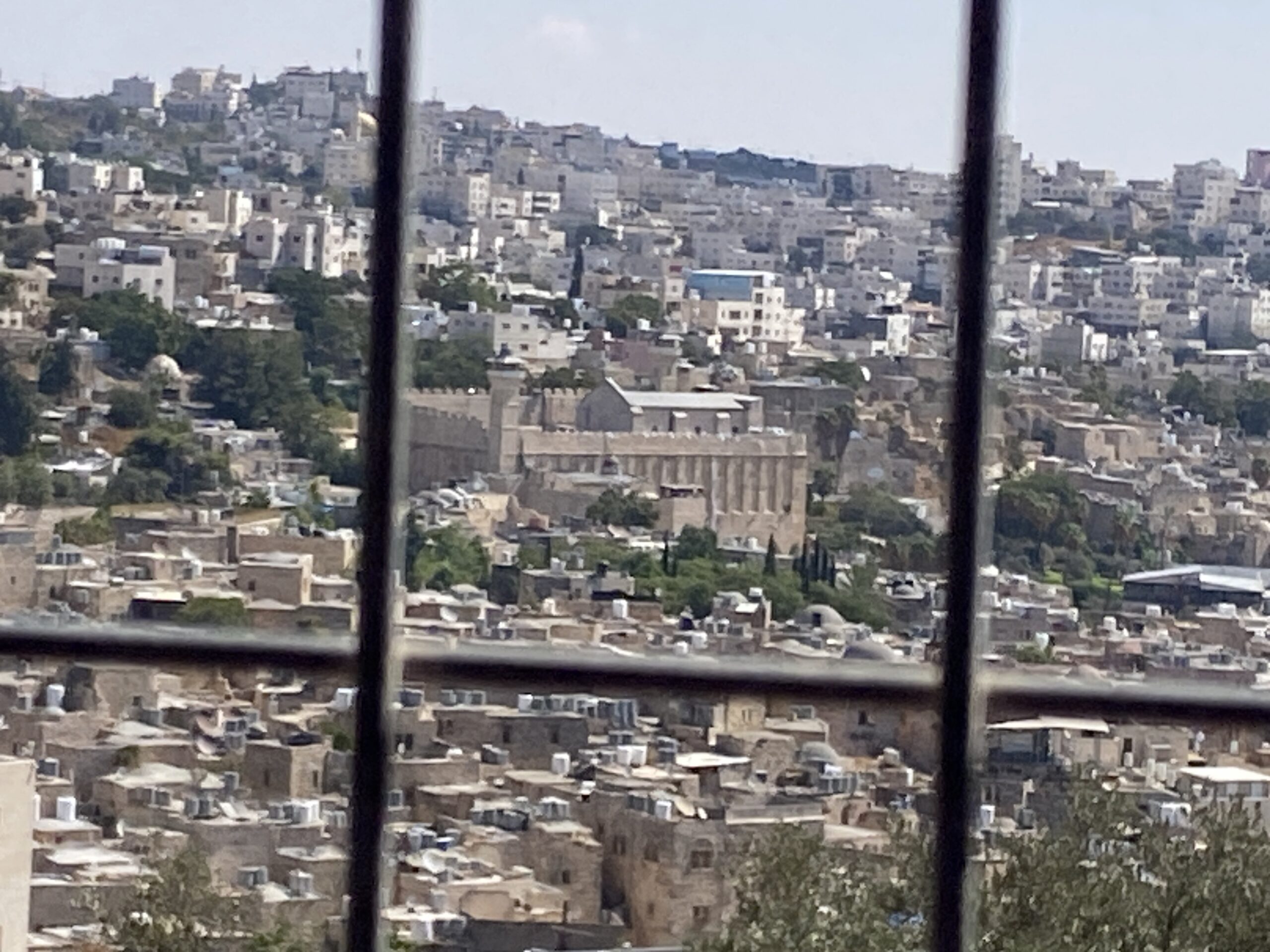 Yael ZoranSep-24-2026Hebron and the Cave of the Patriarchs from Beit Hashalom
-
Meitar checkpoint / Sansana
See all reports for this place-
Meitar Checkpoint / Sansana The checkpoint is located on the Green Line and serves as a border crossing between Israel and the West Bank. It is managed by the Border Crossing Authority of the Defense Ministry. It is comprised of sections for the transfer of goods as well as a vehicle checkpoint (intended for holders of blue identity cards, foreign nationals or diplomats and international organizations). Passing of Palestinians is prohibited, except for those with entry permits to Israel. Palestinians are permitted to cross on foot only. The crossing has a DCO / DCL / DCL / DCL (District Coordination Office), a customs unit, supervision, and a police unit. In the last year, a breach has been opened in the fence, not far from the crossing. This breach is known to all, including the army. There does not appear to be any interest in blocking it, probably as it permits needed Palestinian workers without the bureaucratic permits to get to work in Israel. Food stalls and a parking area economy have been created, but incidents of violent abuse by border police have also been recorded. Updated April 2022
-
South Hebron Hills
See all reports for this place-
South Hebron Hills
South Hebron Hills is a large area in the West Bank's southern part.
Yatta is a major city in this area: right in the border zone between the fertile region of Hebron and its surroundings and the desert of the Hebron Hills. Yatta has about 64,000 inhabitants.
The surrounding villages are called Masafer Yatta (Yatta's daughter villages). Their inhabitants subsist on livestock and agriculture. Agriculture is possible only in small plots, especially near streams. Most of the area consists of rocky terraces.Since the beginning of the 1980s, many settlements have been established on the agricultural land cultivated by the Palestinians in the South Hebron Hills region: Carmel, Maon, Susia, Masadot Yehuda, Othniel, and more. Since the settlements were established and Palestinians cultivation areas have been reduced; the residents of the South Hebron Hills have been suffering from harassment by the settlers. Attempts to evict and demolish houses have continued, along with withholding water and electricity. The military and police usually refrain from intervening in violent incidents between settlers and Palestinians do not enforce the law when it comes to the investigation of extensive violent Jewish settlers. The harassment in the South Hebron Hills includes attacking and attempting to burn residential tents, harassing dogs, harming herds, and preventing access to pastures.
There are several checkpoints in the South Hebron Hills, on Routes 317 and 60. In most of them, no military presence is apparent, but rather an array of pillboxes monitor the villages. Roadblocks are frequently set up according to the settlers and the army's needs. These are located at the Zif Junction, the Dura-al Fawwar crossing, and the Sheep Junction at the southern entrance to Hebron.
Updated April 2022
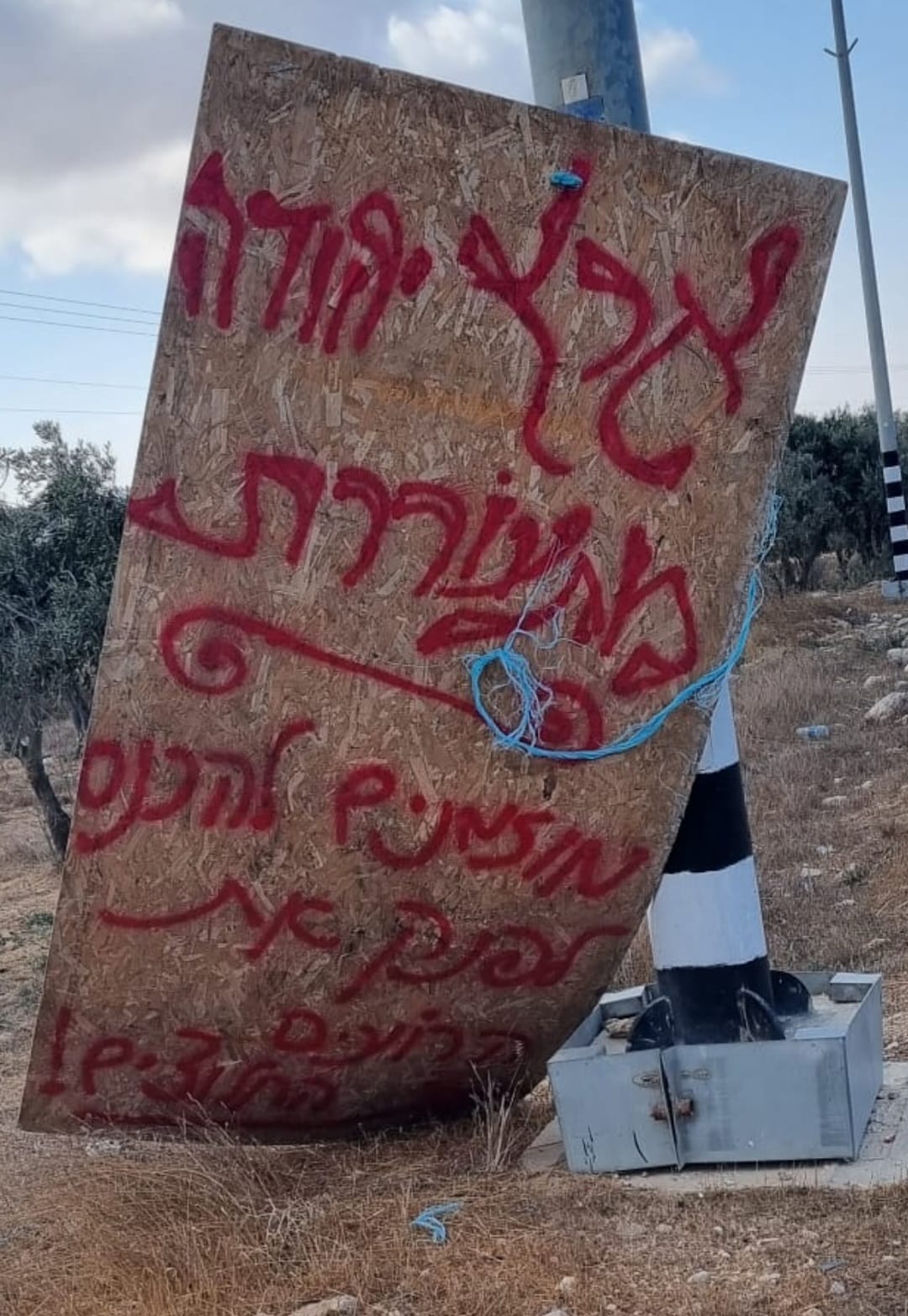 Smadar BeckerOct-17-2026A sign placed by those who call themselves the Pioneer Shepherds, at the outpost adjacent to Qawawis
-
