
Hebron, Sansana, South Hebron Hills, Wed 16.12.09, Morning
trans. by Naomi S.
Sansana
At 6:45am the checking lane is already packed with workers. The parking lot on the Israeli side is full and we know there's a problem. Eventually, by 7:30a, all the workers have passed, not lease because we've made a few phone calls. But people waited for a long time and this is because not all checking positions were manned. The checking-officers need a break, we can understand that, but why at the most pressing times? And why don't they have any replacement? We moved on to the Israeli side, to see how things work there – there's a problem with the difference of mentalities: All checking-officers are women here, and the workers, almost only men, are embarrassed and degraded. Z', the manager of the Taquomiya CP told us that men don't want to do this work, so they have no alternative but to take on women – someone has to attend to this. One bus of prisoners' families has already arrived and the families are waiting. At 7:30am we went on.
Route 60
Almost deserted at this time and almost no cars. All pillboxes are manned – the Sheep junction and Dura Alfawwar.
Hebron
At the entry gate, the civilian security-man detains us, asking an ID only from M., our (non-Jewish) driver – we hand over ours as well. Since he has no authority to detain us, we proceed. Construction work at the Mimre neighborhood is in progress – Netanyahu's "freeze" applies only to prospective construction work, not to anything already at work.
We enter Hebron via the Hebron Border Police station (in order to avoid another gate).
The Zion Route: the pillbox is still deseted. Kapisha neighborhood, Curve 160 and the Pharmacy CP are all deserted and manned by Golani soldiers who, today, are no longer positioned on the rooftops.
We proceed to the Shouhada St.: when we were next to the deserted gas station, Anat Cohen, who parked next to Beit Hadassah noticed our transit and blocked our way. We wanted to turn left, she turns left; we wanted right, she turns right; bumper against bumper, and she even scratched the transit. Then she parked her car and drew out a camera. I pulled out my own, and took photos through the windows. At the same time, Zipi called the police. Someone answered at the Judah and Samaria Police station who didn't understand what we were talking about or where we were and anyway, we're not on the Shouhada St…. turns out we're on King David Rd.
Meanwhile, Anat stepped out of her car, and so did we because she has some sharp tool on her key ring with which she tries to flatten tires – I tries to ask for help from other settlers who were in the area – a mother and child and another person, but they all backed her. Then I tried to take a photo illustrating the distance between her car and ours, at which she got irritated and slammed my camera, causing it to fall and smash on the pavement. At the same time, another settler with a black jeep arrived and parked behind our transit. We felt literally trapped: Anat in front of us, that Jeep behind. Me, with the broken camera, and also some good beatings I've suffered, and the boys who was with Anat – one of her children or grandchildren – about 5yrs old, who, reflecting his excellent upbringing, shouted at Zipi "Nazi".
This took about ten long minutes. During that time, a TIPH patrol passed, with its international policemen. Zipi asked them to take photos but they, as usual, wouldn't do anything – neutrality at its best. Just observing and watching. Long live diplomacy.
Then came the policeman Arnon Zukerman, chief in command of the Patriarchs' Cave Police station, with his long white van. He gets off his vehicle and approached us – Anat lies to him, telling him that we've blocked her way!!! While he talks to us, she approaches her driver and curses him energetically "stinking Arab", "Jewesses-loving Araboush", "how much money do you get for fucking those old ladies"… and this only the gist of it. Arnon asks where I am from and I tell her I'm from Omer. To which he asks me "what would you have done, if people like Anat would have walked around your neighborhood, taking your photos – would you have liked it??" OK. From this one can already figure out who's protected by the Hebron Police.
Then he tells me that he has at his station a "closed military zone" edict applying to all Hebron CPs and asks that I go to the station to see it. I immediately regret not having a camera with which to photograph the edict and the document, but Zipi and I are law-abiding citizens, so we follow him to the police state.
Already at the parking lot he tells me that actually there's no such edit and we're allowed to be everywhere. Apparently, he didn't believe we'd come over to see, and verify. Anat followed in our trail, to make sure policing was effective in driving us away. I am extremely irritated but quiet, tell him that I feel threatened and attacked and all he can do is observe my silence as against Anat's cursing in order to grasp what's going on. He recommends that I file yet another complaint against Anat – my eighth?!?!? What for? Once again, its clear who's handling affairs in Hebron.
Despite it all, we returned to the care and did the full round this time!!! Just to show that we're not afraid, that we're citizens of equal rights (I am afraid, very much so!!). We finished our round and went back home, not before I handed my camera over, for repairs.
Shlomo, my spouse, says that he's had enough and that it's about time I sue Anat Cohen on civil grounds for all the damages she's caused me – I am sure my friends will back me.
Zipi told me that Anat Cohen is settlers aristocracy: the daughter of Moshe Zer, bereaved sister of Gile'ad Zer, may the Lord revenge his death. She's considered a saint amongst her lot. This is not madness but settlers' syndrome.
We're fortunate to be well trained in such violence. Zipi and I have already been stoned on the day Beit HaMeriva (House of Dispute) was evacuated, Michal and I are acquainted with Anat's pearls (of tongue) and Michal and Mira have been subjected to the water treatment.
But it's impossible to habituate and keep swallowing. Each such event kills us a bit.
Hebron
See all reports for this place-
According to Wye Plantation Accords (1997), Hebron is divided in two: H1 is under Palestinian Authority control, H2 is under Israeli control. In Hebron there are 170,000 Palestinian citizens, 60,000 of them in H2. Between the two areas are permanent checkpoints, manned at all hours, preventing Palestinian movement between them and controlling passage of permit holders such as teachers and schoolchildren. Some 800 Jews live in Avraham Avinu Quarter and Tel Rumeida, on Givat HaAvot and in the wholesale market.
Checkpoints observed in H2:
- Bet Hameriva CP- manned with a pillbox
- Kapisha quarter CP (the northern side of Zion axis) - manned with a pillbox
- The 160 turn CP (the southern side of Zion axis) - manned with a pillbox
- Avraham Avinu quarter - watch station
- The pharmacy CP - checking inside a caravan with a magnometer
- Tarpat (1929) CP - checking inside a caravan with a magnometer
- Tel Rumeida CP - guarding station
- Beit Hadassah CP - guarding station
Three checkpoints around the Tomb of the Patriarchs
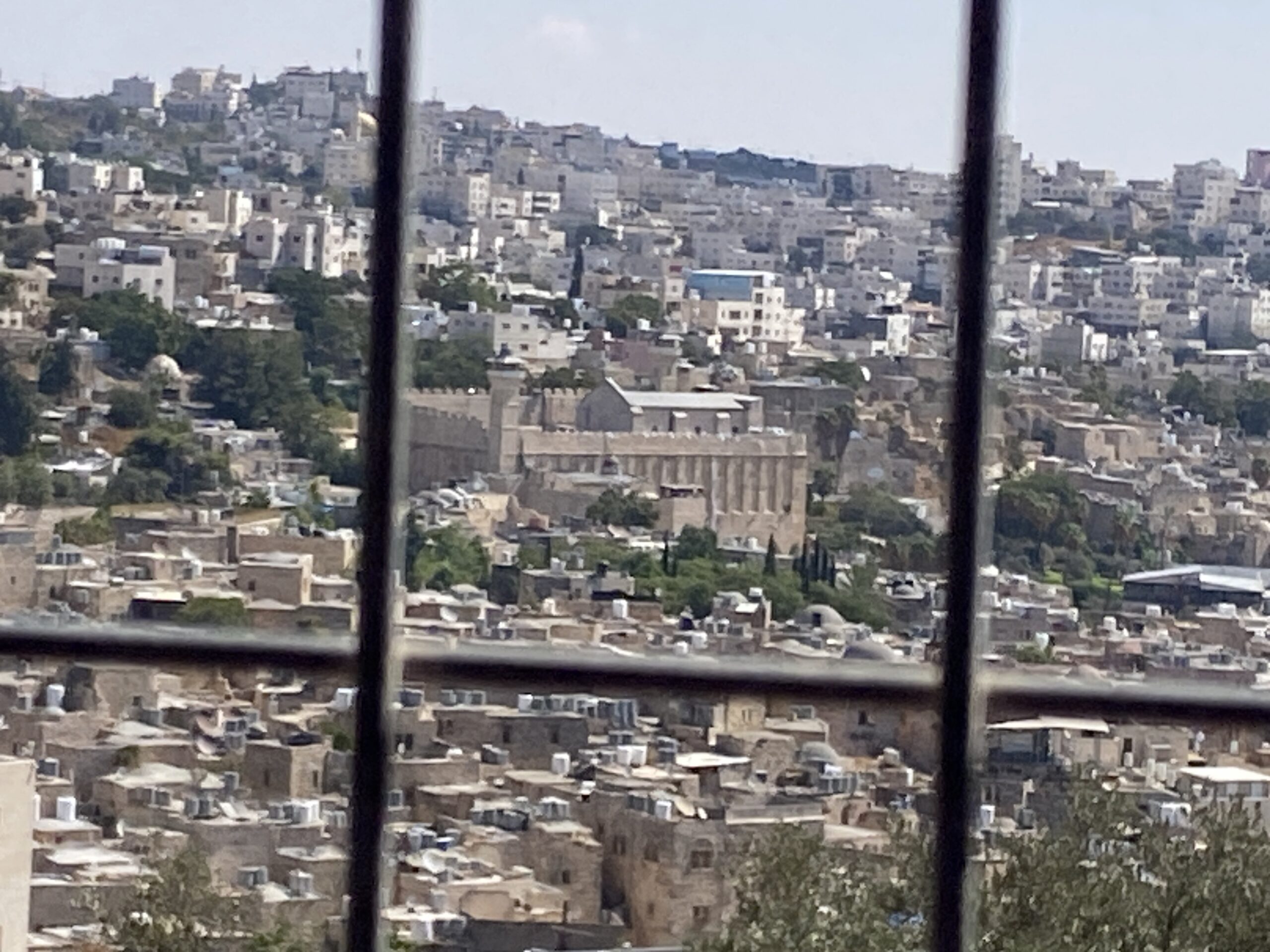 Yael ZoranSep-24-2026Hebron and the Cave of the Patriarchs from Beit Hashalom
-
Meitar checkpoint / Sansana
See all reports for this place-
Meitar Checkpoint / Sansana The checkpoint is located on the Green Line and serves as a border crossing between Israel and the West Bank. It is managed by the Border Crossing Authority of the Defense Ministry. It is comprised of sections for the transfer of goods as well as a vehicle checkpoint (intended for holders of blue identity cards, foreign nationals or diplomats and international organizations). Passing of Palestinians is prohibited, except for those with entry permits to Israel. Palestinians are permitted to cross on foot only. The crossing has a DCO / DCL / DCL / DCL (District Coordination Office), a customs unit, supervision, and a police unit. In the last year, a breach has been opened in the fence, not far from the crossing. This breach is known to all, including the army. There does not appear to be any interest in blocking it, probably as it permits needed Palestinian workers without the bureaucratic permits to get to work in Israel. Food stalls and a parking area economy have been created, but incidents of violent abuse by border police have also been recorded. Updated April 2022
-
South Hebron Hills
See all reports for this place-
South Hebron Hills
South Hebron Hills is a large area in the West Bank's southern part.
Yatta is a major city in this area: right in the border zone between the fertile region of Hebron and its surroundings and the desert of the Hebron Hills. Yatta has about 64,000 inhabitants.
The surrounding villages are called Masafer Yatta (Yatta's daughter villages). Their inhabitants subsist on livestock and agriculture. Agriculture is possible only in small plots, especially near streams. Most of the area consists of rocky terraces.Since the beginning of the 1980s, many settlements have been established on the agricultural land cultivated by the Palestinians in the South Hebron Hills region: Carmel, Maon, Susia, Masadot Yehuda, Othniel, and more. Since the settlements were established and Palestinians cultivation areas have been reduced; the residents of the South Hebron Hills have been suffering from harassment by the settlers. Attempts to evict and demolish houses have continued, along with withholding water and electricity. The military and police usually refrain from intervening in violent incidents between settlers and Palestinians do not enforce the law when it comes to the investigation of extensive violent Jewish settlers. The harassment in the South Hebron Hills includes attacking and attempting to burn residential tents, harassing dogs, harming herds, and preventing access to pastures.
There are several checkpoints in the South Hebron Hills, on Routes 317 and 60. In most of them, no military presence is apparent, but rather an array of pillboxes monitor the villages. Roadblocks are frequently set up according to the settlers and the army's needs. These are located at the Zif Junction, the Dura-al Fawwar crossing, and the Sheep Junction at the southern entrance to Hebron.
Updated April 2022
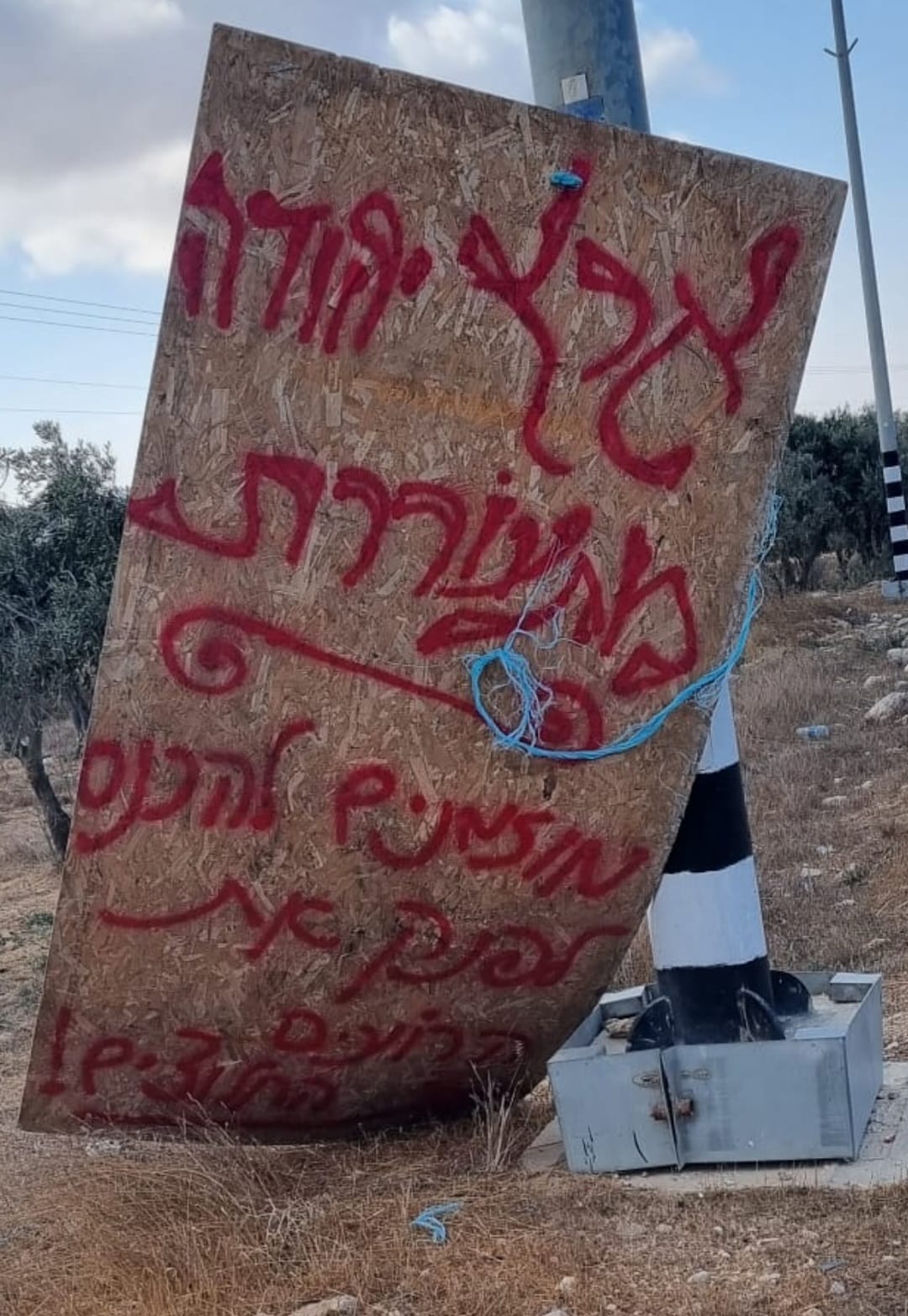 Smadar BeckerOct-17-2026A sign placed by those who call themselves the Pioneer Shepherds, at the outpost adjacent to Qawawis
-
