
Hebron, South Hebron Hills
‘Ata Jabar’s attempts to live next to Kiryat Arba.
The Meitar checkpoint operates without any particular problems.
Highway 317 is almost empty of traffic. Traffic is heavier on Highway 60. We see people harvesting olives along the roadside.
H., our acquaintance, the owner of a grove below A-Tuwani, decided not to harvest this year. There’s not enough fruit on the remaining trees that weren’t cut down by the settlers. We arranged to come help when he works in his grove.
Hebron is full of paratroopers and Border Police soldiers, as usual. But we saw no detainees while we were there, nor any special problems. A new sign on Beit Hadassah with a verse from Jeremiah (32:41): “Yea, I will rejoice over them to do them good, and I will plant them in this land in truth with My whole heart and with My whole soul.”

Little children hang around with soldiers at the guard post next to Beit Hadassah. The symbiosis already extends to schoolchildren and kindergartners. This holy city, like Jerusalem, is full of human rights violations by people who give belief in god a bad name.
The tense quiet continues.
We visited ‘Ata who lives right below the Nofei Mamreh neighborhood. After the land on which Kiryat Arba was erected neighborhood by neighborhood was expropriated from him and his family, the authorities continue to try and make life impossible for him. After he’d made arrangements with the Civil Administration and with Mekorot, the tomatoes and beans again sprouted among his grape vines. But the largest hamula in the area wasn’t able to reach a similar agreement so the authorities decided to impose collective punishment and shut off his water also. His request to separate the water supply and the metering was unsuccessful. He’s always paid for the water and will continue to do so.
So everything wilted – there are no tomatoes, no cabbage, no beans and the vines are also thirsty. A large family which makes its living from the land is “stuck” in view of the settlers.
Their only sin is their land, coveted to expand Kiryat Arba.
So their lives are made unbearable in the hope they’ll give up and leave.
The matter is now in court. It’s lucky there are a few good people trying to help.
We’ll return next week to visit again.
Hebron
See all reports for this place-
According to Wye Plantation Accords (1997), Hebron is divided in two: H1 is under Palestinian Authority control, H2 is under Israeli control. In Hebron there are 170,000 Palestinian citizens, 60,000 of them in H2. Between the two areas are permanent checkpoints, manned at all hours, preventing Palestinian movement between them and controlling passage of permit holders such as teachers and schoolchildren. Some 800 Jews live in Avraham Avinu Quarter and Tel Rumeida, on Givat HaAvot and in the wholesale market.
Checkpoints observed in H2:
- Bet Hameriva CP- manned with a pillbox
- Kapisha quarter CP (the northern side of Zion axis) - manned with a pillbox
- The 160 turn CP (the southern side of Zion axis) - manned with a pillbox
- Avraham Avinu quarter - watch station
- The pharmacy CP - checking inside a caravan with a magnometer
- Tarpat (1929) CP - checking inside a caravan with a magnometer
- Tel Rumeida CP - guarding station
- Beit Hadassah CP - guarding station
Three checkpoints around the Tomb of the Patriarchs
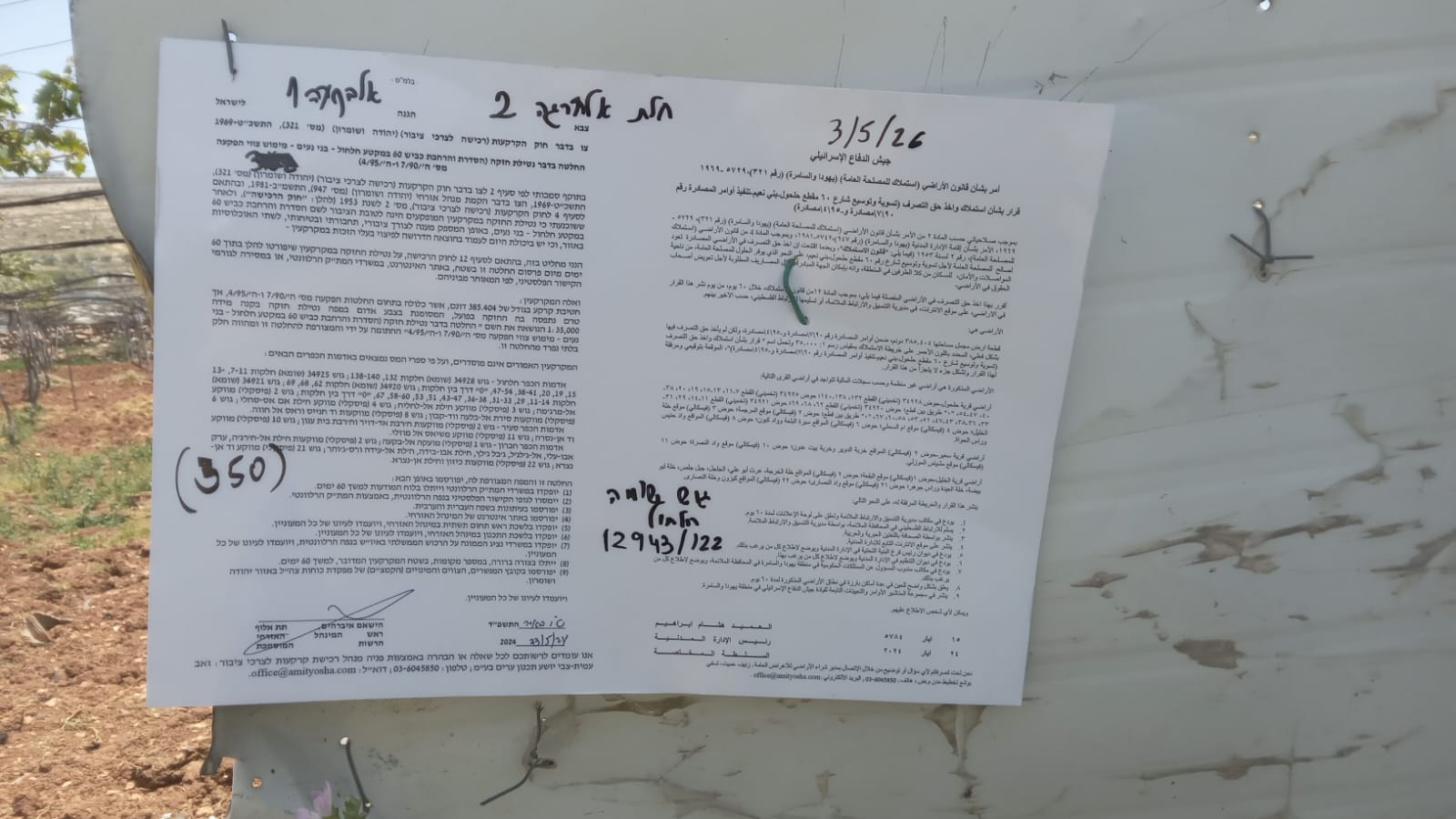 Muhammad D.May-13-2026Hebron - Request for compensation for land expropriation
-
South Hebron Hills
See all reports for this place-
South Hebron Hills
South Hebron Hills is a large area in the West Bank's southern part.
Yatta is a major city in this area: right in the border zone between the fertile region of Hebron and its surroundings and the desert of the Hebron Hills. Yatta has about 64,000 inhabitants.
The surrounding villages are called Masafer Yatta (Yatta's daughter villages). Their inhabitants subsist on livestock and agriculture. Agriculture is possible only in small plots, especially near streams. Most of the area consists of rocky terraces.Since the beginning of the 1980s, many settlements have been established on the agricultural land cultivated by the Palestinians in the South Hebron Hills region: Carmel, Maon, Susia, Masadot Yehuda, Othniel, and more. Since the settlements were established and Palestinians cultivation areas have been reduced; the residents of the South Hebron Hills have been suffering from harassment by the settlers. Attempts to evict and demolish houses have continued, along with withholding water and electricity. The military and police usually refrain from intervening in violent incidents between settlers and Palestinians do not enforce the law when it comes to the investigation of extensive violent Jewish settlers. The harassment in the South Hebron Hills includes attacking and attempting to burn residential tents, harassing dogs, harming herds, and preventing access to pastures.
There are several checkpoints in the South Hebron Hills, on Routes 317 and 60. In most of them, no military presence is apparent, but rather an array of pillboxes monitor the villages. Roadblocks are frequently set up according to the settlers and the army's needs. These are located at the Zif Junction, the Dura-al Fawwar crossing, and the Sheep Junction at the southern entrance to Hebron.
Updated April 2022
 Muhammad D.Jul-13-2026Michal with O.
-