
Hebron, South Hebron Hills
Mahmoud Abu Qabita and his attempts to survive beside the Metzudat Yehuda checkpoint and the Beit Yattir settlement.
To begin, a brief explanation
The Beit Yattir settlement adjoins the security fence along Highway 316 from Arad toward Highway 60. The Metzudat Yehuda checkpoint was erected there for cars and merchandise and is administratively part of the Meitar checkpoint.
The Abu Qabita family has lived there forever, making a living from farming and raising sheep. Since they were next to the settlement they remained on the Israeli side of the fence. On its other side is a small village, Imnazel, with the school to which the family’s 22 children go each morning. Since they’re Palestinians they’re subject to harsh, vicious restrictions on their movements. They must renew their crossing permit every six months. In the past the authorities made it hard for the children, all of whom are known to the checkpoint personnel, of course, to cross if one of them forgot their permit. In last year’s heavy snow they were trapped wet and freezing with no food for them and their flock for a few days because they weren’t able to drive to Yatta and buy what they needed.
I had to convince the checkpoint manager that it’s a humanitarian emergency and he should bend the rules and allow the father to go buy clothes and food for everyone. Last Thursday Mahmoud called me, concerned and hurt. The semi-annual permit hasn’t arrived. “I’ve been pleading for two weeks – aren’t I a human being? You understand, they ignore me at the DCL,” he says. “School begins Sunday and the children don’t yet have permits.” Again many phone calls to the checkpoint manager who’s always willing to help and pressured the DCL officer and the permits arrived.
Why, why, why?
Mahmoud asked me to come visit because he has more to tell. So I came today. First he asked about Yehudit Keshet, who’d been in contact with him for a long time, and asked to give her warm regards.
It turns out that two women, his sister-in-law and his daughter-in-law, didn’t receive their semi-annual permit. Why? It’s unclear. “Apply again, they tell me. One of them gave birth in the Hebron hospital and maybe they’ll make trouble for her when she comes back in two days with the baby. So I called the checkpoint manager again, again gave him the information about the women and again he promised to pressure whoever must be pressured and also instruct his people at the checkpoint, if the permit doesn’t arrive, when she returns from the hospital.
Why must people who’ve lived here forever renew their permits every six months? I ask Gil’ad, the checkpoint manager. Why not give them a permanent permit? You’re right, he answers. I asked the DCL, they’re considering it. Let’s hope they provide a humane solution soon.
Mahmoud and I had a long talk. Until 2006, he says, the army ran the checkpoint and the soldiers knew the family and let them cross without embittering their lives. From the day it was transferred to the Crossings Administration of the Ministry of Defense they’ve made his family’s life difficult. “Aren’t we human beings? Why do they treat us that way? All we want is to live peacefully,” he repeats. The settlers are also harassing them, like everywhere on the West Bank. “Maybe they think we’ll give up and leave? It was our land before the Beit Yattir settlers arrived,” he says. He’s also despairs of the leadership of the Palestinian Authority. “No one cares about us. They only filled their own pockets…We’ll be worse off if the territories are returned,” he says.
At the conclusion of my conversation with Gil’ad, the checkpoint manager, he promises to help as much as he’s able and that Mahmoud should call him whenever there’s a problem.
Let’s hope.
A word in praise of Gil’ad: He’s really always willing to listen and solve problems in a humane manner, something I haven’t experienced elsewhere, and find creative solutions amidst the tangle of impossible regulations he’s expected to apply.
We drove to Hebron. Giv’ati soldiers are now there. The Hazon David “synagogue” has been completely erased, for now, but a large yellow sign has been erected with huge letters: Hazon David Will Return. For now, across the road, right next to the checkpoint between Hebron and Kiryat Arba, a tent has been erected with a table and chair and prayer books. That’s the alternative Hazon David synagogue.
And Hebron is still Hebron
A group of tourists next to the Cave of the Patriarchs, groups of soldiers on an educational tour, and Yehuda Sha’ul from Breaking the Silence with guests from England. He also tells them about us.
‘Abed in his souvenir shop, and two tour guides from Bethlehem who’ve come again with tourists, report that last Thursday, at 14:00, a group of French Jewish tourists came. Suddenly they began a provocation and overturned the stands and destroyed merchandise. The soldiers only watched. Finally the police came and took one for interrogation. The guides from Bethlehem were asked to testify, and when they came to the Kiryat Arba police station saw the detainee. They themselves were kept there until 18:30. There’s a B’Tselem video on the incident I’ve uploaded to Facebook.
It was already afternoon and many children coming home from school preferred not to go through the Tarpa”t checkpoint but walked up toward Tel Rumeida and turned right toward the entrances to H1 that are blocked to vehicles but not to people on foot.
Hebron
See all reports for this place-
According to Wye Plantation Accords (1997), Hebron is divided in two: H1 is under Palestinian Authority control, H2 is under Israeli control. In Hebron there are 170,000 Palestinian citizens, 60,000 of them in H2. Between the two areas are permanent checkpoints, manned at all hours, preventing Palestinian movement between them and controlling passage of permit holders such as teachers and schoolchildren. Some 800 Jews live in Avraham Avinu Quarter and Tel Rumeida, on Givat HaAvot and in the wholesale market.
Checkpoints observed in H2:
- Bet Hameriva CP- manned with a pillbox
- Kapisha quarter CP (the northern side of Zion axis) - manned with a pillbox
- The 160 turn CP (the southern side of Zion axis) - manned with a pillbox
- Avraham Avinu quarter - watch station
- The pharmacy CP - checking inside a caravan with a magnometer
- Tarpat (1929) CP - checking inside a caravan with a magnometer
- Tel Rumeida CP - guarding station
- Beit Hadassah CP - guarding station
Three checkpoints around the Tomb of the Patriarchs
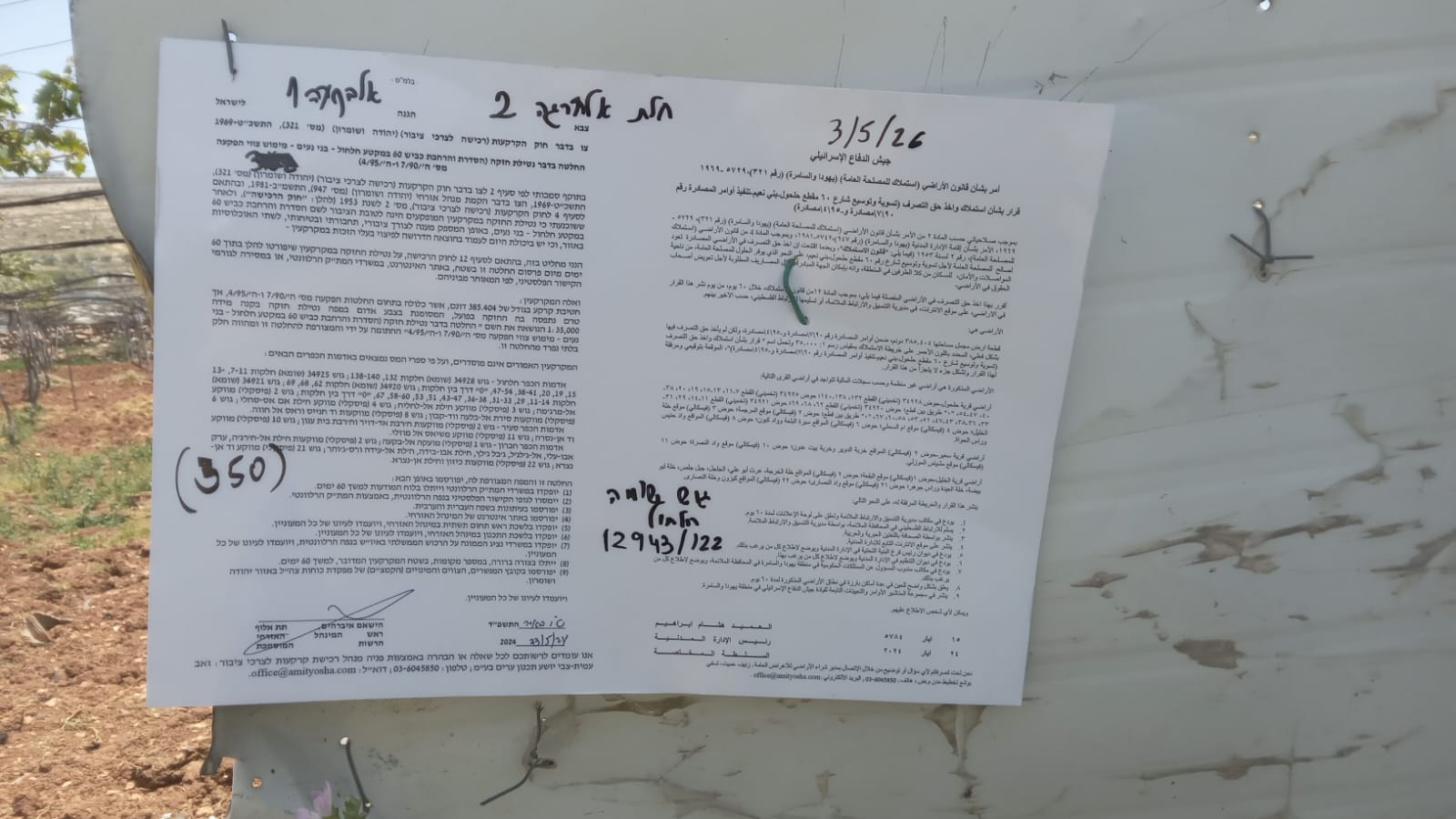 Muhammad D.May-13-2026Hebron - Request for compensation for land expropriation
-
South Hebron Hills
See all reports for this place-
South Hebron Hills
South Hebron Hills is a large area in the West Bank's southern part.
Yatta is a major city in this area: right in the border zone between the fertile region of Hebron and its surroundings and the desert of the Hebron Hills. Yatta has about 64,000 inhabitants.
The surrounding villages are called Masafer Yatta (Yatta's daughter villages). Their inhabitants subsist on livestock and agriculture. Agriculture is possible only in small plots, especially near streams. Most of the area consists of rocky terraces.Since the beginning of the 1980s, many settlements have been established on the agricultural land cultivated by the Palestinians in the South Hebron Hills region: Carmel, Maon, Susia, Masadot Yehuda, Othniel, and more. Since the settlements were established and Palestinians cultivation areas have been reduced; the residents of the South Hebron Hills have been suffering from harassment by the settlers. Attempts to evict and demolish houses have continued, along with withholding water and electricity. The military and police usually refrain from intervening in violent incidents between settlers and Palestinians do not enforce the law when it comes to the investigation of extensive violent Jewish settlers. The harassment in the South Hebron Hills includes attacking and attempting to burn residential tents, harassing dogs, harming herds, and preventing access to pastures.
There are several checkpoints in the South Hebron Hills, on Routes 317 and 60. In most of them, no military presence is apparent, but rather an array of pillboxes monitor the villages. Roadblocks are frequently set up according to the settlers and the army's needs. These are located at the Zif Junction, the Dura-al Fawwar crossing, and the Sheep Junction at the southern entrance to Hebron.
Updated April 2022
 Muhammad D.Jul-13-2026Michal with O.
-