
Hebron, South Hebron Hills
This morning there are fewer soldiers along the road and the same goes for barricades. Quiet.
Hebron
The house of the Patriarchs is guarded by soldiers but children and shvisim (Jewish women’s religious head gear) are peeping from the windows.
The whole area is being filled with fences and checkpoints. The Pharmacy checkpoint is not enough. This is the checkpoint through which all the elderly women, teachers and children of two schools have to make their daily way. The two schools are Al-Fayeha for the girls on the left of the House of the Patriarch and Al-Ibrahimeyya for boys on the right. Now so as to guard the lords of the land who are stuck in the middle as a bone in the throat and people will have to face an even greater hell than before.
The continuation of the story and video of the Shaharbati family
As we remember before at the beginning of Ramadan the video was taken from the family. The police who were called in took the easy way out and took the cameras on which were recorded the TIPH people puncturing the tires of the settlers at Beit Hadassah. The family was told by the soldiers that these would be returned after two days for their own safety. The brothers waited and now that a month has gone past they asked for our help.
We got a power of attorney from them and went to the Hebron police.
At the gate the Bnei Menashe the guard was polite, questions us as to why we have come and phones and says that there is a public relations unit. Boris, the policeman was polite and pleasant and when he heard what he heard and explained what he explained phoned the investigating officer who sounds by his name to be a Druze. After a short interval his honour invited us to his room.
The VCR video is on his table. The complaint by the woman settler is taped to it.
“I phoned her two weeks ago and she has not replied. I wanted to return the video to her”, he says
“But you took it from the Shaharabti family” I say and he does not reply. His reply is that of the right hand which does not know what the left hand has done. “I thought it was theirs”.
“Your friends, the other policemen were at the home of the family and took it from them. You were called in by the settler woman but the evidence which you collected came from their neighbor, the Palestinians.“ This I explain to him.
“Aha, Aha” the polite policeman replied. Write and signs, writes and signs and gives me the video.
We thanks most heartily all the Hebron policemen who are concerned in the matter. They were prepared to return it after two weeks but did not know to whom. But they were polite and pleasant and cooperative.
“Why did they not come themselves to fetch it”? This they ask. “The question is why did you not return as promised.”
“Maybe they are scared”? I ask.
“Nonsense”, says the pleasant policeman.
We happily gave back the video to the owners. He connected it again. Everything is working properly and will continue to record the abuse opposite the house which is documented by the VCR.
So what do we have here? The settlers do not want the organization of the United Nations to show what they are doing to the Palestinians. There have been confrontations. The Palestinians record everything that they can.
The Israeli police is called in by the thieving Cosacks. No one is arrested and they do not deal with the problems although they use the Palestinian cameras to see what is happening. And in the end they want to return the cameras to the settlers.
I hope I have reported this correctly.’
How does one show the surrealism. I do not know. This is Hebron.

Hebron
See all reports for this place-
According to Wye Plantation Accords (1997), Hebron is divided in two: H1 is under Palestinian Authority control, H2 is under Israeli control. In Hebron there are 170,000 Palestinian citizens, 60,000 of them in H2. Between the two areas are permanent checkpoints, manned at all hours, preventing Palestinian movement between them and controlling passage of permit holders such as teachers and schoolchildren. Some 800 Jews live in Avraham Avinu Quarter and Tel Rumeida, on Givat HaAvot and in the wholesale market.
Checkpoints observed in H2:
- Bet Hameriva CP- manned with a pillbox
- Kapisha quarter CP (the northern side of Zion axis) - manned with a pillbox
- The 160 turn CP (the southern side of Zion axis) - manned with a pillbox
- Avraham Avinu quarter - watch station
- The pharmacy CP - checking inside a caravan with a magnometer
- Tarpat (1929) CP - checking inside a caravan with a magnometer
- Tel Rumeida CP - guarding station
- Beit Hadassah CP - guarding station
Three checkpoints around the Tomb of the Patriarchs
 Raya YeorDec-18-2025Hebron - Yusri Jaber and part of his family
-
South Hebron Hills
See all reports for this place-
South Hebron Hills
South Hebron Hills is a large area in the West Bank's southern part.
Yatta is a major city in this area: right in the border zone between the fertile region of Hebron and its surroundings and the desert of the Hebron Hills. Yatta has about 64,000 inhabitants.
The surrounding villages are called Masafer Yatta (Yatta's daughter villages). Their inhabitants subsist on livestock and agriculture. Agriculture is possible only in small plots, especially near streams. Most of the area consists of rocky terraces.Since the beginning of the 1980s, many settlements have been established on the agricultural land cultivated by the Palestinians in the South Hebron Hills region: Carmel, Maon, Susia, Masadot Yehuda, Othniel, and more. Since the settlements were established and Palestinians cultivation areas have been reduced; the residents of the South Hebron Hills have been suffering from harassment by the settlers. Attempts to evict and demolish houses have continued, along with withholding water and electricity. The military and police usually refrain from intervening in violent incidents between settlers and Palestinians do not enforce the law when it comes to the investigation of extensive violent Jewish settlers. The harassment in the South Hebron Hills includes attacking and attempting to burn residential tents, harassing dogs, harming herds, and preventing access to pastures.
There are several checkpoints in the South Hebron Hills, on Routes 317 and 60. In most of them, no military presence is apparent, but rather an array of pillboxes monitor the villages. Roadblocks are frequently set up according to the settlers and the army's needs. These are located at the Zif Junction, the Dura-al Fawwar crossing, and the Sheep Junction at the southern entrance to Hebron.
Updated April 2022
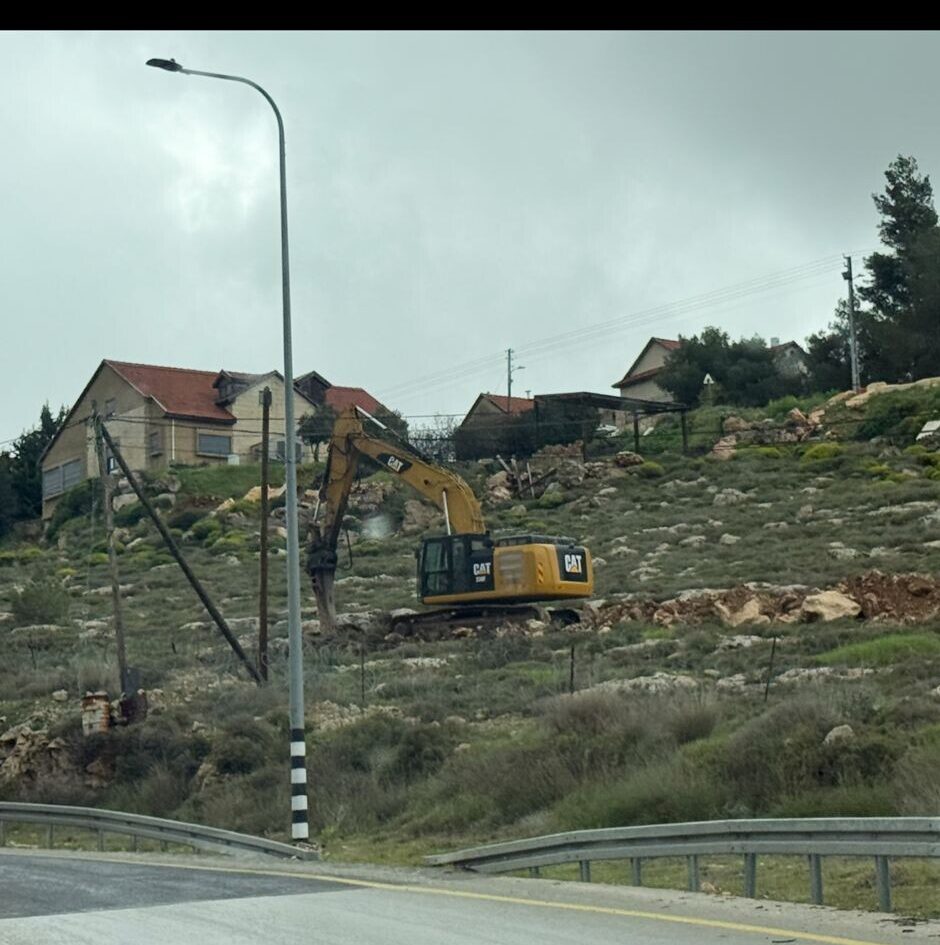 MuhammadFeb-24-2026South Hebron Hill, Beit Hagai: Paving an internal security road
-