
Hebron, South Hebron Hills
On road 60 we saw nothing new.
We met our friends at the Cave of the Patriarchs.
We first went to the house of Rubhi, an old friend who lives near the cave. We went to his house through the Muslim entrance. He and his family greeted us with great happiness and insisted we stay to lunch.
After that we went to meet Abu Aysha. It was important to be there after the horrific happenings of the last two weeks, both with the soldiers and with the settlers.
Because he had told of his historic friendship with the Ezra family, Irit asked to meet him and to tell him of her family connections with this family and to hear from him again on the old ties with the Jews of Hebron in 1948.
Before we went in we met Baruch Marzel. Afterwards we learned why.
This “beautiful” man met us with the words, “Tell me, why are all you women from Machsomwatch so ugly?” Ariela asked if he had a mirror in his home and I told him that he was a ugly inside as outside. At least after that he shut up.
When we were sitting in the house exactly next to the post of the soldiers at Tel Rumeida we heard a lot of noise. Abu Aysha thought that the settlers had heard that we were there and were gathering and that the soldiers had come to prevent anything happening. But at the end of the visit it appeared that we were not the important people there at that date.
Elor Azaria with a gathering of his followers had been invited with great honour to visit site of his criminal act. And we saw them at the ascent to Tel Rumeida. Many very tense soldiers were three and also an ambulance for safety’s sake, also Ofer Ohana of course, who cursed Imad, the photographer of B’tselem. This is how the narrative of their heroism is being built.
I hope that the Ministry of education under the administration of Naftali Bennett will not add this story to the new educational curriculum.
On our way back at the welded floor of the house of the Zehira family there was new graffiti:
“The house of Kalev ben Yefune will be evacuated. Arabs entered into this house illegally.”

Hebron
See all reports for this place-
According to Wye Plantation Accords (1997), Hebron is divided in two: H1 is under Palestinian Authority control, H2 is under Israeli control. In Hebron there are 170,000 Palestinian citizens, 60,000 of them in H2. Between the two areas are permanent checkpoints, manned at all hours, preventing Palestinian movement between them and controlling passage of permit holders such as teachers and schoolchildren. Some 800 Jews live in Avraham Avinu Quarter and Tel Rumeida, on Givat HaAvot and in the wholesale market.
Checkpoints observed in H2:
- Bet Hameriva CP- manned with a pillbox
- Kapisha quarter CP (the northern side of Zion axis) - manned with a pillbox
- The 160 turn CP (the southern side of Zion axis) - manned with a pillbox
- Avraham Avinu quarter - watch station
- The pharmacy CP - checking inside a caravan with a magnometer
- Tarpat (1929) CP - checking inside a caravan with a magnometer
- Tel Rumeida CP - guarding station
- Beit Hadassah CP - guarding station
Three checkpoints around the Tomb of the Patriarchs
 Raya YeorDec-18-2025Hebron - Yusri Jaber and part of his family
-
South Hebron Hills
See all reports for this place-
South Hebron Hills
South Hebron Hills is a large area in the West Bank's southern part.
Yatta is a major city in this area: right in the border zone between the fertile region of Hebron and its surroundings and the desert of the Hebron Hills. Yatta has about 64,000 inhabitants.
The surrounding villages are called Masafer Yatta (Yatta's daughter villages). Their inhabitants subsist on livestock and agriculture. Agriculture is possible only in small plots, especially near streams. Most of the area consists of rocky terraces.Since the beginning of the 1980s, many settlements have been established on the agricultural land cultivated by the Palestinians in the South Hebron Hills region: Carmel, Maon, Susia, Masadot Yehuda, Othniel, and more. Since the settlements were established and Palestinians cultivation areas have been reduced; the residents of the South Hebron Hills have been suffering from harassment by the settlers. Attempts to evict and demolish houses have continued, along with withholding water and electricity. The military and police usually refrain from intervening in violent incidents between settlers and Palestinians do not enforce the law when it comes to the investigation of extensive violent Jewish settlers. The harassment in the South Hebron Hills includes attacking and attempting to burn residential tents, harassing dogs, harming herds, and preventing access to pastures.
There are several checkpoints in the South Hebron Hills, on Routes 317 and 60. In most of them, no military presence is apparent, but rather an array of pillboxes monitor the villages. Roadblocks are frequently set up according to the settlers and the army's needs. These are located at the Zif Junction, the Dura-al Fawwar crossing, and the Sheep Junction at the southern entrance to Hebron.
Updated April 2022
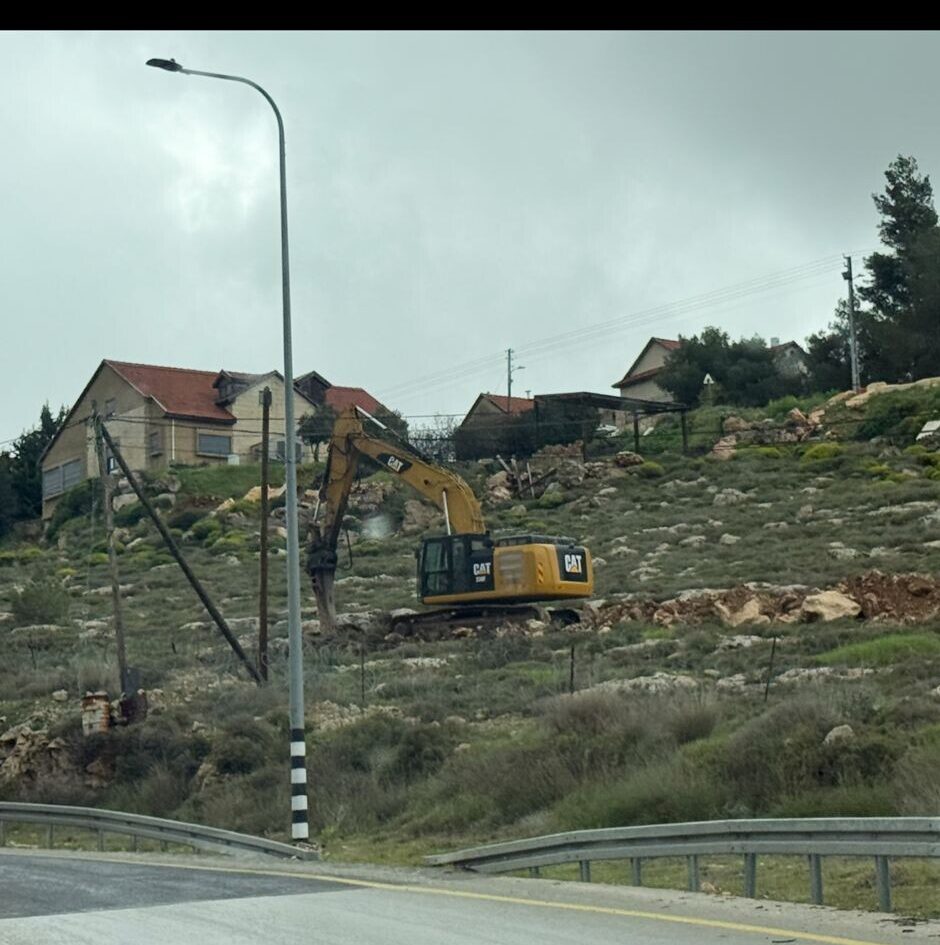 MuhammadFeb-24-2026South Hebron Hill, Beit Hagai: Paving an internal security road
-