
Hebron, South Hebron Hills, Mon 11.7.11, Morning
tran. by Charles K.
Meytar crossing
All the laborers have already crossed. The relatives of prisoners aren’t at the crossing either. Two buses on the Palestinian side.
Route 60
Light traffic on the road; few military vehicles as well.
An observation balloon in the air. A flying checkpoint at the entrance to Dahariyya. The army “strikes camp” when we arrive. We apparently showed up when the morning checkpoint was scheduled to close down.
A pillbox on the hill opposite Deir Razeh, observing the road to Neguhot. For months we’ve seen military bulldozers working there intensively.
They’re apparently expanding the emplacement, paving a road and…maybe more.
Otherwise, we don’t see any military activity anywhere. The summer heat and school vacation affect everything.
Hebron
The guard at the entrance to Kiryat Arba smiles as an old friend. “Have some water,” he says. “It’s hot today.” Given the location and the situation, we’re always surprised when someone behaves decently toward us.
The entire town is napping deeply. No detainees at the checkpoints. Relatively many settlers in many locations on Shuhadeh Street.
They always frighten us more than anything else, and we pass through the area quickly, without delays [particularly since no Palestinians are being harassed anywhere].
TIPH personnel are walking around for a change, and we see them speaking to people.
No other peace organizations are present.
Hebron
See all reports for this place-
According to Wye Plantation Accords (1997), Hebron is divided in two: H1 is under Palestinian Authority control, H2 is under Israeli control. In Hebron there are 170,000 Palestinian citizens, 60,000 of them in H2. Between the two areas are permanent checkpoints, manned at all hours, preventing Palestinian movement between them and controlling passage of permit holders such as teachers and schoolchildren. Some 800 Jews live in Avraham Avinu Quarter and Tel Rumeida, on Givat HaAvot and in the wholesale market.
Checkpoints observed in H2:
- Bet Hameriva CP- manned with a pillbox
- Kapisha quarter CP (the northern side of Zion axis) - manned with a pillbox
- The 160 turn CP (the southern side of Zion axis) - manned with a pillbox
- Avraham Avinu quarter - watch station
- The pharmacy CP - checking inside a caravan with a magnometer
- Tarpat (1929) CP - checking inside a caravan with a magnometer
- Tel Rumeida CP - guarding station
- Beit Hadassah CP - guarding station
Three checkpoints around the Tomb of the Patriarchs
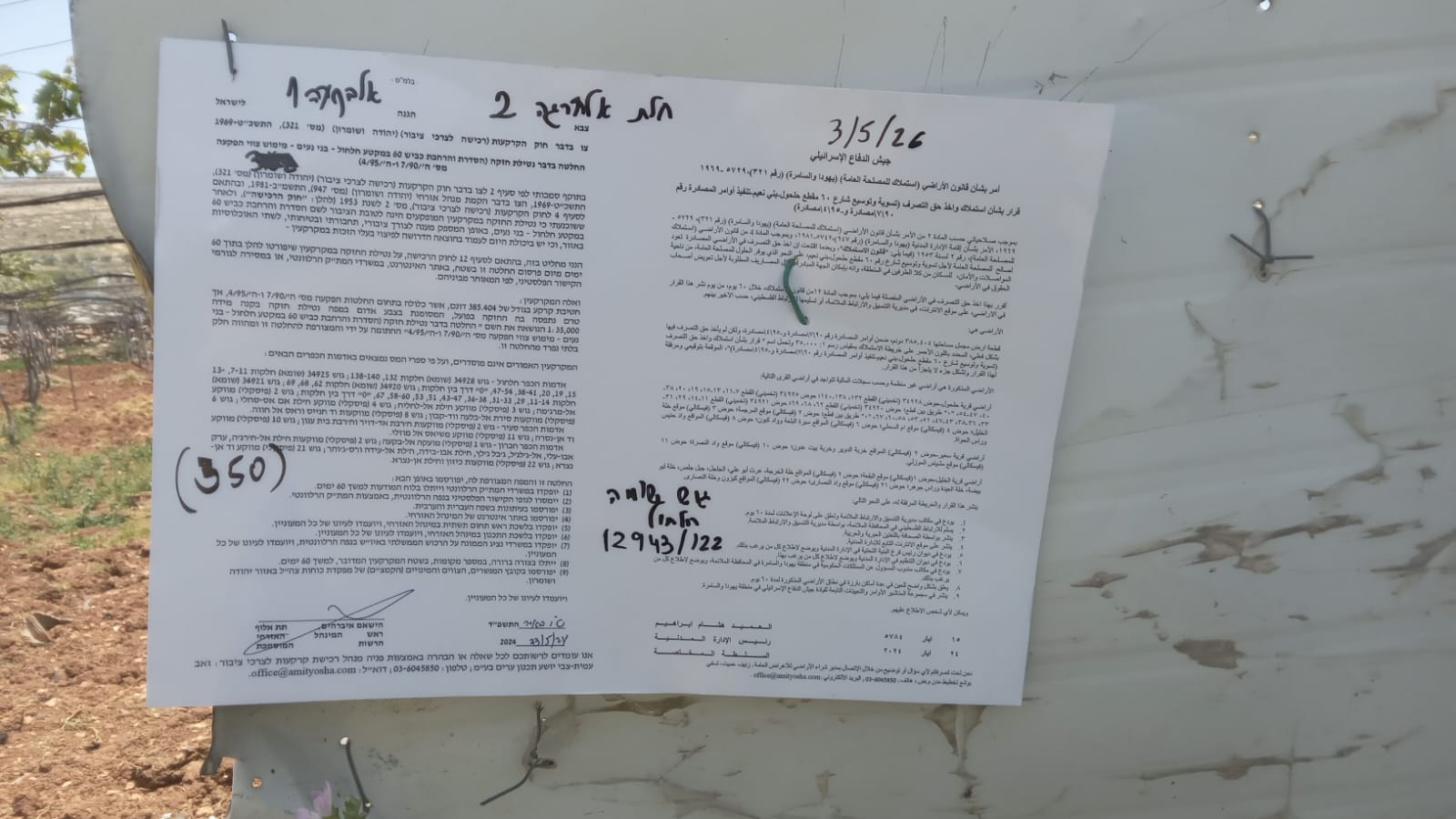 Muhammad D.May-13-2026Hebron - Request for compensation for land expropriation
-
South Hebron Hills
See all reports for this place-
South Hebron Hills
South Hebron Hills is a large area in the West Bank's southern part.
Yatta is a major city in this area: right in the border zone between the fertile region of Hebron and its surroundings and the desert of the Hebron Hills. Yatta has about 64,000 inhabitants.
The surrounding villages are called Masafer Yatta (Yatta's daughter villages). Their inhabitants subsist on livestock and agriculture. Agriculture is possible only in small plots, especially near streams. Most of the area consists of rocky terraces.Since the beginning of the 1980s, many settlements have been established on the agricultural land cultivated by the Palestinians in the South Hebron Hills region: Carmel, Maon, Susia, Masadot Yehuda, Othniel, and more. Since the settlements were established and Palestinians cultivation areas have been reduced; the residents of the South Hebron Hills have been suffering from harassment by the settlers. Attempts to evict and demolish houses have continued, along with withholding water and electricity. The military and police usually refrain from intervening in violent incidents between settlers and Palestinians do not enforce the law when it comes to the investigation of extensive violent Jewish settlers. The harassment in the South Hebron Hills includes attacking and attempting to burn residential tents, harassing dogs, harming herds, and preventing access to pastures.
There are several checkpoints in the South Hebron Hills, on Routes 317 and 60. In most of them, no military presence is apparent, but rather an array of pillboxes monitor the villages. Roadblocks are frequently set up according to the settlers and the army's needs. These are located at the Zif Junction, the Dura-al Fawwar crossing, and the Sheep Junction at the southern entrance to Hebron.
Updated April 2022
 Muhammad D.Sep-8-2026Closed Samu' checkpoint
-
