
Hebron, South Hebron Hills, Mon 29.11.10, Morning
Sansana-Meitar
At 6.45 only prisoners' families and a few men were still there, awaiting inspection. The gates opened at 6.50. Maran from the Red Cross said that Sansana is more efficient than Tarqumyia (although maybe last time he said the opposite.) Ali from the Palestinian DCO asked after Michal and told us that three checking windows were open that morning and that only Sunday is really bad. Seems it depends on who you talk to round here. The claim that the Palestinians should organize things around here, so as to prevent over-crowding is not really relevant: people come from all over the Southern West Bank, traveling for hours with many obstacles and flying checkpoints en route, so it is really impossible to coordinate their arrival. And of course, once they are already in line, there's overwhelming pressure to reach employers by 7am. The only real solution is, therefore – if checkpoint must be had – to open up more checking points/windows. Samir from the falafel tent will probably get his equipment back; if so, why take it in the first place? Well, because…
Route 60
At the entrance to Shamua soldiers are checking those entering. Dura Elfawwar is open. Soldiers stand at the turning just below Beit Hagai and at the entrance to the Industrial Zone.
Hebron
After our routine tour, and the traditional stop-over at Abed's, we decided to take our guests on foot along the Worshippers Way. Outside one of the houses we encountered a patrol of 5-6 soldiers seeking entry into one of the houses. We stopped to observe, hearing a woman's voice and some children from within. One of the TIPH people arrived, ignored us and went on to fetch reinforcement. Meanwhile, the patrol's commander went in search of the home owner, who duly arrived and invited the soldiers in. TIPHers and we in their wake followed. It appears the house overlooks (if you crane-stretch your neck and risk death by falling) the Worshippers Way and so, is convenient for targeting (Jewish) passers by. The soldiers examined the view and left, as did the TIPH people.
We remained with the Jaber family who told us they are eleven souls, two brothers and their wives and children. Every shabbat they have (uninvited) guests in the shape of IDF soldiers who close them in the bedroom, forbid them to use the bathroom or take food and then leave, leaving a mess behind. When we saw, the house was spotlessly clean, but in very poor repair: damp on the ceiling and peeling paint. The owner told us that he would repair it but is forbidden to do so by the Civil Administration/army (not clear which).
We gave them the phone no. of the Center for the Defence of the Indidivual (Moked), with a warning that there is not much that can be done. Details have also been passed on to Hanna Barag and Michal Tzadik (MW), though it is doubtful that anything can be done to help here. One just hopes that the Jabers won't find their balcony closed off one day, leaving them with no light in their living room and kitchen. Had we not been there would the soldiers have burst into the house instead of waiting patiently? Hard to tell. A day in the life of a Palestinian family.
Hebron
See all reports for this place-
According to Wye Plantation Accords (1997), Hebron is divided in two: H1 is under Palestinian Authority control, H2 is under Israeli control. In Hebron there are 170,000 Palestinian citizens, 60,000 of them in H2. Between the two areas are permanent checkpoints, manned at all hours, preventing Palestinian movement between them and controlling passage of permit holders such as teachers and schoolchildren. Some 800 Jews live in Avraham Avinu Quarter and Tel Rumeida, on Givat HaAvot and in the wholesale market.
Checkpoints observed in H2:
- Bet Hameriva CP- manned with a pillbox
- Kapisha quarter CP (the northern side of Zion axis) - manned with a pillbox
- The 160 turn CP (the southern side of Zion axis) - manned with a pillbox
- Avraham Avinu quarter - watch station
- The pharmacy CP - checking inside a caravan with a magnometer
- Tarpat (1929) CP - checking inside a caravan with a magnometer
- Tel Rumeida CP - guarding station
- Beit Hadassah CP - guarding station
Three checkpoints around the Tomb of the Patriarchs
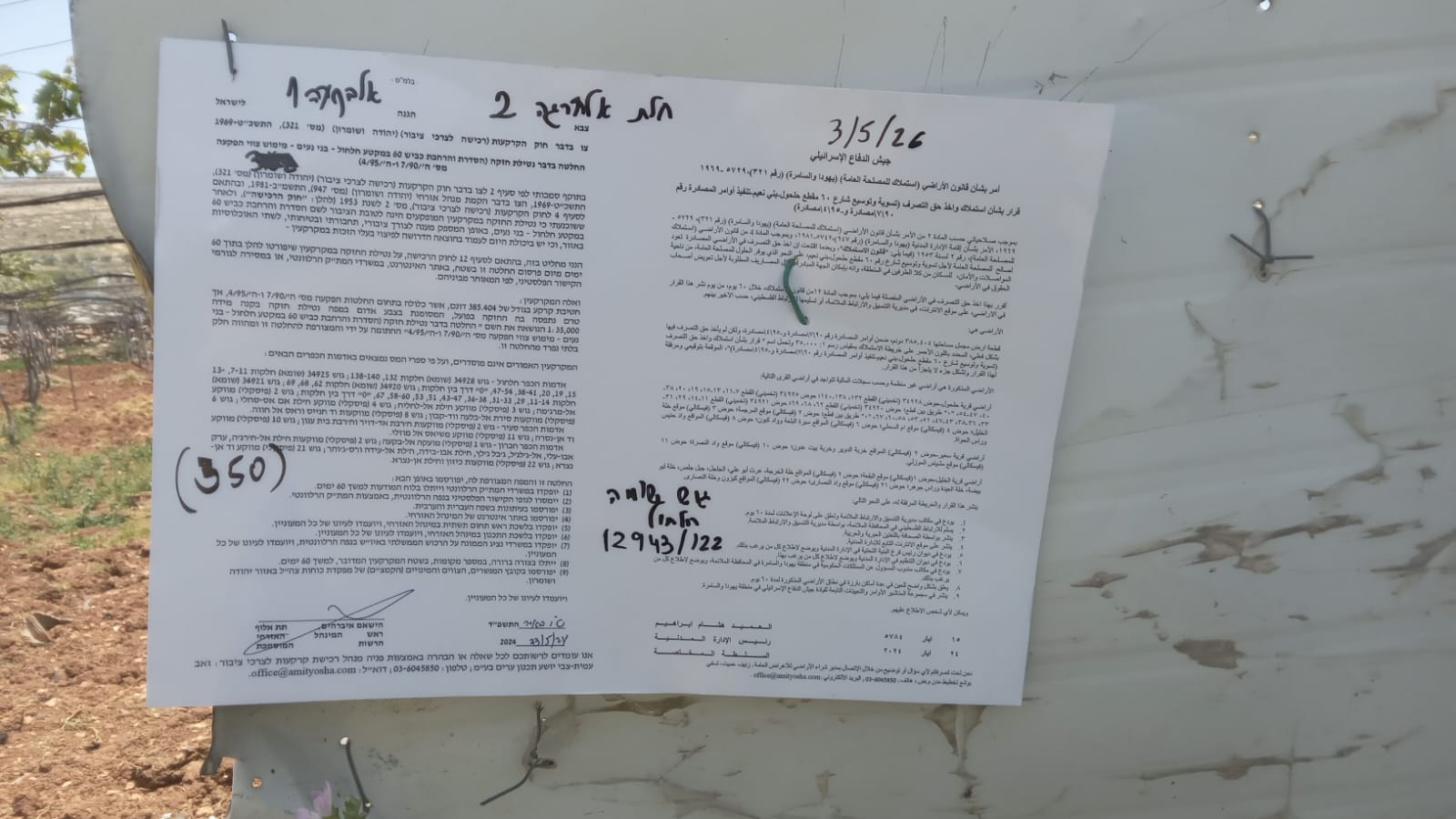 Muhammad D.May-13-2026Hebron - Request for compensation for land expropriation
-
South Hebron Hills
See all reports for this place-
South Hebron Hills
South Hebron Hills is a large area in the West Bank's southern part.
Yatta is a major city in this area: right in the border zone between the fertile region of Hebron and its surroundings and the desert of the Hebron Hills. Yatta has about 64,000 inhabitants.
The surrounding villages are called Masafer Yatta (Yatta's daughter villages). Their inhabitants subsist on livestock and agriculture. Agriculture is possible only in small plots, especially near streams. Most of the area consists of rocky terraces.Since the beginning of the 1980s, many settlements have been established on the agricultural land cultivated by the Palestinians in the South Hebron Hills region: Carmel, Maon, Susia, Masadot Yehuda, Othniel, and more. Since the settlements were established and Palestinians cultivation areas have been reduced; the residents of the South Hebron Hills have been suffering from harassment by the settlers. Attempts to evict and demolish houses have continued, along with withholding water and electricity. The military and police usually refrain from intervening in violent incidents between settlers and Palestinians do not enforce the law when it comes to the investigation of extensive violent Jewish settlers. The harassment in the South Hebron Hills includes attacking and attempting to burn residential tents, harassing dogs, harming herds, and preventing access to pastures.
There are several checkpoints in the South Hebron Hills, on Routes 317 and 60. In most of them, no military presence is apparent, but rather an array of pillboxes monitor the villages. Roadblocks are frequently set up according to the settlers and the army's needs. These are located at the Zif Junction, the Dura-al Fawwar crossing, and the Sheep Junction at the southern entrance to Hebron.
Updated April 2022
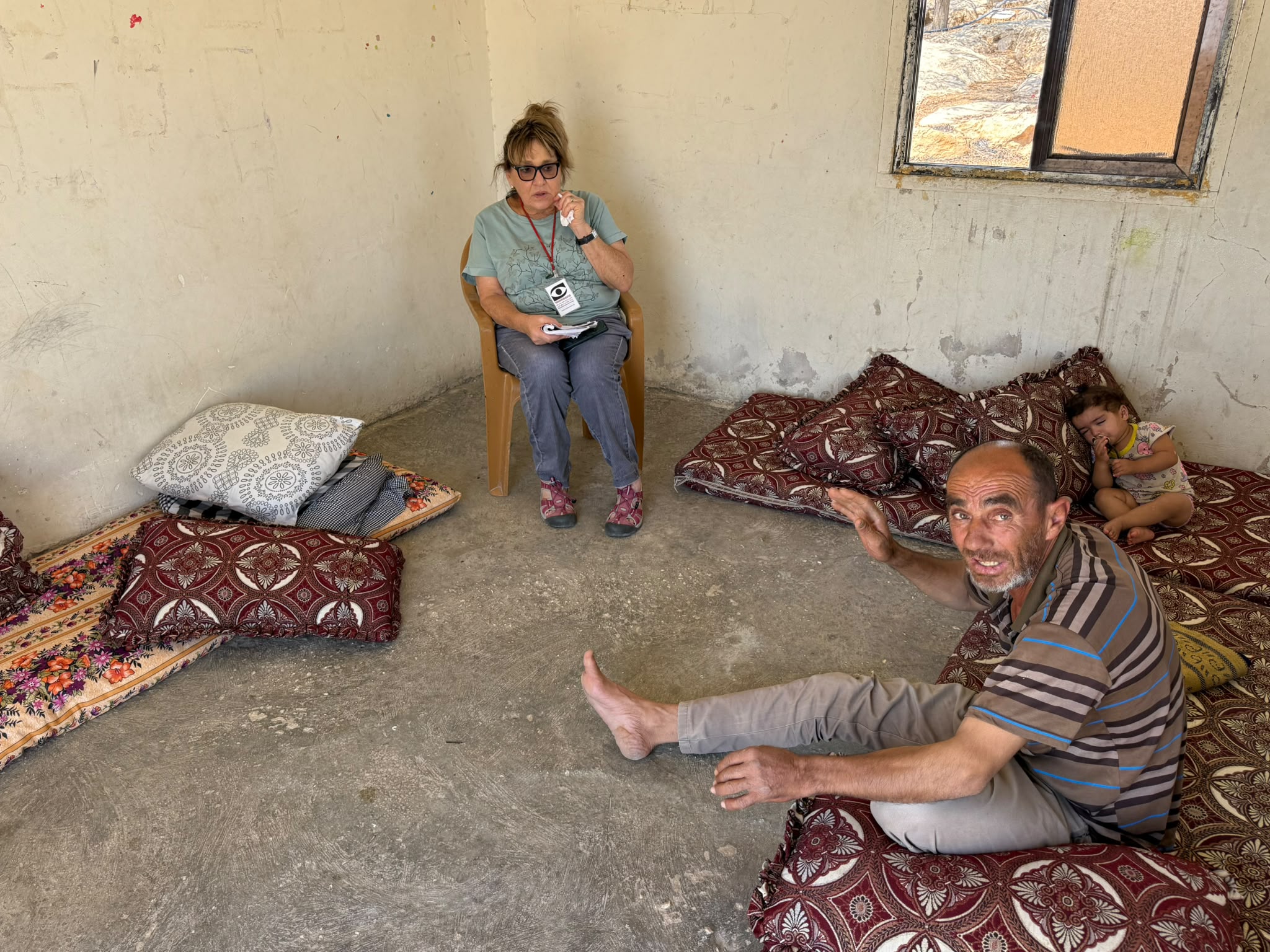 Muhammad D.Sep-14-2026Mufaqara - Fadel tells about the events of Saturday 12.9
-
