
Hebron, South Hebron Hills, Tue 20.8.13, Morning
09:30 – 13:00
Highway 60
The road to Hebron is quiet and “boring.” The observation balloon floats over Beit Haggai. Work is proceeding apace in preparation for opening the checkpoint there; trucks are on site. The pillbox next to the locality has been renovated; it’s now more visible.
We see a military vehicle only at the roadblock opposite Bani Na’im. That used to be the southern entrance to Hebron.
Hebron
We decide to visit Az’am. He wonders what happened to Muhammad. There’s a customer at the metal shop, a tall man dressed in black, looking as if he belongs to some extreme ultra-Orthodox group. He walks around the workshop, conversing fluently in Arabic. A real friend. They’re making something for him. He followed us into Az’am’s office.
He happily introduced himself, asked who we were. I have no choice: I have to set aside my initial impression and my automatic reaction when I see someone like this buying from Palestinians.
“Hello,” he says. “Welcome! I’m David, I live in Kiryat Arba, I’m friends with everyone, believe in dialogue and coexistence.” He keeps talking, answers questions we hadn’t yet asked. “I have ‘diplomatic immunity’ in Hebron and in Arab countries. People contact me to solve disputes; the situation here is improving. The majority of Jews and Arabs live peacefully with one another; I believe it won’t be long before there’ll be coexistence.”
“Do you know Anat Cohen?”
“Of course; she curses me, calls me a traitor,” he says with a grin.
“Do you know Ofer Ohana?”
“Of course; he’s beginning to change his mind,” he says.
“Do you know Malachi Levinger?”
“He’s one of the moderates who’s adopting my approach,” he replies.
“So what have you to say about his behavior in Ata Jabar’s field, when he brought his children with hoes to uproot Jabar’s seedlings?”
He looks embarrassed. “You should know there’s a difference between what you see and what that person really thinks.” The benevolent expression returns, a speech about respecting every person, no matter who he is, about being opposed to violence toward anyone. “I’m friends with everyone, and I’m not the only one like that here. There are many of us; I visit Az’am and his family at home; they visit us in Kiryat Arba.”
“Do many Jews here think like you?”
“Yes,” he says, “the majority. Extremists like Anat are in the minority here, they’re just louder.”
We asked Az’am what he thinks. His answer was vague, polite, like someone who’s learned what it takes to survive. He’s smiling, gentle, good-hearted. He radiates an alluring humanity. “People here call me ‘Sheikh Daoud,” David adds. “I do only mitzvahs and good deeds. I also have a small winery in Kiryat Arba – ‘David’s Harp.’” “Where do you get the grapes,” I ask. “From the Galilee and the Golan Heights; I don’t want grapes from disputed land. I sell to stores throughout the country. Much goes to charity, organizations that provide food to the needy for the holidays, aid to families…there’s no shortage of work.”
He doesn’t stop smiling, his eyes are beaming. His sparse black beard conceals the face of a young man. He didn’t want to be photographed. We said goodbye to one another.
Netanya sums it up: “We’ve never met someone like that.”
Hebron
See all reports for this place-
According to Wye Plantation Accords (1997), Hebron is divided in two: H1 is under Palestinian Authority control, H2 is under Israeli control. In Hebron there are 170,000 Palestinian citizens, 60,000 of them in H2. Between the two areas are permanent checkpoints, manned at all hours, preventing Palestinian movement between them and controlling passage of permit holders such as teachers and schoolchildren. Some 800 Jews live in Avraham Avinu Quarter and Tel Rumeida, on Givat HaAvot and in the wholesale market.
Checkpoints observed in H2:
- Bet Hameriva CP- manned with a pillbox
- Kapisha quarter CP (the northern side of Zion axis) - manned with a pillbox
- The 160 turn CP (the southern side of Zion axis) - manned with a pillbox
- Avraham Avinu quarter - watch station
- The pharmacy CP - checking inside a caravan with a magnometer
- Tarpat (1929) CP - checking inside a caravan with a magnometer
- Tel Rumeida CP - guarding station
- Beit Hadassah CP - guarding station
Three checkpoints around the Tomb of the Patriarchs
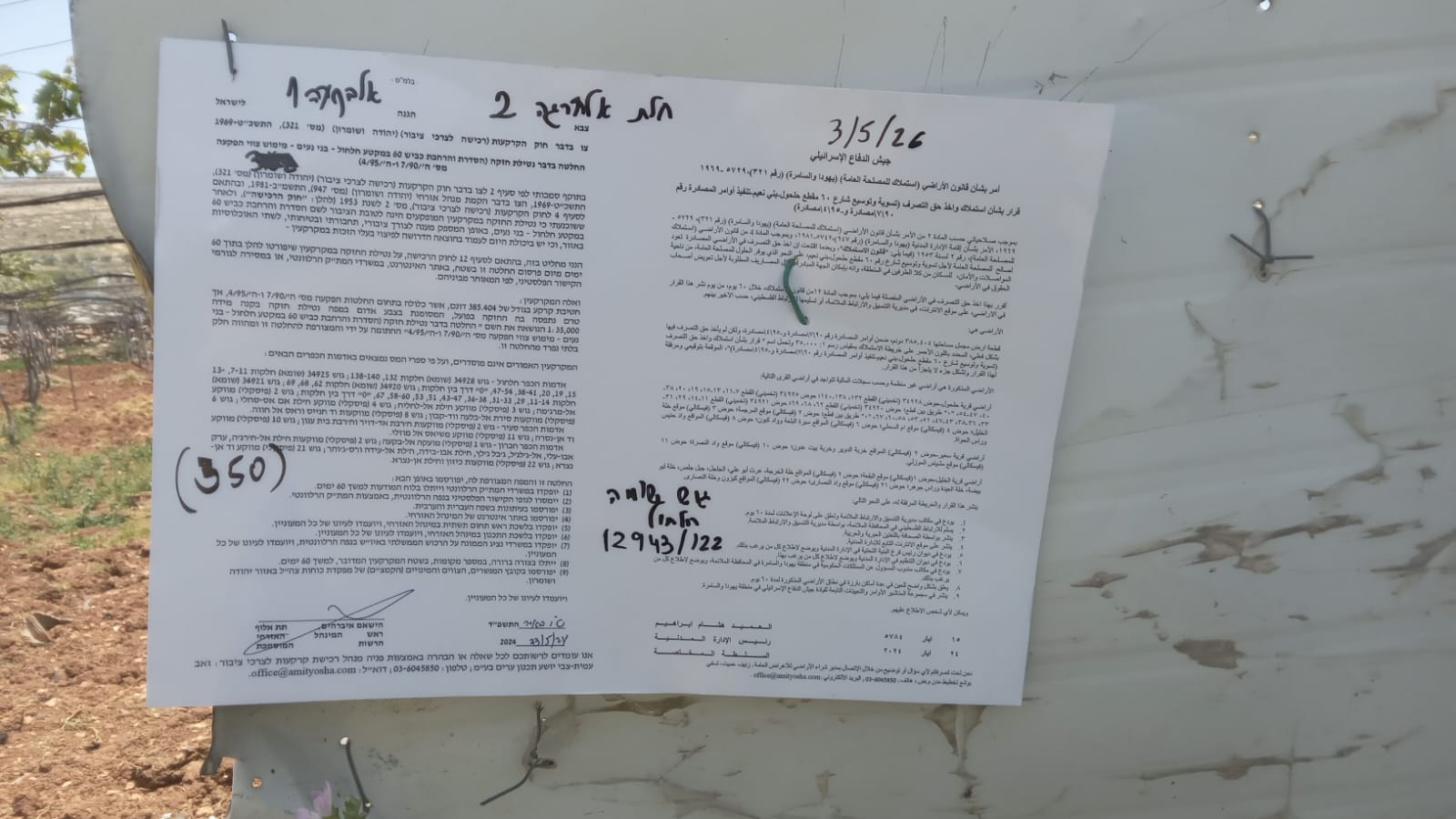 Muhammad D.May-13-2026Hebron - Request for compensation for land expropriation
-
South Hebron Hills
See all reports for this place-
South Hebron Hills
South Hebron Hills is a large area in the West Bank's southern part.
Yatta is a major city in this area: right in the border zone between the fertile region of Hebron and its surroundings and the desert of the Hebron Hills. Yatta has about 64,000 inhabitants.
The surrounding villages are called Masafer Yatta (Yatta's daughter villages). Their inhabitants subsist on livestock and agriculture. Agriculture is possible only in small plots, especially near streams. Most of the area consists of rocky terraces.Since the beginning of the 1980s, many settlements have been established on the agricultural land cultivated by the Palestinians in the South Hebron Hills region: Carmel, Maon, Susia, Masadot Yehuda, Othniel, and more. Since the settlements were established and Palestinians cultivation areas have been reduced; the residents of the South Hebron Hills have been suffering from harassment by the settlers. Attempts to evict and demolish houses have continued, along with withholding water and electricity. The military and police usually refrain from intervening in violent incidents between settlers and Palestinians do not enforce the law when it comes to the investigation of extensive violent Jewish settlers. The harassment in the South Hebron Hills includes attacking and attempting to burn residential tents, harassing dogs, harming herds, and preventing access to pastures.
There are several checkpoints in the South Hebron Hills, on Routes 317 and 60. In most of them, no military presence is apparent, but rather an array of pillboxes monitor the villages. Roadblocks are frequently set up according to the settlers and the army's needs. These are located at the Zif Junction, the Dura-al Fawwar crossing, and the Sheep Junction at the southern entrance to Hebron.
Updated April 2022
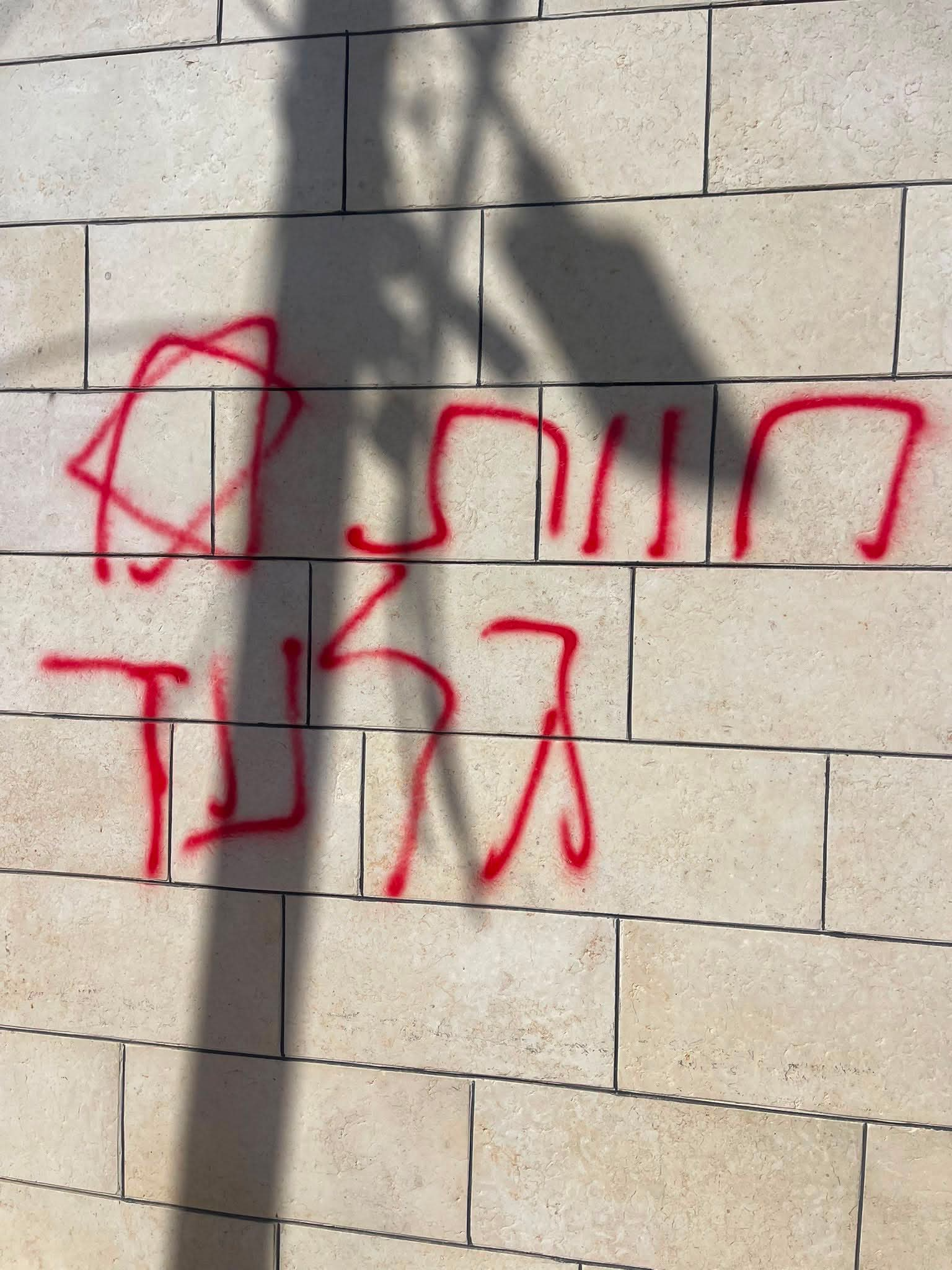 A Palestinian residentJul-19-2026Graffiti sprayed in A-Tuwani
-