
Hebron, South Hebron Hills, Tue 21.6.11, Morning
Guests: Shahar, Pu’ah and Arye
Translator: Charles K.
day of despair, even more than usual.
Meitar crossing
The Palestinian side is empty at this time, except for peddlers and people who aren’t allowed to enter Israel – it’s not clear why they keep coming.
There’s a lot of mess and filth everywhere.
As soon as we arrive, people approach us with notices from the police and from the Shin Bet that they’re not allowed to enter Israel and ask for our assistance. We again explain that Sylvia will try to help them if they send her all the relevant documents. Another referral to Chaya Ofek, and again we think there may be some people whom we can help to some degree.
Route 317
We decided to visit two sad, despairing places: the first, people living next to the settlement of Sussia, the second, the residents of Bir el Eid, at the foot of Ya’akov Talya’s farm and the illegal settlement of Mizpeh Ya’ir.
Sussiya
Tents and sheds belonging to people who have deeds to the land dating from the Turkish period are scattered next to the attractive, thriving settlement.
Civil Administration personnel know about these deeds, and ignore them. They’re permitting the settlers to abuse and harass these people, preventing them from grazing their flocks, plowing, planting, etc.
We sat in the tents’ shade. The women smile and serve tea made with water from one of the jerrycans in which a little water is stored. “The owner,” in excellent Hebrew learned during 25 years working in Israel, tells us for the umpteenth time about his conflicts with the settlers, the police and the army, who always show up after the settlers have already plowed (at 1 AM), and “seem” to separate the sides and calm things down. An “Israelbluff,” for the glory of the state of Israel. “Look at the electrical cables,” he says to us. “Look at the water pipes, all of them pass right by me and I’m not allowed to touch them, I can’t use them. I can’t obtain electricity or water.” A few almond trees and grape vines are planted next to olive groves and hothouses. A small pen of goats, which also contains chickens, rabbits and doves, all of them gathered together, faint from the heat. All the “residences” look the same, all are the same size, the ones for people as well as those for animals. Staff from the Villages Group and international organizations installed wind turbines and photoelectric solar cells to generate electricity for the residents. The poles carrying high-tension lines through their land provide electricity only to the “lords of the land.” These inhabitants are “transparent.” Suddenly police and military vehicles arrive. The man we’re speaking with apologizes and hurries to talk with them. “They came because I called them,” he says. “Yesterday we were attacked again; they tried to expel us.” We might be in the way. We leave.
Bir el Eid
Approximately 90 people live in tents scattered in the valley between Mitzpeh Ya’ir (an illegal outpost) and Ya’akov Talya’s farm. They say they’re only allowed to live in the caves. They’re not permitted to erect a single tent or shack. But the caves are small, and not appropriate for human habitation, so they’ve used cloth sheeting to erect tent-like structures. Between 2009 and yesterday they’ve received 17 warning notices. Their case is being handled by attorneys with the help of Rabbis for Human Rights. The Civil Administration, knowing that the court will issue an order forbidding demolition until it reaches a decision, beat it by a day, and yesterday backhoes, bulldozers, soldiers and civilians arrived, demolished the structures and removed everything of value. We saw the injunction, which came a few hours too late… The Red Cross arrived, provided thin white tents, mattresses, water, etc. There – the encampment exists once again. They say the tents aren’t appropriate for the weather or for their needs. We hope they’ll be able to get their goods back. A list of what was taken has been given to the attorneys.
The inhabitants recount the brutal behavior of those who removed them, Civil Administration personnel and the army. Again the same sight, Ya’akov Talya, his wife, his four children and his mother on the hill above, seven people living in attractive buildings. His large barn and stables are visible, the water pipe leading to the compound, and the electrical pole. Until someone decides otherwise, he gets everything a person needs. The same is true at Mitzpeh Ya’ir, they have everything they need, while their neighbors are entitled to nothing. Our hosts ask, “That all happened yesterday, and it wasn’t on the news?! Wasn’t in the paper?” Why should it be in the paper?! Had one of those being thrown out defended themselves by attacking a soldier, “they” would have been written and published about. But who cares about “them”?
We feel very ashamed and despairing, promise to write about it and publicize it as best we can. That’s what it’s like in the southern Hebron hills, arbitrariness and evil, arrogance and obtuseness.
Hebron
Construction of the magnificent “Derekh HaBanim” at the entrance to Kiryat Arba has been completed, as well as the Nofei Mamreh neighborhood.
Signs of life again at Mitzpeh Avihai on the hill to the right.
We also see adults and children again moving around at the Federman farm.
The Giv’ati soldiers have left. Flags of the Kfir regiment wave in the wind.
Many tourists at both entrances to the Cave of the Patriarchs.
A large group of soldiers on Shuhada Street – the younger members of the regiment – leaving the historical museum of the Hebron Jewish community. They heard explanations that will help them to better serve the homeland.
We wonder whether anyone also explains to them why the street is deserted and why all the shops are closed.
Border Police soldiers man all the checkpoints near the Cave of the Patriarchs. They stop people briefly and immediately let them through. A guy with a watermelon at Curve 160 – both are inspected. The watermelon is also ok. Soldiers man the other checkpoints. Everything seems quiet.
Hebron
See all reports for this place-
According to Wye Plantation Accords (1997), Hebron is divided in two: H1 is under Palestinian Authority control, H2 is under Israeli control. In Hebron there are 170,000 Palestinian citizens, 60,000 of them in H2. Between the two areas are permanent checkpoints, manned at all hours, preventing Palestinian movement between them and controlling passage of permit holders such as teachers and schoolchildren. Some 800 Jews live in Avraham Avinu Quarter and Tel Rumeida, on Givat HaAvot and in the wholesale market.
Checkpoints observed in H2:
- Bet Hameriva CP- manned with a pillbox
- Kapisha quarter CP (the northern side of Zion axis) - manned with a pillbox
- The 160 turn CP (the southern side of Zion axis) - manned with a pillbox
- Avraham Avinu quarter - watch station
- The pharmacy CP - checking inside a caravan with a magnometer
- Tarpat (1929) CP - checking inside a caravan with a magnometer
- Tel Rumeida CP - guarding station
- Beit Hadassah CP - guarding station
Three checkpoints around the Tomb of the Patriarchs
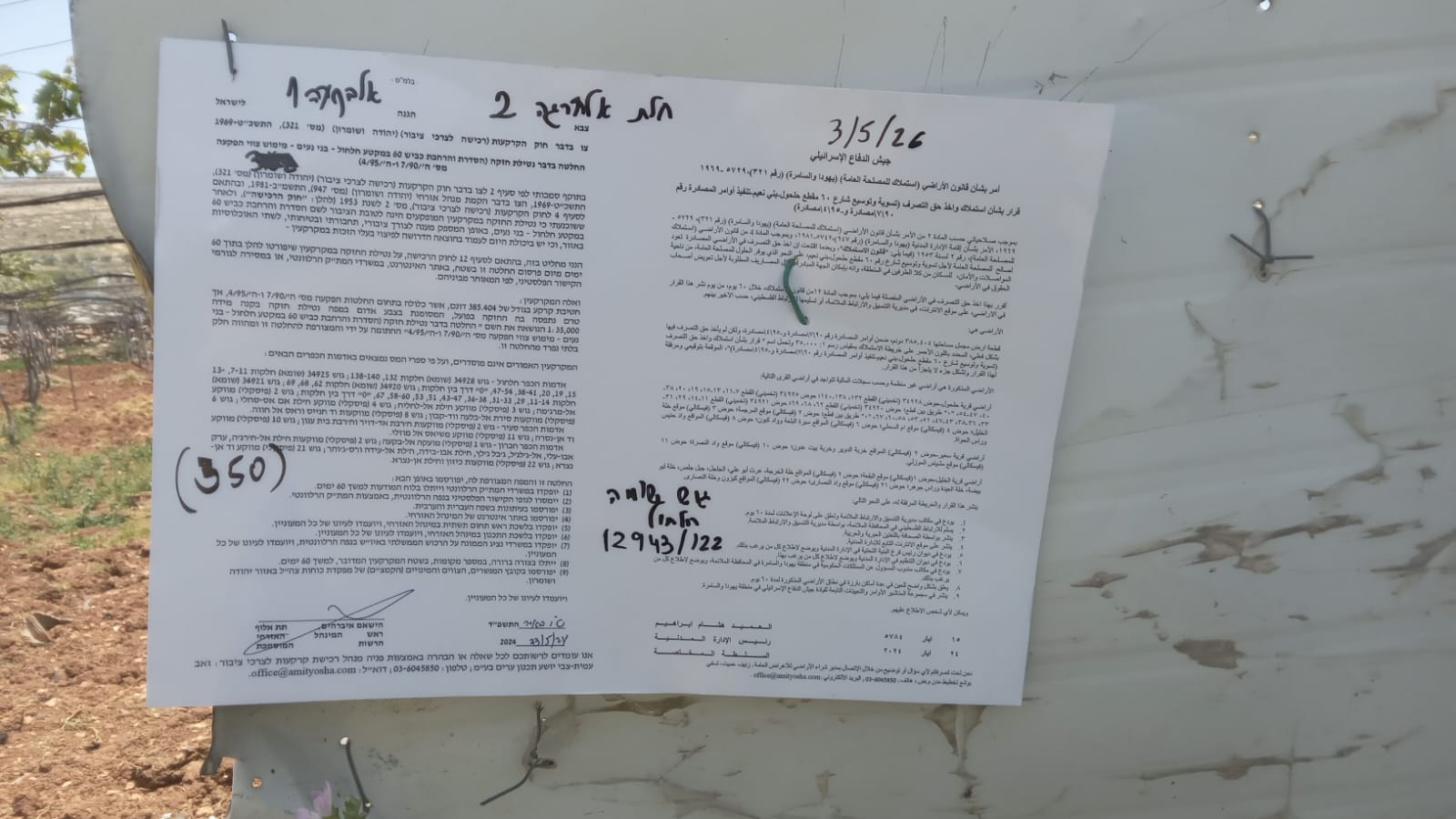 Muhammad D.May-13-2026Hebron - Request for compensation for land expropriation
-
South Hebron Hills
See all reports for this place-
South Hebron Hills
South Hebron Hills is a large area in the West Bank's southern part.
Yatta is a major city in this area: right in the border zone between the fertile region of Hebron and its surroundings and the desert of the Hebron Hills. Yatta has about 64,000 inhabitants.
The surrounding villages are called Masafer Yatta (Yatta's daughter villages). Their inhabitants subsist on livestock and agriculture. Agriculture is possible only in small plots, especially near streams. Most of the area consists of rocky terraces.Since the beginning of the 1980s, many settlements have been established on the agricultural land cultivated by the Palestinians in the South Hebron Hills region: Carmel, Maon, Susia, Masadot Yehuda, Othniel, and more. Since the settlements were established and Palestinians cultivation areas have been reduced; the residents of the South Hebron Hills have been suffering from harassment by the settlers. Attempts to evict and demolish houses have continued, along with withholding water and electricity. The military and police usually refrain from intervening in violent incidents between settlers and Palestinians do not enforce the law when it comes to the investigation of extensive violent Jewish settlers. The harassment in the South Hebron Hills includes attacking and attempting to burn residential tents, harassing dogs, harming herds, and preventing access to pastures.
There are several checkpoints in the South Hebron Hills, on Routes 317 and 60. In most of them, no military presence is apparent, but rather an array of pillboxes monitor the villages. Roadblocks are frequently set up according to the settlers and the army's needs. These are located at the Zif Junction, the Dura-al Fawwar crossing, and the Sheep Junction at the southern entrance to Hebron.
Updated April 2022
 A Palestinian residentJul-21-2026Sha'ab al-Butum – Settlers pass through the village with an ATV and herds.
-