
Hebron, Southern Hebron Hills, Sansana, Visit to villages Sussia, Um-Al-Hir, Tuesday, 21.9.2011, Morning
Guests: Amos L., Mina I.
Translator: Charles K.
10:00-16:00
The twentieth of September, the beginning of an historic, historic process.
We began a longer day than usual in an attempt to see what people are feeling on this day and hear what they have to say, as much as possible. Even though I’m writing this report three days later, three days during which we were part of history, thoughts and hopes last longer, everything is still real and fascinating, even if not particularly surprising.
Meitar crossing
No one crossing at this hour.
Occasionally a merchant shows up who doesn’t have to be at work at 7 in the morning.
The food sellers are bored; some people who are still prohibited from entering Israel but keep coming in the morning anyway, hoping, stand near them. After we gave them the information they needed and again gave them telephone numbers for Sylvia and Chaya, we tried to discover how they were feeling about today.
Those who dared speak said they don’t believe anything will happen, nor do they want anything to happen because their leadership is neither appropriate nor is it any good.
Who, or what, could help, we asked?
Only someone who follows the Koran’s path.
What does the Koran require, we asked? They tell us about the special relationship between Muhammad and his Jewish neighbor and the prohibition against violence, killing, etc.
It’s not new, but reminds us that, like on our side, the book is the same book. Everyone interprets it in their own way to justify their actions.
There are more police vehicles and more inspections on Route 60, but mainly there are new Israeli flags hung all along the road. The settlers in the southern Hebron hills are telling everyone whose land this is and what sort of independence day it is.
We decided to visit people in Sussia again, who suffer continually from the settlers’ abuse.
How are they doing today?
Many men sit idly. Some speak fluent Hebrew, from the years they worked in Israel, but now they’re no longer allowed to do so.
We heard a variety of responses:
- The Palestinians must obtain full control of Area C, otherwise nothing will change.
- There’s no need for two states. Everyone should live together in one state.
- Hamas was elected? That shows that democracy worked. Didn’t you elect Lieberman? they ask.
But no one believes anything will really happen now.
We also drove to Umm el Hir, where the authorities are trying to demonstrate that the same law applies to them as to Migron – every illegal structure will be demolished. This deception is unbearable. The quantity of evil that the residents of Carmel and the Civil Administration pour onto their next-door neighbors cries out to heaven. Electric lines and irrigation pipes traversing the territories, as well as in Sussia, are for others, not for them, and are only to be looked at. It’s all for the “lords of the land.”
Again we hear only the reports of their suffering, and about the attempts of peace organizations to assist them. An extremely frustrating experience.
Hebron
The guard at the entrance to Kiryat Arba recognizes us. “You’ve come to celebrate the establishment of the state with the Palestinians?” he asks, and continues to be as pleasant as usual.
Buildings continue to be added to the illegal settlement of Mitzpeh Avichai.
We stopped to see how the Federman farm is doing. It’s lively. While we explain to our guests what’s what, a beaten-up Subaru arrives, driven by a very blond young man. Who are you?, he asks. “Why are you disturbing us?” “Who are you?” “I live here,” he replies, pointing to the farm compound. “Go, go help your friends; did you all come to cause trouble?” He drives off and we see the vehicle go down into the valley where the family, which no one dares “touch,” lives.
In Hebron all is quiet and tense. Army and police at every corner. As usual, the city makes us despair, but there’s nothing out of the ordinary.
At the Cave of the Patriarchs: Earsplitting Jewish music sounding from Beit Gutnick. Young peace activists sit across the street at ‘Abed’s shop, complaining that the soldiers harass them. We ask them to put it in writing, clearly and with details so we can complain. Meanwhile, we suggest they lower their profile and observe more discretely, and remember that they’re in contact with very young people, who are just as enthusiastic as they, and have as much energy [of the opposite kind], with all that implies…
On our way home, the best cucumbers are found at the al Fawwar grocery. M., our friend, doesn’t believe anything will really happen. “Netanyahu doesn’t really want peace, right?” he asks. So there won’t be peace.
It’s all kalam fadi – just talk.
Hebron
See all reports for this place-
According to Wye Plantation Accords (1997), Hebron is divided in two: H1 is under Palestinian Authority control, H2 is under Israeli control. In Hebron there are 170,000 Palestinian citizens, 60,000 of them in H2. Between the two areas are permanent checkpoints, manned at all hours, preventing Palestinian movement between them and controlling passage of permit holders such as teachers and schoolchildren. Some 800 Jews live in Avraham Avinu Quarter and Tel Rumeida, on Givat HaAvot and in the wholesale market.
Checkpoints observed in H2:
- Bet Hameriva CP- manned with a pillbox
- Kapisha quarter CP (the northern side of Zion axis) - manned with a pillbox
- The 160 turn CP (the southern side of Zion axis) - manned with a pillbox
- Avraham Avinu quarter - watch station
- The pharmacy CP - checking inside a caravan with a magnometer
- Tarpat (1929) CP - checking inside a caravan with a magnometer
- Tel Rumeida CP - guarding station
- Beit Hadassah CP - guarding station
Three checkpoints around the Tomb of the Patriarchs
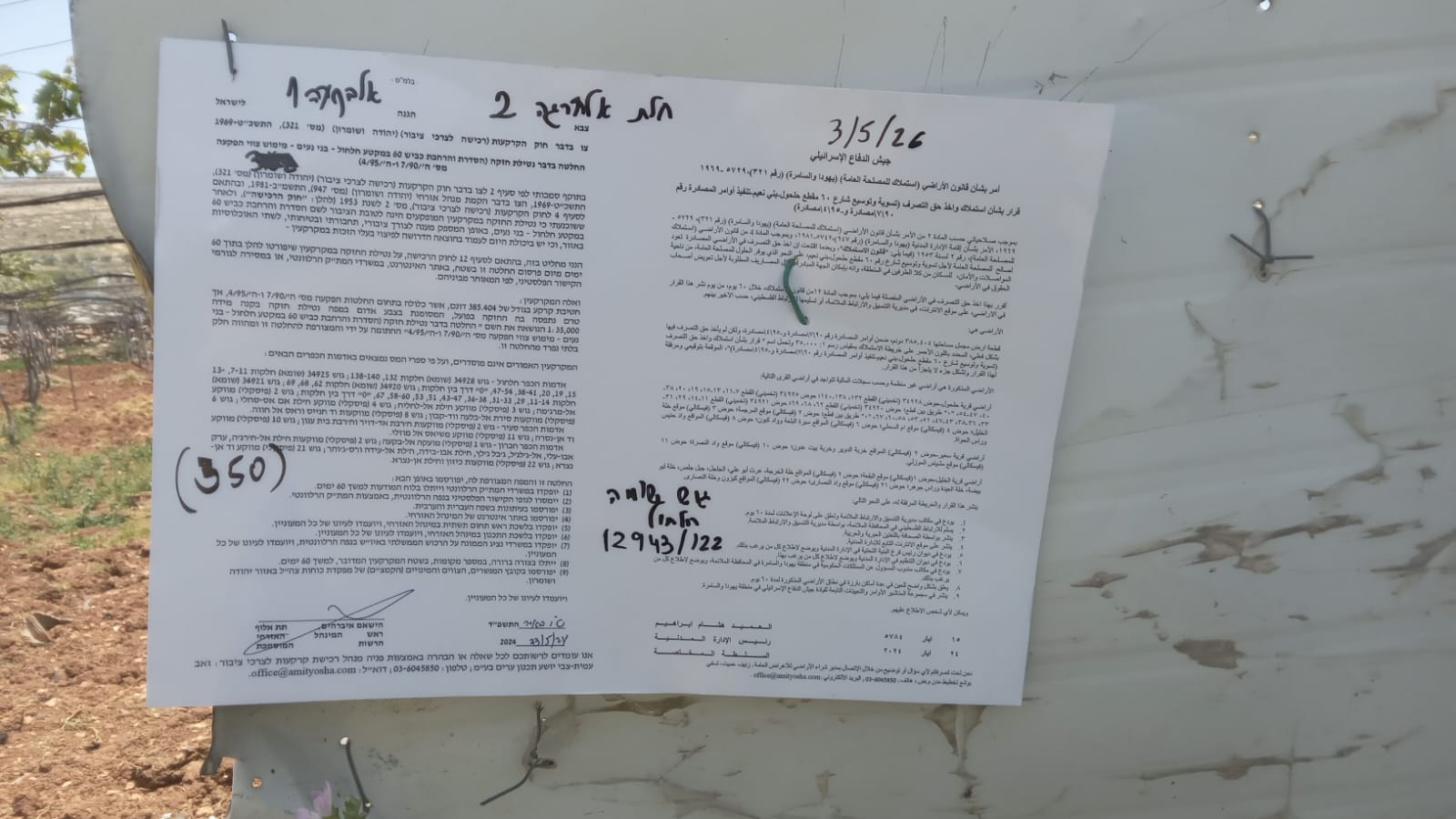 Muhammad D.May-13-2026Hebron - Request for compensation for land expropriation
-
South Hebron Hills
See all reports for this place-
South Hebron Hills
South Hebron Hills is a large area in the West Bank's southern part.
Yatta is a major city in this area: right in the border zone between the fertile region of Hebron and its surroundings and the desert of the Hebron Hills. Yatta has about 64,000 inhabitants.
The surrounding villages are called Masafer Yatta (Yatta's daughter villages). Their inhabitants subsist on livestock and agriculture. Agriculture is possible only in small plots, especially near streams. Most of the area consists of rocky terraces.Since the beginning of the 1980s, many settlements have been established on the agricultural land cultivated by the Palestinians in the South Hebron Hills region: Carmel, Maon, Susia, Masadot Yehuda, Othniel, and more. Since the settlements were established and Palestinians cultivation areas have been reduced; the residents of the South Hebron Hills have been suffering from harassment by the settlers. Attempts to evict and demolish houses have continued, along with withholding water and electricity. The military and police usually refrain from intervening in violent incidents between settlers and Palestinians do not enforce the law when it comes to the investigation of extensive violent Jewish settlers. The harassment in the South Hebron Hills includes attacking and attempting to burn residential tents, harassing dogs, harming herds, and preventing access to pastures.
There are several checkpoints in the South Hebron Hills, on Routes 317 and 60. In most of them, no military presence is apparent, but rather an array of pillboxes monitor the villages. Roadblocks are frequently set up according to the settlers and the army's needs. These are located at the Zif Junction, the Dura-al Fawwar crossing, and the Sheep Junction at the southern entrance to Hebron.
Updated April 2022
 Muhammad D.Sep-8-2026Closed Samu' checkpoint
-
