
Hebron, Tarqumiya
Tarqumiya crossing
Something’s changed here recently; their attitude toward us has improved.
Hebron
A large sign – “Beit HaShalom” – hangs on Beit HaMeriva and long Israeli flags extend down to the street. Soldiers are stationed on the roof and it is surrounded by razor wire. That’s called “Shalom.”
In fact, the entire area is “decorated” with various signs, like “Celebrating freedom, on the way to redemption.”
Passover has ended; now the Cave of the Patriarchs area is relatively quiet. Many tourists are there, from various places. A group of Americans with a guide sits at ‘Abed’s shop talking to ‘Abed’s son, Muhammad, who speaks English well. ‘Abed is very bitter about all the political leaders – from the Palestinian Authority, from Israel, from Saudi Arabia, Putin, etc. “We’re all small and weak compared to them,” he says.
We visited the Jewish industrial area that set itself up in the middle of a Palestinian neighborhood. We looked at Giv’at Gal above and the mobile homes placed there. A question arose: How do they bring a mobile home through a military checkpoint? In other words – does the army allow it?
The owner of a shop selling second-hand electrical appliances invites us in, hands us over to his landlady so she can take us to an upper step leading to her roof to view the “landscape” of the hill with the mobile homes: next to the high wall they erected around their house tractors are working, making a mess, very noisy, on land belonging to the Jabbar family. More land expropriation? During holidays soldiers are stationed on her roof.
We accepted the invitation of the woman whose name – how symbolic – is Salam to come in for tea, and heard the whole story. She says it’s hard to make a living, economic conditions are difficult and that affects everything…we exchanged phone numbers. Is there a way to find out what’s going on with that settlement?
Hebron
See all reports for this place-
According to Wye Plantation Accords (1997), Hebron is divided in two: H1 is under Palestinian Authority control, H2 is under Israeli control. In Hebron there are 170,000 Palestinian citizens, 60,000 of them in H2. Between the two areas are permanent checkpoints, manned at all hours, preventing Palestinian movement between them and controlling passage of permit holders such as teachers and schoolchildren. Some 800 Jews live in Avraham Avinu Quarter and Tel Rumeida, on Givat HaAvot and in the wholesale market.
Checkpoints observed in H2:
- Bet Hameriva CP- manned with a pillbox
- Kapisha quarter CP (the northern side of Zion axis) - manned with a pillbox
- The 160 turn CP (the southern side of Zion axis) - manned with a pillbox
- Avraham Avinu quarter - watch station
- The pharmacy CP - checking inside a caravan with a magnometer
- Tarpat (1929) CP - checking inside a caravan with a magnometer
- Tel Rumeida CP - guarding station
- Beit Hadassah CP - guarding station
Three checkpoints around the Tomb of the Patriarchs
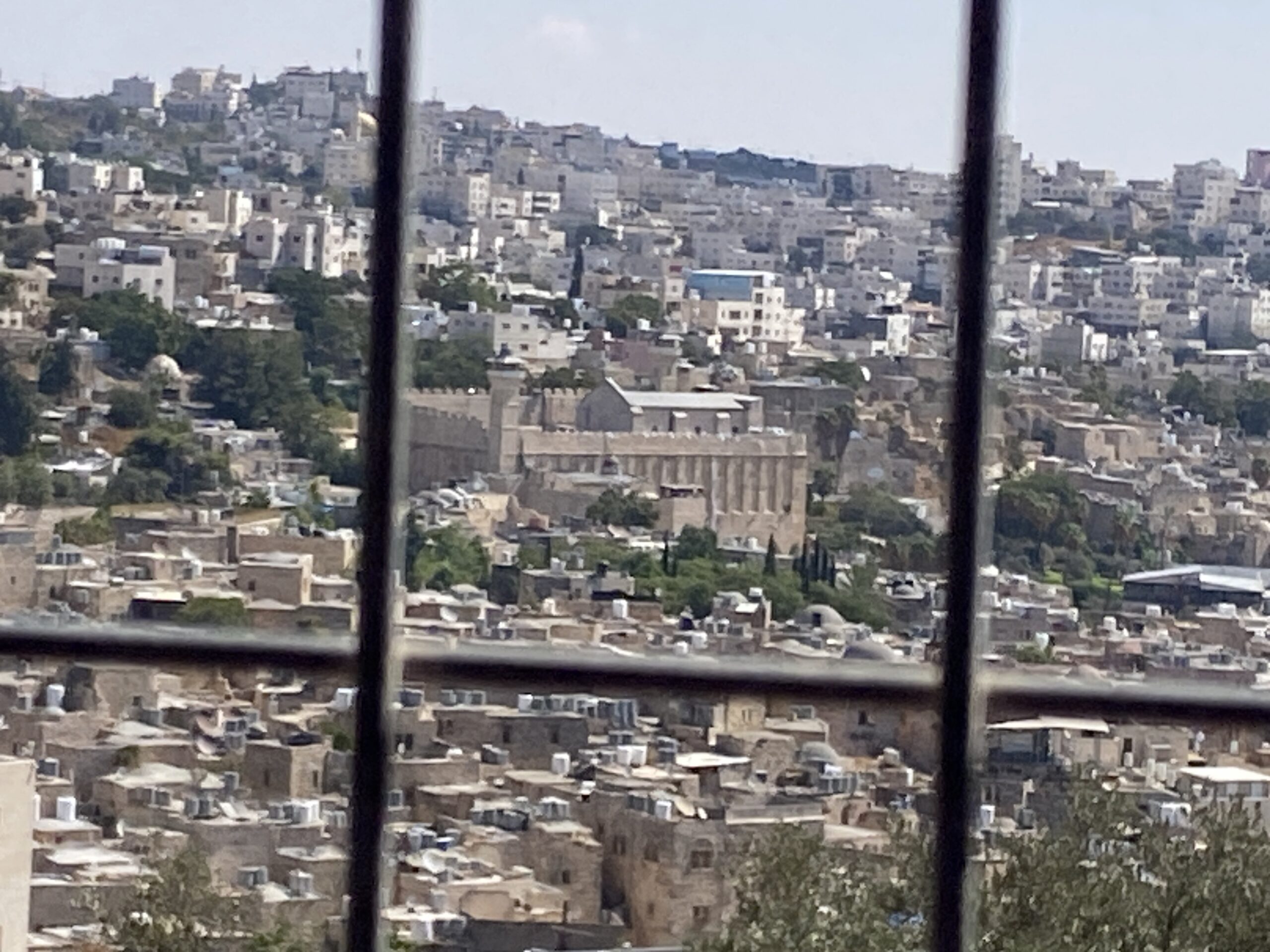 Yael ZoranSep-24-2026Hebron and the Cave of the Patriarchs from Beit Hashalom
-
Tarqumiya CP
See all reports for this place-
The Tarqumiya Checkpoint is one of the largest and busiest checkpoints where people and goods cross into Israel. It is located on the Separation Barrier close to the Green Line, on Road 35 (connecting Beer Sheva and Hebron). It is run by the Israel Defense Ministry’s Crossings Administration with civilian secuirty companies running the day to day operations. The checkpoint is indeed open to vehicles in both directions 24/7, but Palestinians are prevented from crossing in vehicles, except in special cases. MachsomWatch activists visit the checkpoint as it opens at 3:45 am, in order to observe the daily passage of nearly 10,000 Palestinian workers. The workers arrive from throughout the Southern West Bank. Our activists report on the tremendous overcrowding at this checkpoint; they have observed young men climbing and scrambling on the fences and roofs of the ‘access cages’. This is how the work day begins for those who ‘build the land of Israel’. updated November 2019
-
