
Hebron, Tarqumiya
We went out to observe despite the doubts about the security conditions on the day after the terrible attack in the Jerusalem Synagogue.
The road that leads out of Kiryat Arba to Hebron was quiet as usual. Here, opposite the hut – the Hazon David [Vision of David] synagogue has changed from a tent to some kind of caravan, in other words, it has been up-graded..
At the turn. 160 – there is a number of soldiers. All is quiet.
At Abed's we met a group of Norwegians from the Ecumenical Organization, EAPPI (a program that tracks Palestine and Israel). They are traveling throughout the West Bank for only a week. They expressed interest in us and in our activities. Nina made the effort to explain our position to them, and emphasized the fact that it is important to hear all the sides and to become acquainted with the complexities of the situation. They asked for written material, and we gave them the Makhsomwatch flyer in English. From information that reached the group's guide, we discovered that there is, apparently, some event with colonists near or in the Cordoba School and that is why it is impossible to drive any place in that direction. And indeed we saw that the police had closed off the road that leads there, near the pharmacy. Although it was only 11 am — crowds of children were coming back from school When we asked about this- they said that they had simply finished studying today. (Ibrahamiya School for boys, and Elfakha School for girls)
After making some telephone calls, we drove to visit Umm-Ahmad, who lives under Giv'at-Gal. In her house we met two of her friends from Hebron (one lives under Tel Rumeida). To our sorrow we could converse with them only thanks to Mohammed's translating for us and for them. They agreed with us that what happened yesterday was very bad. There also sat with us two sons-in-law and a small grandchild of the sweet owner of the house who prepared excellent coffee fro us. One of the sons-in-law is forbidden entry by the General Security Force, and he would like to work in Israel. We gave him details so that he can get in touch with Sylvia. (So far we have not been able to get hold of her.)
On the way back — at the Tarkumiya passage – the woman inspector asks a lot of questions today (because of yesterday's tragedy?)
Hebron
See all reports for this place-
According to Wye Plantation Accords (1997), Hebron is divided in two: H1 is under Palestinian Authority control, H2 is under Israeli control. In Hebron there are 170,000 Palestinian citizens, 60,000 of them in H2. Between the two areas are permanent checkpoints, manned at all hours, preventing Palestinian movement between them and controlling passage of permit holders such as teachers and schoolchildren. Some 800 Jews live in Avraham Avinu Quarter and Tel Rumeida, on Givat HaAvot and in the wholesale market.
Checkpoints observed in H2:
- Bet Hameriva CP- manned with a pillbox
- Kapisha quarter CP (the northern side of Zion axis) - manned with a pillbox
- The 160 turn CP (the southern side of Zion axis) - manned with a pillbox
- Avraham Avinu quarter - watch station
- The pharmacy CP - checking inside a caravan with a magnometer
- Tarpat (1929) CP - checking inside a caravan with a magnometer
- Tel Rumeida CP - guarding station
- Beit Hadassah CP - guarding station
Three checkpoints around the Tomb of the Patriarchs
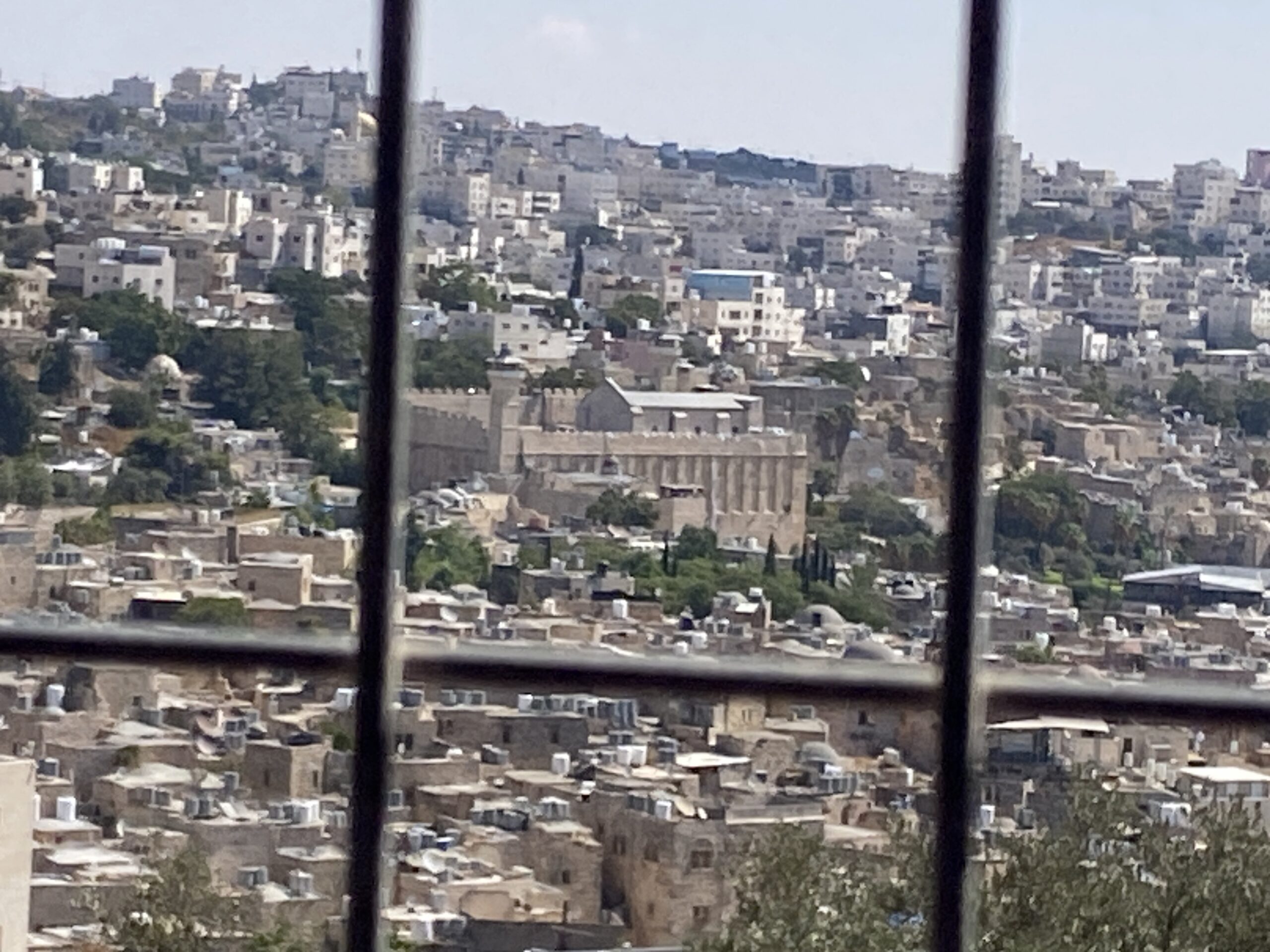 Yael ZoranSep-24-2026Hebron and the Cave of the Patriarchs from Beit Hashalom
-
Tarqumiya CP
See all reports for this place-
The Tarqumiya Checkpoint is one of the largest and busiest checkpoints where people and goods cross into Israel. It is located on the Separation Barrier close to the Green Line, on Road 35 (connecting Beer Sheva and Hebron). It is run by the Israel Defense Ministry’s Crossings Administration with civilian secuirty companies running the day to day operations. The checkpoint is indeed open to vehicles in both directions 24/7, but Palestinians are prevented from crossing in vehicles, except in special cases. MachsomWatch activists visit the checkpoint as it opens at 3:45 am, in order to observe the daily passage of nearly 10,000 Palestinian workers. The workers arrive from throughout the Southern West Bank. Our activists report on the tremendous overcrowding at this checkpoint; they have observed young men climbing and scrambling on the fences and roofs of the ‘access cages’. This is how the work day begins for those who ‘build the land of Israel’. updated November 2019
-
