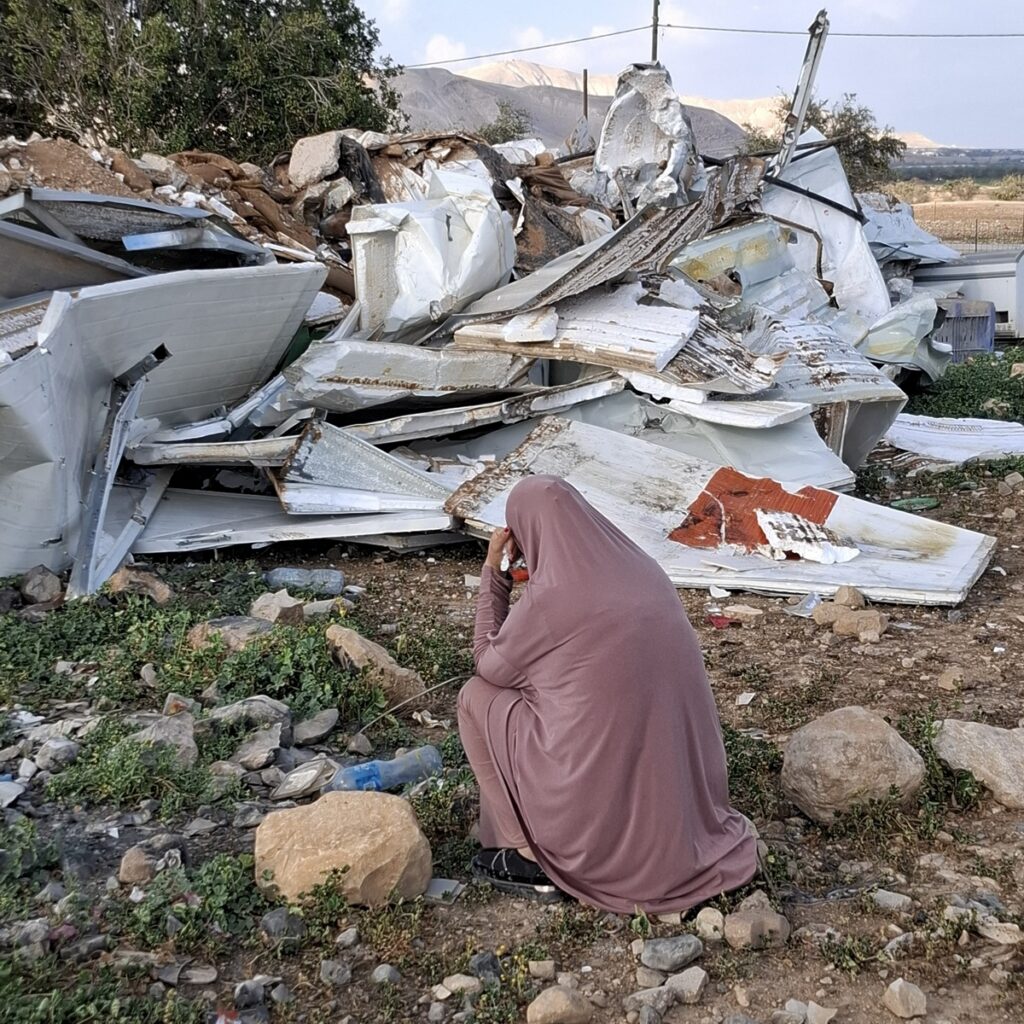
Hebron - the Cave of the Patriarchs is turning into a fortified destination

Route 60
Empty , and the signs of the Jewish takeover are increasing: an article in this morning’s “Haaretz” about the idea of legalizing sheep farms. There is already evidence of this in the field: the metal structure on the hill in front of Shem’a that probably stores sheep,has a new green sign – Havat Yehuda. First buds of the takeover and the sequel is scary.
Hebron:
We wanted to visit Issa and find out what happened over the weekend which had not been clear in the videos he sent. On the phone, he explained that on Saturday there was a funeral procession for a Palestinian that passed in front of the base on the way to the cemetery on Shuhada Street, and the soldiers humiliated the mourners . Issa was not in town so he sent us to look for the aggressive soldier as he claimed, whose name was Ben Lulu.
Behind the Al Ibrahimiya boys’ school, inside an Arab house, an auxiliary company was located. A large new sign declares this (there is no documentation – for obvious reasons) and military vehicles are parked under the building. Some young soldiers greeted me and were amused to hear that I was looking for Ben Lulu. He appeared in sports clothes, so it is not clear what his rank is, and while we are talking, the lieutenant also appeared, who was not ready to reveal his name, but claimed that he has been in the field for a long time and knows the situation well. It was important to him that I should know that there were stone throwers from among the settlers (“residents” in his language) who were arrested, just as 5 Palestinians who carried knives (“terrorists” in his language). The discussion went nowhere, and when I mentioned Issa, my arguments were clearly rejected because “I am not ready to listen to the words of a terrorist.” But I quietly explained that it’s not every day that we complain to the army and if I did, there was probably inappropriate behavior by one of his command that might be worth Investigating.
On the way to the Cave of the Patriarchs, I met an American man who introduced himself as a Palestinian, coming from Boston to understand the conflict. In fact, his grandparents are from Haifa and his father grew up in Haifa after ‘48 and is therefore an Israeli citizen, but it was important for him to emphasize that he is Palestinian, and was happy to hear that there are also Israelis who do not support the settlements and the current situation.
Coffee at Abed’s, who looks more despondent than ever – there are no tourists, the Cave of the Patriarchs is turning into a fortified destination before his eyes. A double fence, now the noise and dust of metal sawing for some facility that looks like an elevator to the Gutnick house.
Several groups of Israelis, wearing kippahs, come to hear about the place, and receive comprehensive lectures. The Breakers of Silence are not amongst the lecturers. Nothing good will come of this. On the way back the only solace is the oasis of Ma’ayan El Fawwar and the thriving agriculture around it.
Dura Al-Fawwar Junction
See all reports for this place-
Junction on Route 60: west - the town of El Dura, east - the Al Fawwar refugee camp. There is a manned pillbox at the junction. From time to time the army sets up flying checkpoints at the entrance to El Fawwar and Al Dura. Al-Fawwar is a large refugee camp (7,000 inhabitants in 2007) established in 1949 to accommodate Palestinian refugees from Be'er Sheva and Beit Jubrin and environs. There are many incidents of stone-throwing. In the vicinity of the pillbox there are excellent agricultural areas, Farmers set up stalls adjacent to the plots close to the road. In recent months the civil administration has set up dirt embankments thereby blocking access to the stalls, and making it impossible for the farmers to sell their vegetables. Updated April 2021, Michal T.
-
Hebron
See all reports for this place-
According to Wye Plantation Accords (1997), Hebron is divided in two: H1 is under Palestinian Authority control, H2 is under Israeli control. In Hebron there are 170,000 Palestinian citizens, 60,000 of them in H2. Between the two areas are permanent checkpoints, manned at all hours, preventing Palestinian movement between them and controlling passage of permit holders such as teachers and schoolchildren. Some 800 Jews live in Avraham Avinu Quarter and Tel Rumeida, on Givat HaAvot and in the wholesale market.
Checkpoints observed in H2:
- Bet Hameriva CP- manned with a pillbox
- Kapisha quarter CP (the northern side of Zion axis) - manned with a pillbox
- The 160 turn CP (the southern side of Zion axis) - manned with a pillbox
- Avraham Avinu quarter - watch station
- The pharmacy CP - checking inside a caravan with a magnometer
- Tarpat (1929) CP - checking inside a caravan with a magnometer
- Tel Rumeida CP - guarding station
- Beit Hadassah CP - guarding station
Three checkpoints around the Tomb of the Patriarchs
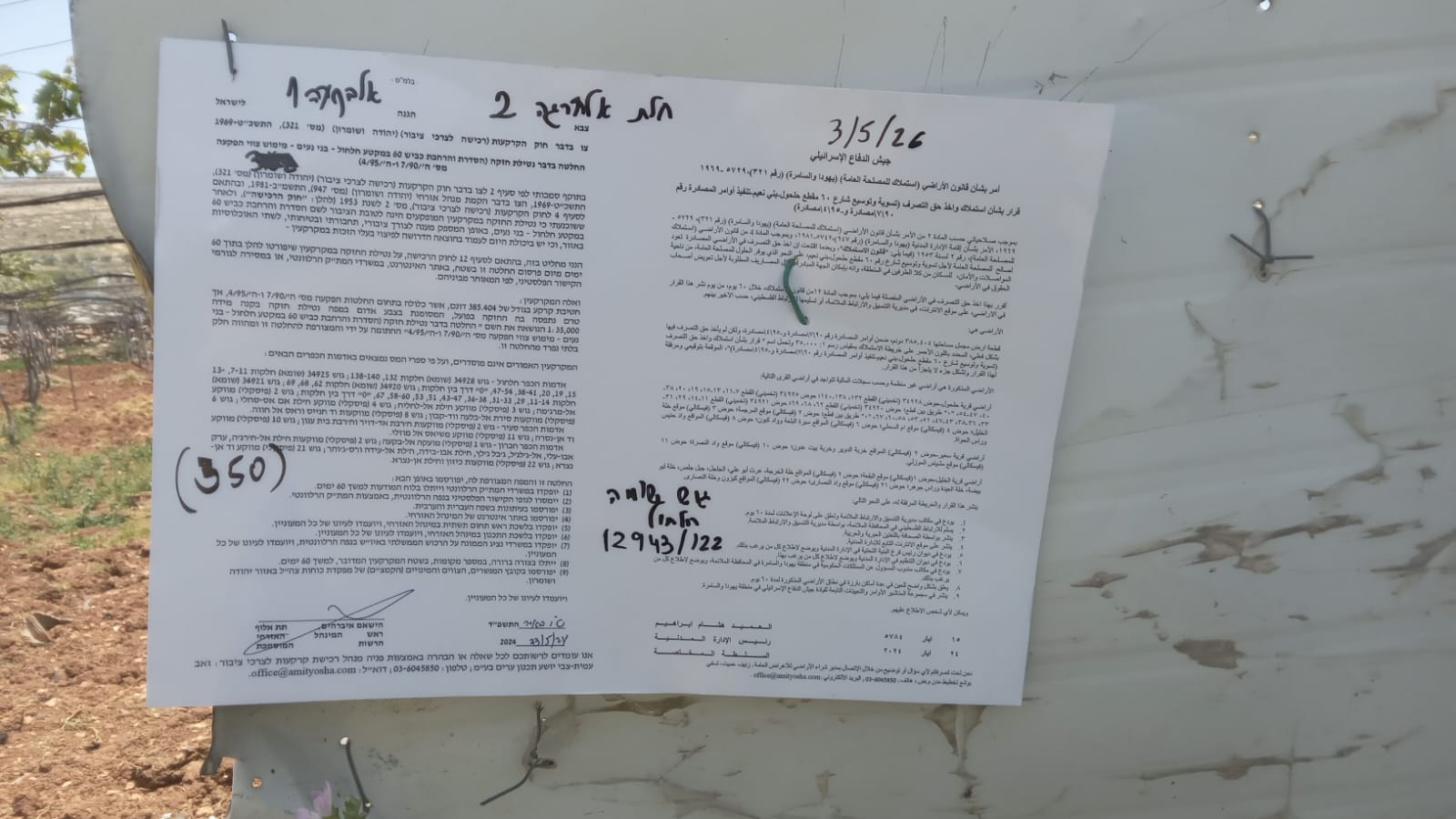 Muhammad D.May-13-2026Hebron - Request for compensation for land expropriation
-
South Hebron Hills
See all reports for this place-
South Hebron Hills
South Hebron Hills is a large area in the West Bank's southern part.
Yatta is a major city in this area: right in the border zone between the fertile region of Hebron and its surroundings and the desert of the Hebron Hills. Yatta has about 64,000 inhabitants.
The surrounding villages are called Masafer Yatta (Yatta's daughter villages). Their inhabitants subsist on livestock and agriculture. Agriculture is possible only in small plots, especially near streams. Most of the area consists of rocky terraces.Since the beginning of the 1980s, many settlements have been established on the agricultural land cultivated by the Palestinians in the South Hebron Hills region: Carmel, Maon, Susia, Masadot Yehuda, Othniel, and more. Since the settlements were established and Palestinians cultivation areas have been reduced; the residents of the South Hebron Hills have been suffering from harassment by the settlers. Attempts to evict and demolish houses have continued, along with withholding water and electricity. The military and police usually refrain from intervening in violent incidents between settlers and Palestinians do not enforce the law when it comes to the investigation of extensive violent Jewish settlers. The harassment in the South Hebron Hills includes attacking and attempting to burn residential tents, harassing dogs, harming herds, and preventing access to pastures.
There are several checkpoints in the South Hebron Hills, on Routes 317 and 60. In most of them, no military presence is apparent, but rather an array of pillboxes monitor the villages. Roadblocks are frequently set up according to the settlers and the army's needs. These are located at the Zif Junction, the Dura-al Fawwar crossing, and the Sheep Junction at the southern entrance to Hebron.
Updated April 2022
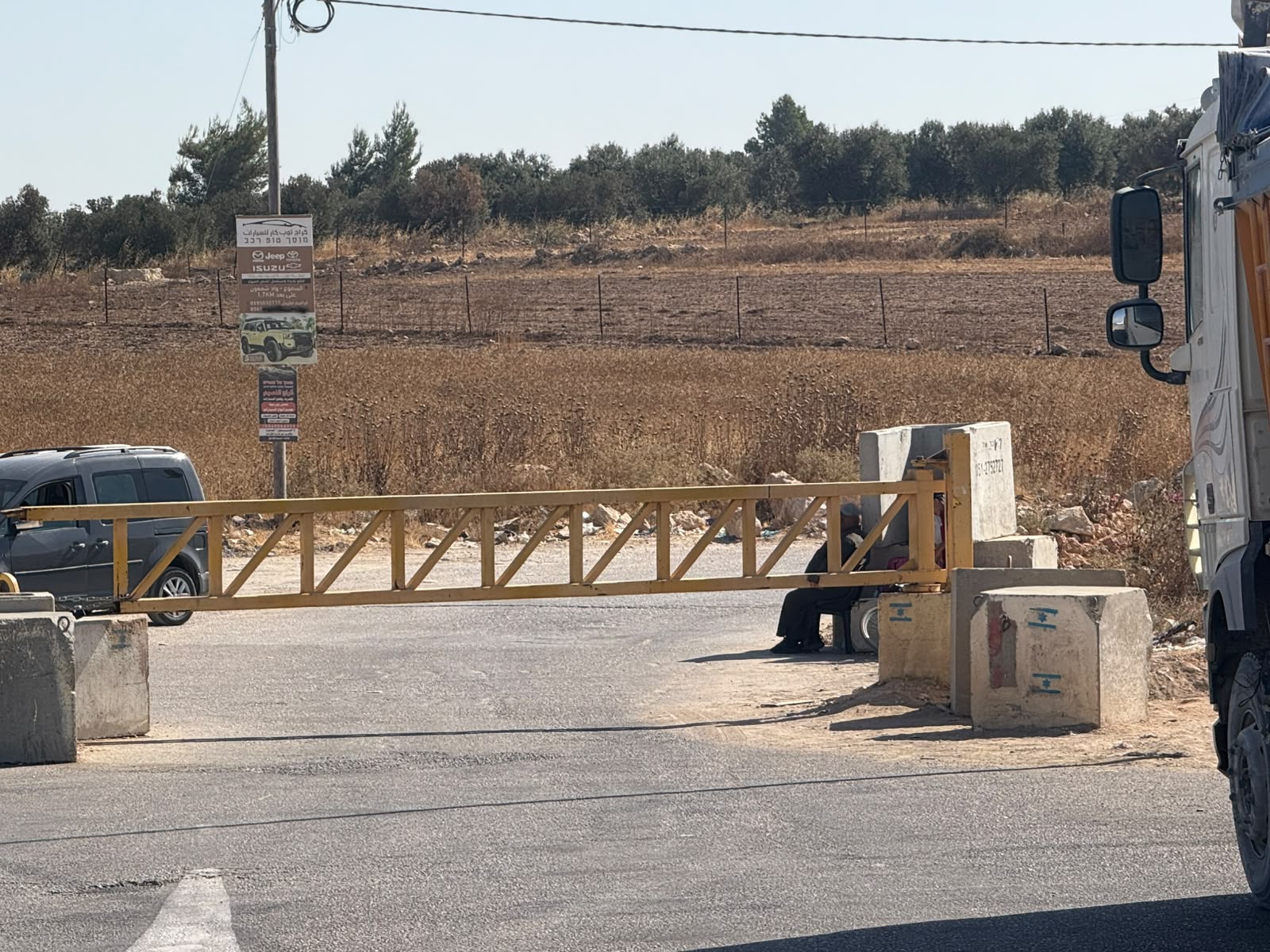 Muhammad D.Aug-5-2026Samu' barrier
-