
Hebron, Wed 8.12.10, Morning
Translator: Charles K.
Hebron
Entry to Kiryat Arba goes smoothly, without delays. Additional buildings on Giva’t Avichai, as well as on the slope and another small structure and something looking live it might be a grape arbor.
Paving the new, wide road is coming along nicely. Soon there will be a “King’s highway” to Kiryat Arba.
The new buildings built on the way up from the road in the eastern part of Kiryat Arba are already occupied, at least partially.
At this hour (about 10 AM) most children are in school. Three soldiers stand before we reach the descent to Curve 160 and there’s another soldier observing from the position, and the same at the Tarpa”t crossing.
It’s quiet. At Tel Rumeida there’s again a solitary soldier, very un-communicative, barely responded “Hello,” and immediately crossed to the other side of the road – apparently our presence stressed him out. We stood far from him and quietly observed for a few minutes. He immediately makes a phone call and apparently as a result we’re stopped on our way down at every possible location, and next to Beit Hadassah the soldier also asks to see our ID cards.
Only today did we learn that soldiers in the occupied territories serve as police forces and are allowed to demand to see ID cards. But what did the soldier at Beit Hadassah want? Only Muhammad’s ID, “because of the car.”
We were permitted to continue and drove down to the Cave of the Patriarchs. It’s full of visitors and people celebrating the holiday, and to make it even more festive the music from Beit Gutnick is again blasting away. We met two officers, and the junior of the two agreed that the music from Beit Gutnick is too loud, and immediately went over and spoke to someone who had emerged from the building, without results…Then we spoke to the senior officer, the Hebron DCO commander, who said that the muezzin’s call at 4AM also disturbs the neighborhood – the bottom line is that everyone has to respect each other.
On the basis of this friendly conversation, and our general impression from our tour today, it seems that the army is primarily concerned to keep things quiet. Apparently we managed to “scare” the soldiers.
On our way back – a soldier with rifle pointing down at the road stood at the humanitarian checkpoint – a seductive occupation scene.
There hasn’t yet been a Hanukkah miracle here.
Hebron
See all reports for this place-
According to Wye Plantation Accords (1997), Hebron is divided in two: H1 is under Palestinian Authority control, H2 is under Israeli control. In Hebron there are 170,000 Palestinian citizens, 60,000 of them in H2. Between the two areas are permanent checkpoints, manned at all hours, preventing Palestinian movement between them and controlling passage of permit holders such as teachers and schoolchildren. Some 800 Jews live in Avraham Avinu Quarter and Tel Rumeida, on Givat HaAvot and in the wholesale market.
Checkpoints observed in H2:
- Bet Hameriva CP- manned with a pillbox
- Kapisha quarter CP (the northern side of Zion axis) - manned with a pillbox
- The 160 turn CP (the southern side of Zion axis) - manned with a pillbox
- Avraham Avinu quarter - watch station
- The pharmacy CP - checking inside a caravan with a magnometer
- Tarpat (1929) CP - checking inside a caravan with a magnometer
- Tel Rumeida CP - guarding station
- Beit Hadassah CP - guarding station
Three checkpoints around the Tomb of the Patriarchs
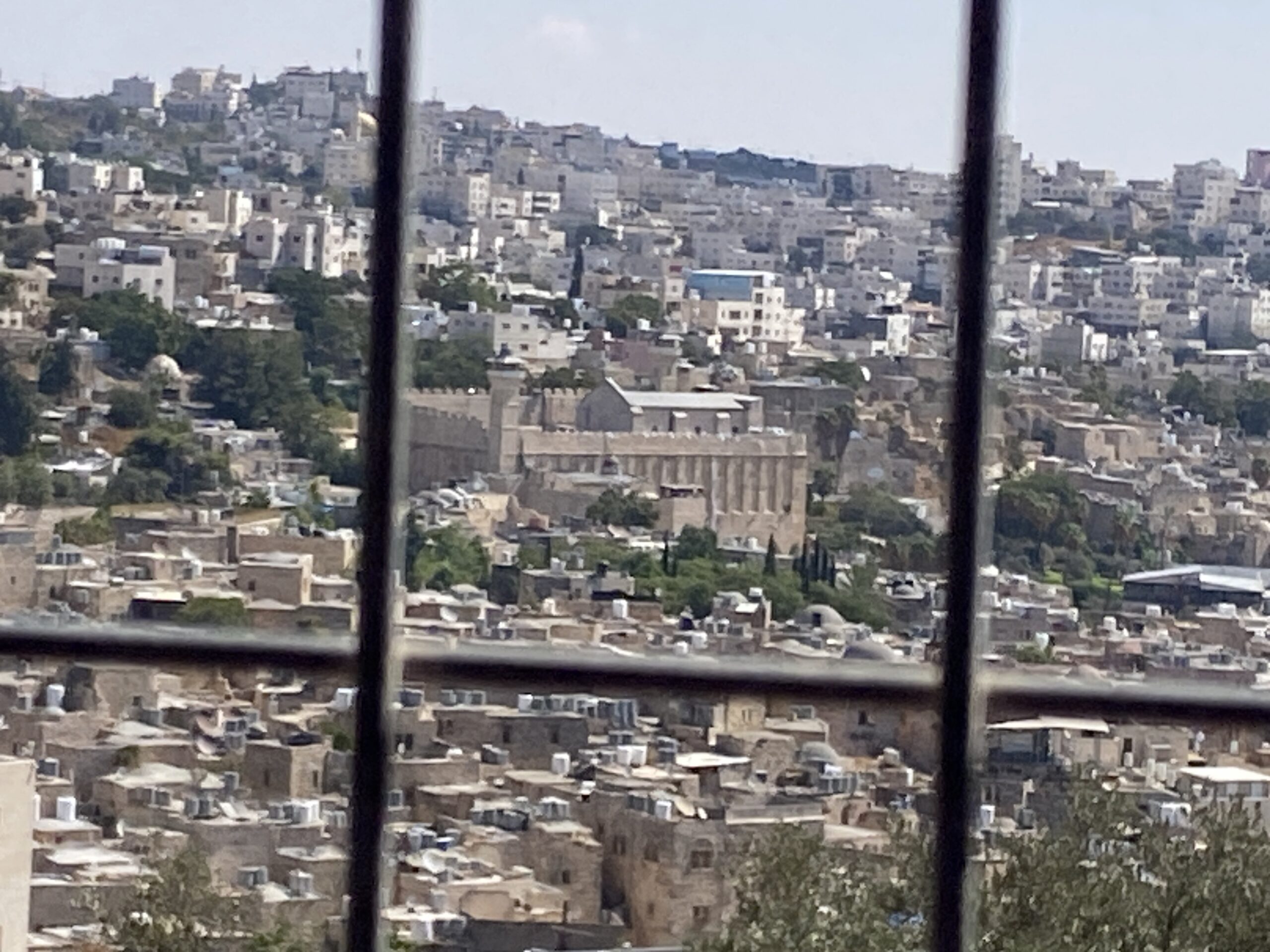 Yael ZoranSep-24-2026Hebron and the Cave of the Patriarchs from Beit Hashalom
-
