
Hizma, Jaba (Lil), Qalandiya
1. The trial of Ibrahim, the 15 year old boy from the Qalandiya refugee camp who’s jailed in the Russian Compound has been repeatedly delayed.
Because of the frequent postponements it’s impossible to know when the trial will be held, said Ibrahim’s brother who sells fruit at the exit from the checkpoint.
On the wall, near the brother’s cart, a new photograph of a new shahid from the refugee camp, below an older picture of a previous shahid from the refugee camp.

The proximity of the prisoner’s brother to the pictures of those who’d been murdered reminds me of what an acquaintance once said when we talked about a different youth who’d been arrested: “Now he’s in Ofer prison, at least they didn’t shoot him.”
“At least…”
2. The soldiers’ presence in and around the Jaba checkpoint creates traffic jams of vehicles coming from Ramallah.

The soldiers are members of the search and rescue unit, still traumatized by the hit and run attack at Rantis aimed at their comrades.
In addition to the soldiers, the corpse of the cat that was run over more than a week ago is still lying near the checkpoint; no one removed it.
Maybe “the Arab” (in the words of the commander last week) hadn’t come, and maybe he came but no one told him.
This explosive reality, in which the stinking corpse lies beside frightened, traumatized soldiers with itchy trigger fingers reflects a reality much broader than what’s true of this particular location.
3. “It’s a closure” said Zvi, the commander of the soldiers standing at the entrance to Hizmeh village, who stopped and inspected every vehicle seeking to enter, and allowed in only those who lived there, and ordered the others to turn around.

“They completely blocked the two other entrances. It’s been like this for a month. They keep opening and closing it” said the villagers.
Zvi confirmed his words and emphasized that he’s actually very humane; see, he allowed entry to a vehicle delivering medicine to the pharmacy in the village, nor did he forbid the delivery of eggs.
“Because there are people in this village planning attacks, and we’ve already discovered knives here,” Zvi explained the rationale for the closure.
No, he didn’t know what international law says about collective punishment – so I told him.
4. When the State’s Attorney instructs the Comptroller of the Israel Police to compensate me for detaining me illegally, that’s additional proof that the police flagrantly violate the law they’re supposed to uphold.
Once again, I’m grateful to Attorney Talya Ramati who represented me and supported me and accompanied me throughout the entire process.
I don’t know whether national police headquarters will notify Ami Shagar, the Qalandiya police commander, and his subordinates, of the State’s Attorney’s decision – the same Ami who not so subtly tried to make a deal with me, that if I do what he asks, he’ll decide how much he’ll let do what I have a legal right to do.
I refused the deal, as I always do, and oppose deals and agreements with representatives of the regime, but I intend to keep with me a copy of the State’s Attorney’s letter to show it to them if those police officers there or anywhere else harass me, and I invite anyone who wishes to use it as she sees fit.
By the way – I chose to sue the system itself, not Menashe Hai personally, the policeman who had detained me two years ago, and Ami, the precinct commander who backed Menashe up and took responsibility for the detention.
Hizma
See all reports for this place-
Hizma
A checkpoint at the north-eastern entrance to the Jerusalem area which was annexed in 1967, at Pisgat Zeev. The passage is allowed to bearers of blue IDs only. Open 24 hours a day.
-
Jaba' (Lil)
See all reports for this place-
Jaba' (Lil) In fact, the Jaba checkpoint is east of the Qalandiya checkpoint. Its declared purpose is the prevention of Israeli citizens from entering Area A. A road checkpoint for vehicles, located on Road 65, borders the southern fence of Kfar Jaba, about three kilometers east of the Qalandiya checkpoint, on the road leading to the settlement of Adam on Road 60. Archaeological excavations within the village found the remains of a cloth house from the First Temple period. The events that led to the construction of the checkpoint are precisely here: on the day of the abduction of Gilad Shalit and before the outbreak of the Second Lebanon War, a 17-year-old man from one of the settlements was abducted by a Palestinian cell. His body was found several days later at the entrances to Ramallah. A military investigation revealed that his abductors had taken him along this route. The checkpoint was set up to prevent future kidnappings and to warn settlers from traveling to Ramallah and entering Area A (which is forbidden for Israelis). The checkpoint that operates around the clock. Usually only vehicles traveling in the direction of Ramallah are inspected. (November 2016): Every morning, when the settlers en masse travel to Jerusalem on Route 60 and every afternoon they return from Jerusalem on Route 60, the army initiates a traffic jam at the entrance to the Jaba checkpoint and stops the movement of Palestinians traveling toward Route 60. (February 2020): In the last two years the checkpoint has not always been manned. Sometimes the soldiers come and just stand, sometimes they come and stop and check those who enter the village, sometimes they patrol the alleys of the village, sometimes they fire stun grenades and gas and sometimes they invade houses and stop young people, say those passing through the Hazma checkpoint. (Updated February 2020)
-
Qalandiya Checkpoint / Atarot Pass (Jerusalem)
See all reports for this place-
Click here to watch a video from Qalandiya checkpoint up to mid 2019 Three kilometers south of Ramallah, in the heart of Palestinian population. Integrates into "Jerusalem Envelope" as part of Wall that separates between northern suburbs that were annexed to Jerusalem in 1967: Kafr Aqab, Semiramis and Qalandiya, and the villages of Ar-Ram and Bir Nabala, also north of Jerusalem, and the city itself. Some residents of Kafr Aqab, Semiramis and Qalandiya have Jerusalem ID cards. A terminal operated by Israel Police has functioned since early 2006. As of August 2006, northbound pedestrians are not checked. Southbound Palestinians must carry Jerusalem IDs; holders of Palestinian Authority IDs cannot pass without special permits. Vehicular traffic from Ramallah to other West Bank areas runs to the north of Qalandiya. In February 2019, the new facility of the checkpoint was inaugurated aiming to make it like a "border crossing". The bars and barbed wire fences were replaced with walls of perforated metal panels. The check is now performed at multiple stations for face recognition and the transfer of an e-card. The rate of passage has improved and its density has generally decreased, but lack of manpower and malfunctions cause periods of stress. The development and paving of the roads has not yet been completed, the traffic of cars and pedestrians is dangerous, and t the entire vicinity of the checkpoint is filthy. In 2020 a huge pedestrian bridge was built over the vehicle crossing with severe mobility restrictions (steep stairs, long and winding route). The pedestrian access from public transport to the checkpoint from the north (Ramallah direction) is unclear, and there have been cases of people, especially people with disabilities, who accidentally reached the vehicle crossing and were shot by the soldiers at the checkpoint. In the summer of 2021, work began on a new, sunken entrance road from Qalandiya that will lead directly to Road 443 towards Jerusalem and Tel Aviv. At the same time, the runways of the old Atarot airport were demolished and infrastructure was prepared for a large bus terminal. (updated October 2021)
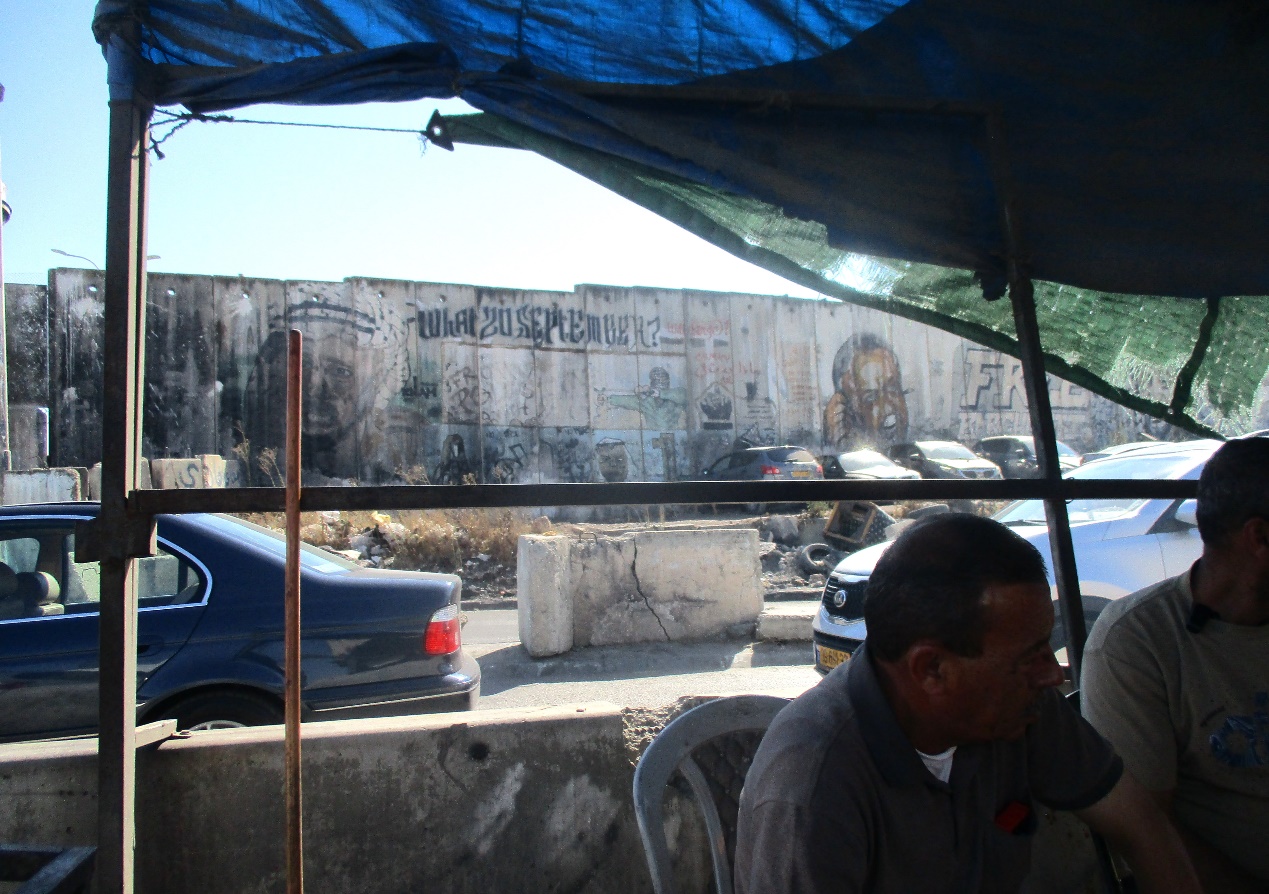 Tamar FleishmanJul-21-2026Qalandiya. Conversation in the shadow of the wall
-
