
Hizma, Qalandiya
The vehicle taking patients home to Gaza was already filled. Carrying nine passengers including a child who looked at me from the inside. Nine are actually eight who are actually four returning patients. How come? Every patient has an accompanier, and the whole group has a Gaza in charge – namely nine in all, 4 of them patients. Few patients returning means that few patients were actually issued permits to exit the Gaza Strip for treatments in the West Bank, namely – the number of permits issued patients and wounded persons has actually been reduced. Which means that more people are wasting away, ill without medication nor doctors nor appropriate equipment to save them of their misery.
They have a face. Worst is when they have a face. Thus spake the captain in Hanoch Levin’s famous play, “The Dreaming Child”.
“Pits are bottomless” was the lesson I learned from the poet Eliezer Kagan when I was his student. How else can one understand the new greeting sign put up by the sovereign?
(In Hebrew the ill-worded or misspelled sign could literally mean “Welcome for passage are the feet of Jerusalemites”…)
There is something winning in this ignorance but also suspicious about the persons who posted it as it is.
And what the Palestinians say about this sign is that whoever thought this was the track to take is proven wrong for in reality, on Fridays and Saturdays the gate is in fact locked. Perhaps it is after all a gate for people observing the Sabbath??
A certain army procedure is named “Reaction-stimulation”: a provocation meant to make Palestinians react, in reaction to which the army reacts in turn.
This is what happens every single night at Hizma village. Army vehicles enter it, drive up and down streets, their tires screeching, and are not satisfied until some children throw stones.
Stones thrown are considered ‘disruption of the public order’ and the army’s reaction to that is using crowd dispersal means such as firing stun and teargas grenades to restore order, until the next night.
Not only Palestinians collectively experience the might of the Israeli army. This might strikes individuals as well.
One of these individuals is Mohammad whose 24-year old son was arrested two weeks ago. For nearly a week the family had no idea where the son was taken nor why. He simply disappeared. One day notification came that he would be seen by a judge at Ofer Military Court the next day. So the mother went to Ofer and came home with her son, who was not released until she deposited a 1,500 shekel bail.
What did they want from him? His details were found on the cell phone of one of his village buddies, accused of stealing and burning the bag of an Israeli secret service person who was shopping in one of the village nurseries.

Hizma
See all reports for this place-
Hizma
A checkpoint at the north-eastern entrance to the Jerusalem area which was annexed in 1967, at Pisgat Zeev. The passage is allowed to bearers of blue IDs only. Open 24 hours a day.
-
Qalandiya Checkpoint / Atarot Pass (Jerusalem)
See all reports for this place-
Click here to watch a video from Qalandiya checkpoint up to mid 2019 Three kilometers south of Ramallah, in the heart of Palestinian population. Integrates into "Jerusalem Envelope" as part of Wall that separates between northern suburbs that were annexed to Jerusalem in 1967: Kafr Aqab, Semiramis and Qalandiya, and the villages of Ar-Ram and Bir Nabala, also north of Jerusalem, and the city itself. Some residents of Kafr Aqab, Semiramis and Qalandiya have Jerusalem ID cards. A terminal operated by Israel Police has functioned since early 2006. As of August 2006, northbound pedestrians are not checked. Southbound Palestinians must carry Jerusalem IDs; holders of Palestinian Authority IDs cannot pass without special permits. Vehicular traffic from Ramallah to other West Bank areas runs to the north of Qalandiya. In February 2019, the new facility of the checkpoint was inaugurated aiming to make it like a "border crossing". The bars and barbed wire fences were replaced with walls of perforated metal panels. The check is now performed at multiple stations for face recognition and the transfer of an e-card. The rate of passage has improved and its density has generally decreased, but lack of manpower and malfunctions cause periods of stress. The development and paving of the roads has not yet been completed, the traffic of cars and pedestrians is dangerous, and t the entire vicinity of the checkpoint is filthy. In 2020 a huge pedestrian bridge was built over the vehicle crossing with severe mobility restrictions (steep stairs, long and winding route). The pedestrian access from public transport to the checkpoint from the north (Ramallah direction) is unclear, and there have been cases of people, especially people with disabilities, who accidentally reached the vehicle crossing and were shot by the soldiers at the checkpoint. In the summer of 2021, work began on a new, sunken entrance road from Qalandiya that will lead directly to Road 443 towards Jerusalem and Tel Aviv. At the same time, the runways of the old Atarot airport were demolished and infrastructure was prepared for a large bus terminal. (updated October 2021)
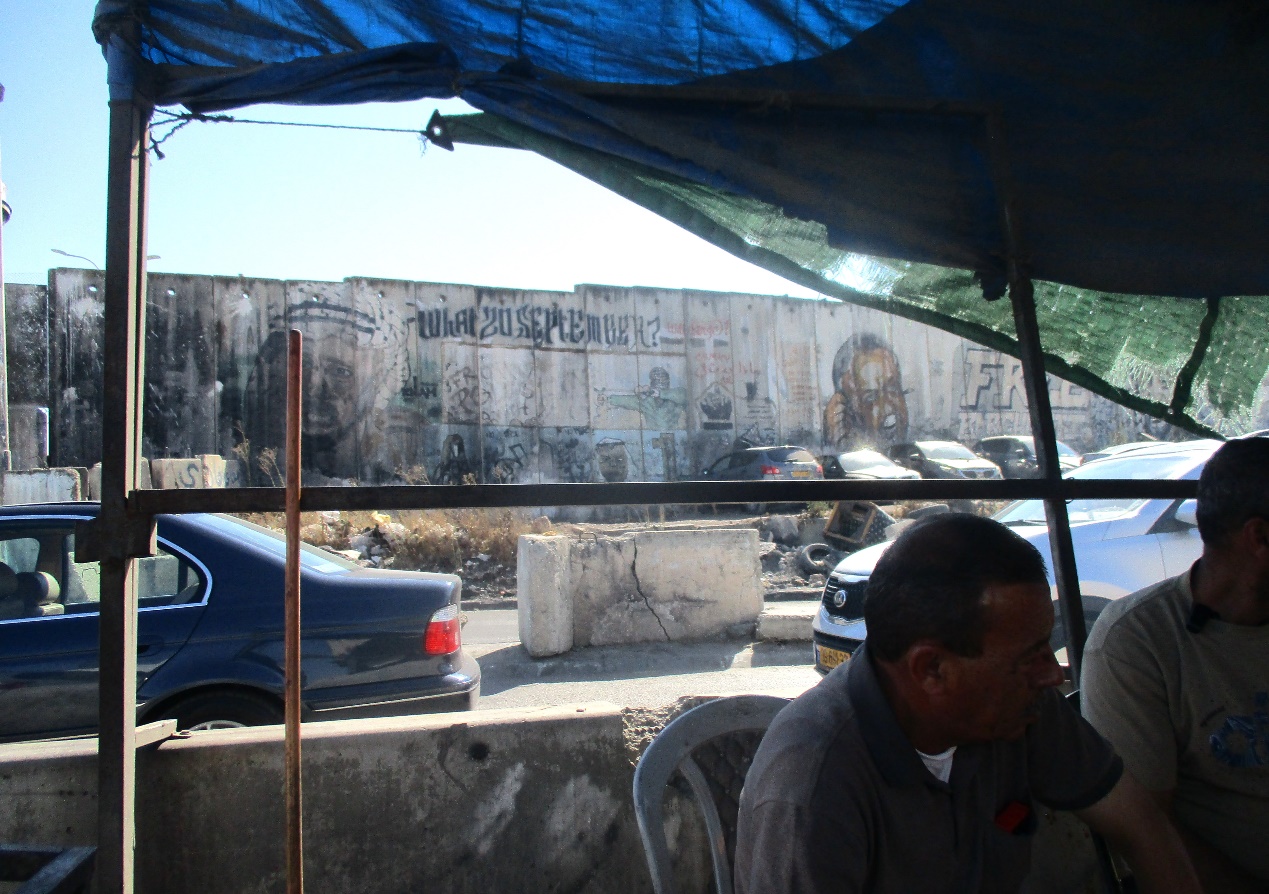 Tamar FleishmanJul-21-2026Qalandiya. Conversation in the shadow of the wall
-
