
Hizma, Qalandiya
At Qalandiya the army distributed sealed cardboard packets containing clear plastic bags holding 15 cucumbers seeds.

A friend showed me the plastic bag. Vivi Suri translated the Arabic text:
“To the residents of the West Bank: the khiar [cucumbers] and the akhtiyar [the choice] are in your hands.
Eliminate the knives and the havoc from your land
And sow hope and progress instead.”
It’s you who are murdering us, not the opposite, said my friend to the officer who’d given him the gift, and asked why the army had chosen cucumbers.
I sensed how insulted my friend felt and his discomfort. Something about his body language and his reluctance and ability to specify just what had offended him made me think that the story had a hidden subtext and the cucumber had a sexual connotation.
I’d heard about the propaganda leaflets the army was distributing. But not about the gifts. I decided it was worth looking into.
Here’s the answer, in chronological order:
It turns out that January is definitely the wrong month for sowing cucumbers – they simply won’t grow said the owner of a plant nursery.
There was a Hebrew text on the back of the plastic bag that led me to the producer of the organic seeds,“Or Hadash” in the Avney Hefetz settlement. I telephoned. I spoke with David who confirmed that it’s not the season to sow cucumbers and told me that the order came from the Ministry of Defense just last week.
And get this: a friend of mine, a language expert, who’d heard the story of the cucumbers, said there’s a saying in Arabic: “A cucumber – sometimes in the mouth, sometimes up the ass.”
After most of the tale of the cucumber had been decoded, Nir Gontej asked me not to release it before Ha’aretz published its weekly supplement. I controlled myself.
http://www.haaretz.co.il/magazine/tozeret/.premium-1.2821913
————————
It’s been like this for a very long time said a resident of Hizma village as we stood talking and saw military vehicles and an armored police vehicle entering the village.

They don’t miss a day. On a good day it’s only once, more often on days that aren’t so good, but there’s no day without the army here, also at night, in the streets, sometimes on foot, sometimes only in cars, sometimes stopping people, sometimes arresting children, four days ago they arrested a 14-year-old boy.

The soldiers stand all day and all night on the hill past the homes at the edge of the village.
And how’s business? Many customers are afraid to come.
Many of the customers of the shops and garages in the village are Jews, from Jerusalem, Pisgat Ze’ev and Adam. Because here, they say, prices are lower and there’s good quality merchandise. If only the customers would come back and things return to what they had been.
Hizma
See all reports for this place-
Hizma
A checkpoint at the north-eastern entrance to the Jerusalem area which was annexed in 1967, at Pisgat Zeev. The passage is allowed to bearers of blue IDs only. Open 24 hours a day.
-
Qalandiya Checkpoint / Atarot Pass (Jerusalem)
See all reports for this place-
Click here to watch a video from Qalandiya checkpoint up to mid 2019 Three kilometers south of Ramallah, in the heart of Palestinian population. Integrates into "Jerusalem Envelope" as part of Wall that separates between northern suburbs that were annexed to Jerusalem in 1967: Kafr Aqab, Semiramis and Qalandiya, and the villages of Ar-Ram and Bir Nabala, also north of Jerusalem, and the city itself. Some residents of Kafr Aqab, Semiramis and Qalandiya have Jerusalem ID cards. A terminal operated by Israel Police has functioned since early 2006. As of August 2006, northbound pedestrians are not checked. Southbound Palestinians must carry Jerusalem IDs; holders of Palestinian Authority IDs cannot pass without special permits. Vehicular traffic from Ramallah to other West Bank areas runs to the north of Qalandiya. In February 2019, the new facility of the checkpoint was inaugurated aiming to make it like a "border crossing". The bars and barbed wire fences were replaced with walls of perforated metal panels. The check is now performed at multiple stations for face recognition and the transfer of an e-card. The rate of passage has improved and its density has generally decreased, but lack of manpower and malfunctions cause periods of stress. The development and paving of the roads has not yet been completed, the traffic of cars and pedestrians is dangerous, and t the entire vicinity of the checkpoint is filthy. In 2020 a huge pedestrian bridge was built over the vehicle crossing with severe mobility restrictions (steep stairs, long and winding route). The pedestrian access from public transport to the checkpoint from the north (Ramallah direction) is unclear, and there have been cases of people, especially people with disabilities, who accidentally reached the vehicle crossing and were shot by the soldiers at the checkpoint. In the summer of 2021, work began on a new, sunken entrance road from Qalandiya that will lead directly to Road 443 towards Jerusalem and Tel Aviv. At the same time, the runways of the old Atarot airport were demolished and infrastructure was prepared for a large bus terminal. (updated October 2021)
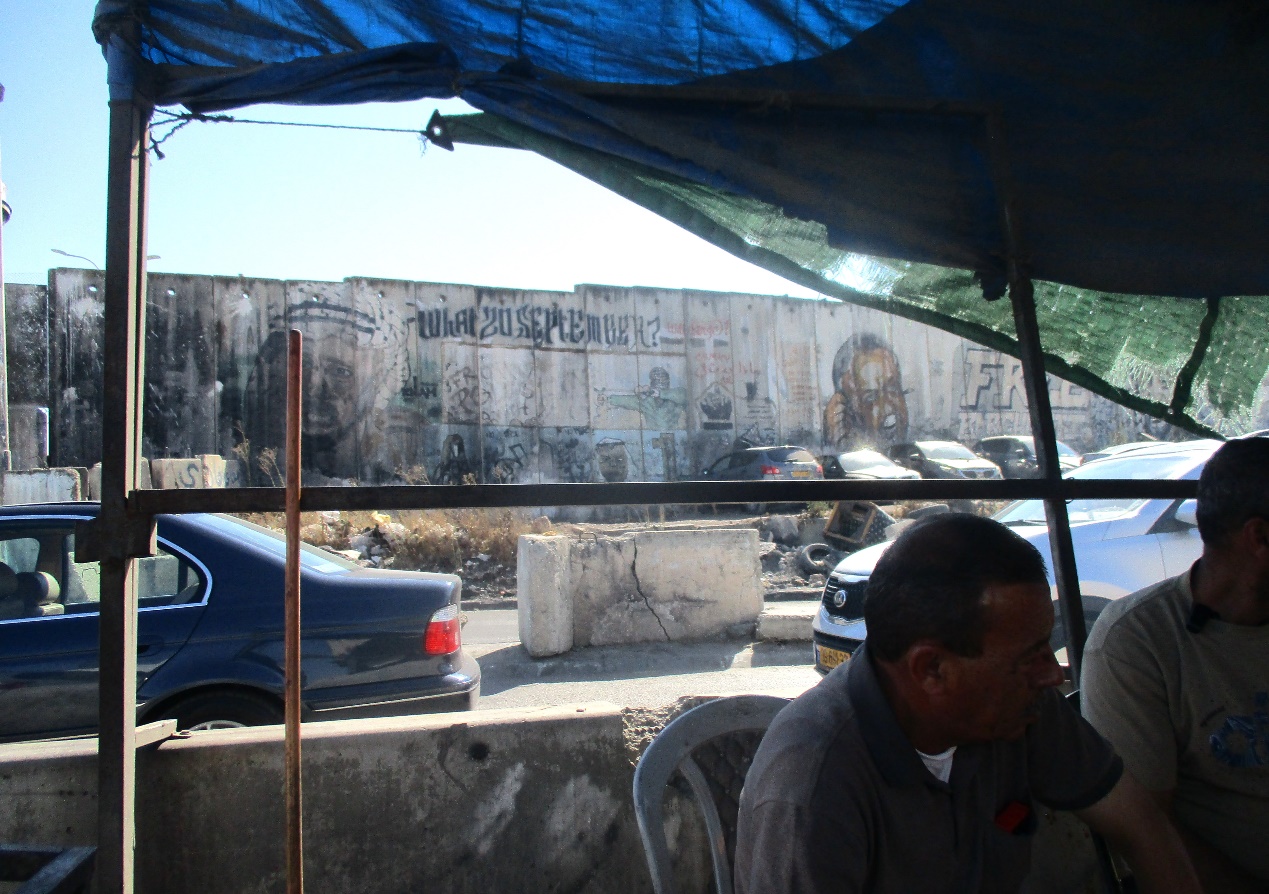 Tamar FleishmanJul-21-2026Qalandiya. Conversation in the shadow of the wall
-
