
Hizma, Qalandiya, Sun 9.6.13, Afternoon
Translating: Ruth Fleishman
Ten minutes of standing in the line leading to the soldiers' post and three more minutes of standing in the inspection zone, were enough to grasp how they implement the declared objective of "keeping the population in a state of constant uncertainty"- the words of a high ranking officer.
People were taken inside the inspection zone in groups of three. Just before me in line was an elder man who placed the few metal objects he carried in his pockets on a plastic tray, that was taken away by the convey belt inside the metal detector. He presented his ID and passage permit to the soldiers through the bullet proof window.
The soldiers, using the computer on their desk, thoroughly examined his identity, they asked over and over again that he present the ID and ordered him to shove the permit through the crack in the wall. The permit passed over to the other side, and as the soldiers took it into their hands it was confiscated. The man froze with a terrified look on his face. "Why?" I asked. "Because", replied the soldier. "That's not an answer", I insisted. "It's calcified" replied the soldier. I insisted. He explained that these orders came from above, that neither he knew who gave them or why, but from then on this man was prevented passage by the GSS and all that it entails.
The Palestinian, whose gaze wondered off from the soldiers over to us, the two Israeli women he had never met and most probably would never meet again, sensed a tone of solidarity as though he expected that his salvation would come from us, and like a person who had his entire world collapse, asked: "What will I do now?"- "Hurry to the DCL, they still haven't closed", replied the soldiers.
Lost and confused he rushed to make his way in the crowd that massed on the turnstiles outside. His belongings that were earlier placed on the plastic tray: a phone, a key set and some coins, were forgotten.
We hurried after him and through the metal bars handed his possessions over to him.
There was also a woman who came all the way from Nablus. She arrived panting at the checkpoint and she told us that eleven years earlier soldiers had entered her home, shot and murdered her husband, leaving her to take care of ten orphans. Recently, one of her children fell ill and was admitted to Mukased hospital in East Jerusalem, and that is where she was heading to. She was the only one to receive a permit to visit her son from the authorities of occupation. His brothers, being the children of a man murdered by the army, are regarded as a threat to the state of Israel and were prevented from sitting aside their brother's bed.
"The profile of danger" they call it, it is indeed a damned profile…
Living their shattered lives, the Palestinians are forced to arrive from between the fences and metal bars, all for the sake of their survival .We have only made a few steps alongside them, but it was enough make us to feel upon arriving at the other side as though we have been kicked in the stomach with nailed boots.
Or as an anonymous hand inscribed on the tower:
"Shame for The World for this chicpont"
At Hizme checkpoint a woman from the BP ("I am the commander of the checkpoint" she said) gave the order that we be detained at the zone intended for detainment and inspection of the vehicles that belong to Palestinians from Jerusalem, in contrast with the settlers that aren't inspected at all.
The "commander" looked long and hard at our IDs and the details on it in the search for a way to "screw" us. Upon not finding anything she released us without satisfaction.
If there is something to be learned from this detainment is that it is important, even if it scarcely happens, that we feel a bit of the humiliation and threats that the Palestinians suffer from each and every day, and each and every hour at that very place.
Hizma
See all reports for this place-
Hizma
A checkpoint at the north-eastern entrance to the Jerusalem area which was annexed in 1967, at Pisgat Zeev. The passage is allowed to bearers of blue IDs only. Open 24 hours a day.
-
Qalandiya Checkpoint / Atarot Pass (Jerusalem)
See all reports for this place-
Click here to watch a video from Qalandiya checkpoint up to mid 2019 Three kilometers south of Ramallah, in the heart of Palestinian population. Integrates into "Jerusalem Envelope" as part of Wall that separates between northern suburbs that were annexed to Jerusalem in 1967: Kafr Aqab, Semiramis and Qalandiya, and the villages of Ar-Ram and Bir Nabala, also north of Jerusalem, and the city itself. Some residents of Kafr Aqab, Semiramis and Qalandiya have Jerusalem ID cards. A terminal operated by Israel Police has functioned since early 2006. As of August 2006, northbound pedestrians are not checked. Southbound Palestinians must carry Jerusalem IDs; holders of Palestinian Authority IDs cannot pass without special permits. Vehicular traffic from Ramallah to other West Bank areas runs to the north of Qalandiya. In February 2019, the new facility of the checkpoint was inaugurated aiming to make it like a "border crossing". The bars and barbed wire fences were replaced with walls of perforated metal panels. The check is now performed at multiple stations for face recognition and the transfer of an e-card. The rate of passage has improved and its density has generally decreased, but lack of manpower and malfunctions cause periods of stress. The development and paving of the roads has not yet been completed, the traffic of cars and pedestrians is dangerous, and t the entire vicinity of the checkpoint is filthy. In 2020 a huge pedestrian bridge was built over the vehicle crossing with severe mobility restrictions (steep stairs, long and winding route). The pedestrian access from public transport to the checkpoint from the north (Ramallah direction) is unclear, and there have been cases of people, especially people with disabilities, who accidentally reached the vehicle crossing and were shot by the soldiers at the checkpoint. In the summer of 2021, work began on a new, sunken entrance road from Qalandiya that will lead directly to Road 443 towards Jerusalem and Tel Aviv. At the same time, the runways of the old Atarot airport were demolished and infrastructure was prepared for a large bus terminal. (updated October 2021)
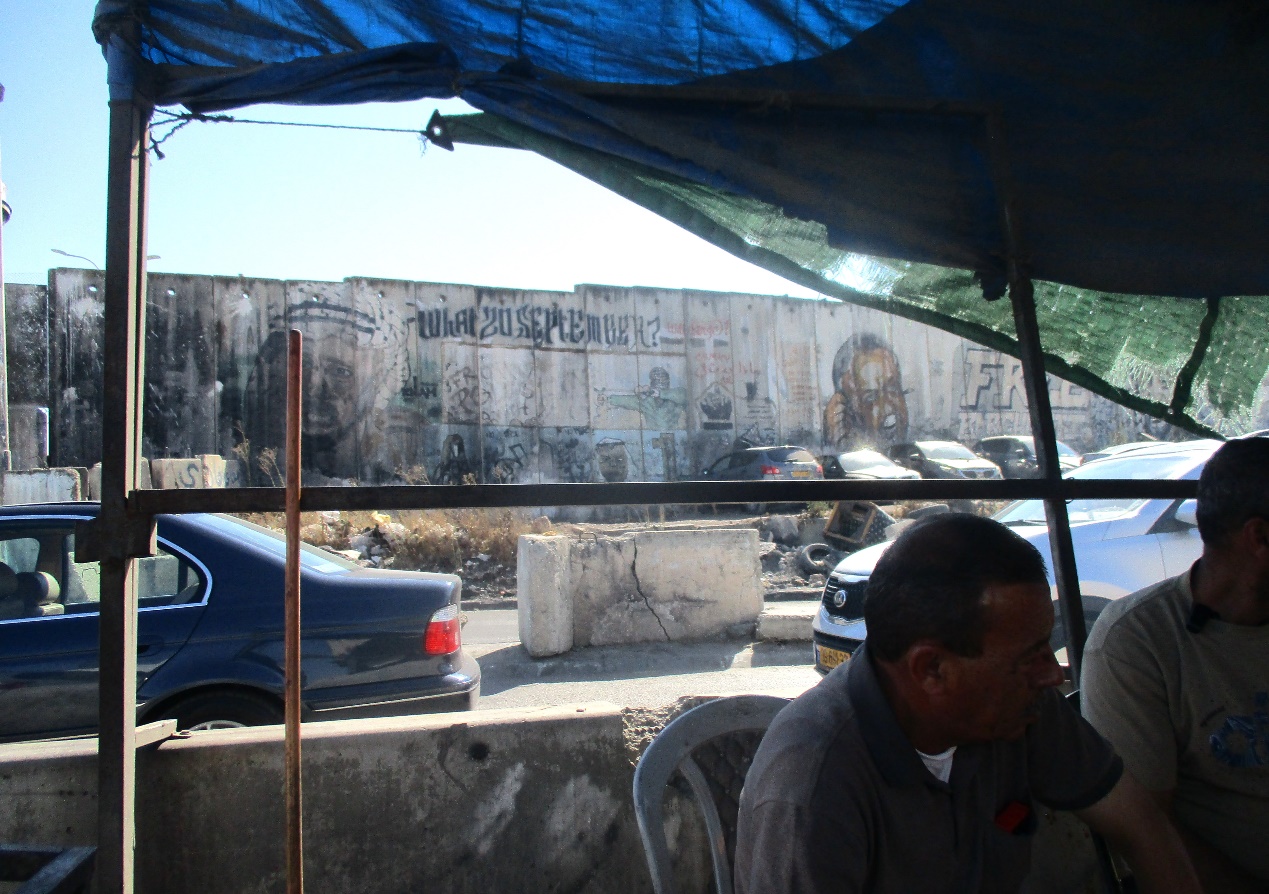 Tamar FleishmanJul-21-2026Qalandiya. Conversation in the shadow of the wall
-
