
Huwwara
Huwwara, Wednesday 13/04/05, PMObservers: E Debbie Y., Deborah L.(reporting)SUMMARY: Wednesday at the Huwwara checkpoint: I got to see what it was like when the soldiers were polite, the traffic was flowing, no one was punished for cutting ahead, and no one was crushed against the turnstiles. As a result I saw clearly how all the seeming “everything is okay” was just the thinnest layer covering a deep, subtle, underlying violence. The fears, threats, cruelties and injustices were a breath away waiting for just the smallest of movements on either side to upset the delicate balance. This somehow permeated even deeper into the spirit because there was nothing concrete to fight against. I found it unnerving, debilitating, and demoralizing. The checkpoint officer was so sympathetic, patient, reasonable and flexible that I wanted to say “what is a nice boy like you doing in a dump like this”. The fact that one can be this kind of good human being and yet carry out this work is somehow more difficult to assimilate and requires one to grabble with the complexity of what each of us views as acceptable or unacceptable. It is all too disquieting.During the shift one of the soldiers saw me watching the young men having their bags checked between the two turnstiles and how the men then had to wait until the soldiers noticed they were available so the button could be pushed to release the turnstile and allow them to pass through. This soldier said he wanted to ask me a question and that my answer was important to him. He said , “I know it is difficult to watch all this but don’t you see that after what happened yesterday(referring to the 15 year old with the bombs tied around him who had been caught the day before)we have to do this?” I said, “Perhaps if this were a checkpoint going into Israel but surely not just between Palestinian Villages.” As the clock ticked through the afternoon, young men waited on line for as long as a half hour; women laden with heavy packages and crying babies waited on line and then had to continue their walk of over 500 meters before catching their bus or taxi; cars were prevented passage because they were not the right size or they did not have the proper permit; students notes or books were confiscated as subversive material; the police were called again and again to check on those with blue IDs who had entered Nablus earlier and now wanted to return to their homes; a man from the infamous “wanted” list was stopped, handcuffed, blindfolded and had his phone taken away from him before he could make a call. All part of a day’s work and all standard procedure.DETAILS ACCORDING TO THE HOUR:13:00 Stopped at Tel Hashomar Hospital to pick up the father of the 2 brothers who were wounded by army gunfire last Wednesday in Kalil and brought him to Hawarre. The father told us his sons were improving each day. What good did it do, he asked, that the army said “sorry, we made a mistake” He told us his sons were good boys and had never done anything. He was deeply grateful for the work the doctors were doing.13:50 Tapuach with 23 vehicles, 3 soldiers on guard with only one checking. We unfortunately continued without stopping because of the guest in our car. 14:00 The town of Hawarre still closed. The taxi drivers at the check point told us they had heard that Hawaree was being punished until Friday.(Note report from Beit Furik Hawarre , TuesdayAM 12/04/05 by Deb. L in English for more detail.)14:15 When we arrived at the checkpoint there were about 50 people on line behind the turnstiles closest to Nablus, there was a humanitarian line for woman and those over 40 outside the turnstiles with the officer A. checking them, the truck that x-rays packages was not there so packages were checked by hand at a station between the back set and front set of turnstiles, 2 soldiers were checking IDs at the front, and one soldier was guarding. The wait on line was just a few minutes for those on the humanitarian line but the wait for the others was more then 20 minutes because of the packages being checked by hand. Two soldiers were checking cars coming into Nablus and 2 were checking those leaving Nablus.14:30 A. asked some soldiers why only 2 were checking IDs. He was told that the 3rd soldier was on his eating break. There is now one detainee who is guarded by a soldier. He is being held because he has an Israeli ID. He is waiting for the police to come. There are 8 vehicles waiting to enter Nablus.14:36 12 vehicles waiting to go in to Nablus. It takes 39 minutes for the last car to get to the front.14:37 The Israeli with the car is released without having to call the police for him. He evidently had a permit after all.(He was held a total of 7 minutes.) 14:40 Humanitarian line closed for a few minutes. We notice that the water faucets in the north are broken and were told in Hawarre South by a taxi driver that they get a new supply of water only every four days and they need it every two days now that it is so hot.14:45 It looks as though there might be another soldier checking IDs, but no they can’t find a 3rd “wanted” list so he goes off to look for one.14:53 Officer A. says that a 14 year old can not go through even though he is with his mother and he is on her ID card. They are now not allowing any boys aged 14-20 who live in Nablus or the surrounding towns pass through without a special permit even when accompanied by a parent. I call the Moked to ask if this is correct. They say they don’t think so but they will check. Until the end of the shift they did not have an answer. Perhaps it is just a reaction to having caught a 15 year old yesterday with bombs wrapped around his body.14:57 The soldier at the area set aside for detainees starts to check the IDs of all those coming into Nablus. 15:10 The line of younger men starts to move faster. The car I had noted at the back of the line almost 40 minutes ago gets to the front of the line and is not allowed to pass. The two men who are lawyers had been called to the Army Court House in Ofir and were on their way home to Nablus. O. says they can go home but their car can not. The paper they have which shows they were invited to come to the Army Court House is not enough. The Court is closed and can not be called. O. trys to call some one at the Matak and is told he is in a meeting and can not be disturbed. The lawyers are told to take their car to the side and wait. We ask what the problem is . O. says “don’t bother it is just a power game.” The answer surprises me since I remember O. on his first day and the sympathy he displayed. It seems he has gotten worn down by the work.15:18 Now it seems there is a specific order about checking the people coming into Nablus. They are looking for someone in particular. The soldier checking them no longer stands in the place of the detainees but closer to the south.15:22 Officer A. continues to have his eyes everywhere making sure the soldiers are doing their jobs and checking people through quickly.15:31 Police arrive to check the Israeli detainee. He waited about an hour until they came and they take about 10 minutes checking him. It is all done very civilly.15:35 Officer A. decides to let the two lawyers through even though there has been no response from the Matak. (This is only one of many examples where Officer A. rather then Matak O. is helpful.)15:50 A. notices the humanitarian line is not orderly. Closes it until they move back. Opens within 3 minutes.16:00 The Police who had come to check the detainee take advantage of the fact that they are here anyway and start to go along the line of cars waiting to go into Nablus and start checking each and every one for their IDs and their car registration. I say, “don’t you think it is enough that they have to wait on line without having to go through another check from you.” The answer is “We’re not bothering them.They are just waiting for the soldiers anyway.” Meanwhile there are about 4 cars behind the police car that can’t move ahead and this is after they have already had to wait on line leaving Nablus. The Police get the hint and leave.16:08 A Palestinian from Gaza is stopped and detained because they suspect a forged ID. The soldiers look at his ID as compared to others. There are those that say it is forged and those that say it is not. Might as well get it checked, is the conclusion.16:15 A group of representatives from Pal/Tel with their identifications around their necks on long ribbons is stopped and told by O. that their car doesn’t have a permit. They argue with him, pull the car aside, and wait. Eventually they are released by Officer A.16:18: Two more detainees from Israel who also have Jordanian passports. They say they are not Israeli citizens just Israeli residents. I make a call to check if there is anything to be done. It seems not. The police are called again.16:47 Officer A. makes sure that there are no 4 people checking IDs as well as a 5th at the humanitarian line. Another turnstile is opened as well.16:53 And yet another Israeli detainee. There are now 4. All of them say they did not see the sign. The one right near the north checkpoint is handwritten in Hebrew.16:56 The man they were looking for coming into Nablus has been found. He is a regal looking man in his 30s with a beard wearing a brown suit and carrying a briefcase. They put him in the detainee area. They see him take out his mobile phone and take it from him. All this is done very quietly. 17:04 The soldiers have the “wanted” man come out of the detainee area and put plastic handcuffs on him and put him in the locked booth. He doesn’t resist. He stands in the booth looking out. The people who are coming into Nablus see him and there are those who recognize him and call him “Shech”. When the soldiers see this, they take him out and put a shirt around his eyes as a blind fold and put him back in the booth. He continues to stand. The soldiers stop checking people coming into Nablus. They have their man.17:16 A van with no windows is not let through by O. A soldier at the checking booth sees this and argues with O. telling him that it is okay. The soldier claims that he had allowed the man to pass through just this morning. O. insists saying the van has produce in it and is therefore commercial. The other soldier gives up saying that in the morning the truck was empty. Is this then the rule? A vehicle that may be commercial when full is an ordinary vehicle when empty? If so then an empty truck we saw being sent back to Nablus when it wanted to leave was forced to return unjustifiably because it did not have anything in it. 17:17 A soldier keeps checking on the phone to see when the police are coming to check the Israelis. Some students complain to us that their notebooks have been taken away and they need them for tests tomorrow. We check with officer A. and he tells the students to just hop over the wall and take whatever books are theirs. They can’t quite believe it. A. tells the soldiers that it doesn’t matter if the notebooks have “suspicious” stickers on them. He brushes their concern about it away. It is obvious to A. that these notes and books are important to the students and are not evidence of subversive material.17:20 A. tells young men that are just sitting and chatting on the wall in the area behind the turnstiles in the direction of Nablus to either get on line if they are leaving Nablus, or go on into Nablus if that is where they are heading. They immediately get off the wall and stand on line.17:30 The police come. As the detainees run to the police jeep they stop and ask us if we could ask the Shech for his mother’s number because they know he wants to call her and tell her he is being held up. I ask A. if I can do it because as I approach the booth the other soldiers tell me not to get any closer. A. explains to me that he promised the “wanted” man that he could call his mother but not yet. A. says he must wait for the okay from the Shaback because the Shech’s mother might warn other “wanted” men that are also being tracked down. We leave.17:45 Tapuach is empty of vehicles. When we ask what happened that there are no car,. they said to us ,”You should have seen it up till now.” This is a first. There was a lone jeep in Hawaree on the side but no flying checkpoints.
Huwwara
See all reports for this place-
The Huwwara checkpoint is an internal checkpoint south of the city of Nablus, at the intersection of Roads 60 and 5077 (between the settlements of Bracha and Itamar). This checkpoint was one of the four permanent checkpoints that closed on Nablus (Beit Furik and Awarta checkpoints to the east and the Beit Iba checkpoint to the west). It was a pedestrian-only barrier. As MachsomWatch volunteers, we watched therre since 2001 two shifts a day - morning and noon, the thousands of Palestinians leaving Nablus and waiting for hours in queues to reach anywhere else in the West Bank, from the other side of the checkpoint the destination could only be reached by public transport. In early June 2009, as part of the easing of Palestinian traffic in the West Bank, the checkpoint was opened to vehicular traffic. The passage was free, with occasional military presence in the guard tower. Also, there were vehicle inspections from time to time. Since the massacre on 7.10.2023, the checkpoint has been closed to Palestinians.
On February 26, 2023, about 400 settlers attacked the town's residents for 5 hours and set fire to property, such as houses and cars. Disturbances occurred in response to a shooting of two Jewish residents of Har Bracha by a Palestinian Terrorist. The soldiers stationed in the town did not prevent the arson and rescued Palestinian families from their homes only after they were set on fire. No one was punished and Finance Minister Smotrich stated that "the State of Israel should wipe out Hawara." Left and center organizations organized solidarity demonstrations and support actions for the residents of Hawara.Hawara continued to be in the headlines in all the months that followed: more pogroms by the settlers, attacks by Palestinians and a massive presence of the army in the town. It amounted to a de facto curfew of commerce and life in the center of the city. On October 5, 2023, MK Zvi established a Sukkah in the center of Hawara and hundreds of settlers backed the army blocked the main road and held prayers in the heart of the town all night and the next day. On Saturday, October 7, 23 The "Swords of Iron" war began with an attack by Hamas on settlements surrounding Gaza in the face of a poor presence of the IDF. Much criticism has been made of the withdrawal of military forces from the area surrounding Gaza and their placement in the West Bank, and in the Hawara and Samaria region in particular, as a shield for the settlers who were taking over and rioting.
On November 12, 2023, the first section of the Hawara bypass road intended for Israeli traffic only was opened. In this way, the settlers can bypass the road that goes through the center of Hawara, which is the main artery for traffic from the Nablus area to Ramallah and the south of the West Bank. For the construction of the road, the Civil Administration expropriated 406 dunams of private land belonging to Palestinians from the nearby villages. The settlers are not satisfied with this at the moment, and demand to also travel through Hawara itself in order to demonstrate presence and control.(updated November 2023)
.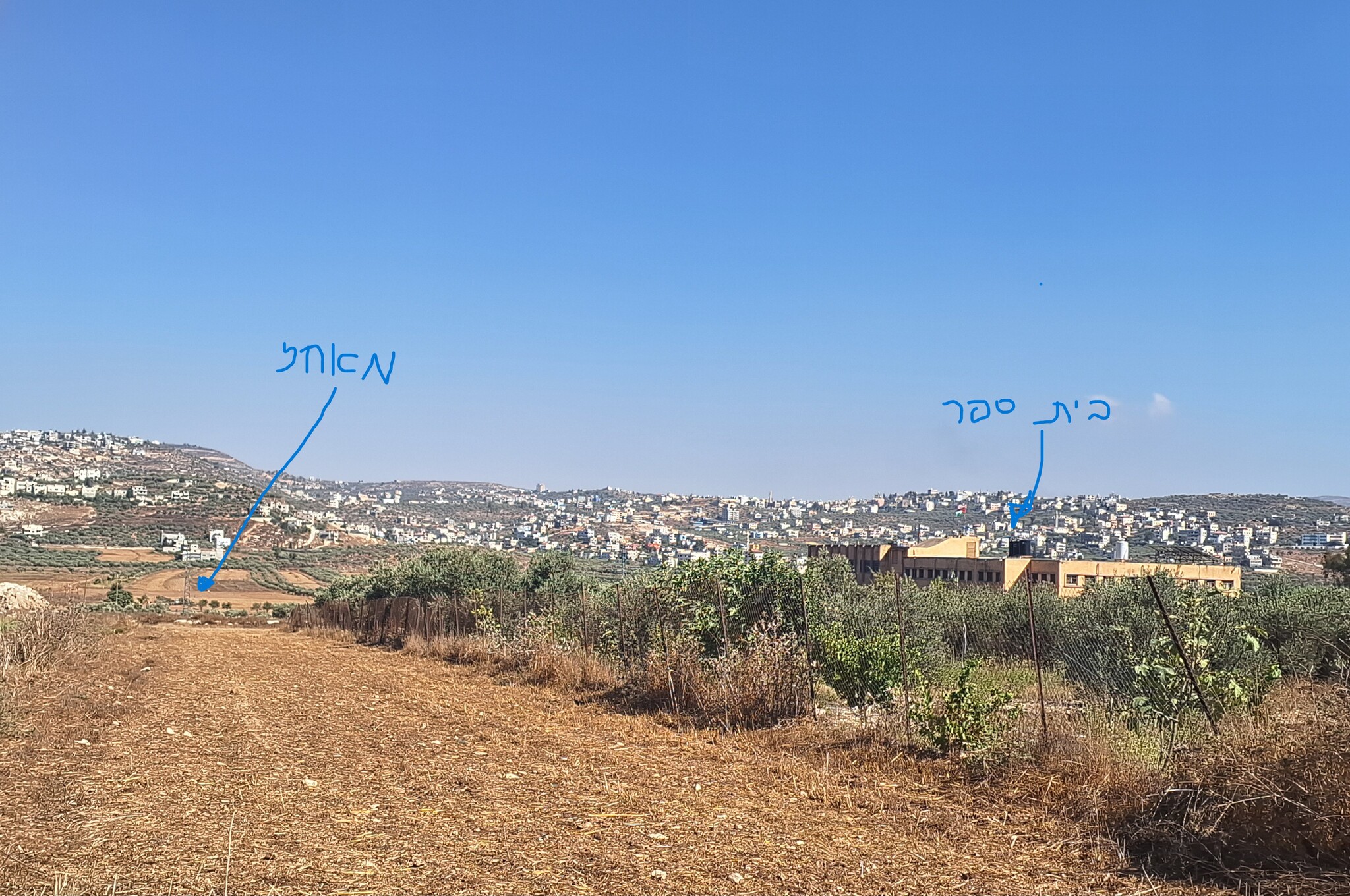 Ronit Dahan-RamatiAug-24-2026Huwara: The school on the outskirts of town and an outpost hidden among the trees
-
