
Huwwara
Huwwara, Saturday April 30th, noon.Observers: Tammy G., Hava H., Aya K. (reporting)The South side of the checkpoint – till recently used to prevent entry into Nablus – is now desolate. The remains of the screening / prevention station (depending on who you ask) are empty, aside from tables with sand bags, covered waiting areas, lines of low concrete walls and foul-smelling toilets. There are no tormentors, and no tormented. Like Pompei after the lava covered the ancient city and left a void that testifies to what was there, these remains only serve to highlight the futility of what took place here.Within and outside of these remains life goes on – flowers on sale, more people who are simply doing their best simply to be able to earn enough to buy something to eat. Today nobody checks those who enter Nablus. Not to worry, tomorrow they’ll be checking – or maybe not. If it’s suddenly not required, why was it needed before? Why was it necessary to prevent thousands of people from returning to their homes, visiting their relatives or coming to work. I remember a woman who wanted to bring some dates to her sister – whom she has not seen for the last two years – and I remember the soldiers chasing her away. Today she would have passed. Is this just abuse for the sake of abuse, or is it – as per one of the signs in the office of the head of the Civilian Administration – a way to ‘keep the Palestinians in a state of uncertainty’?We proceeded to the North side, now called Huwwara checkpoint, manned by soldiers, small parts of a large oppressive machine, all doing their jobs and serving their country – just nice boys and girls. This Saturday, perhaps due to the lack of any particularly evil person there, they all look very much alike.The X-Ray machine works relentlessly. As a reminder, the first barrier to pass is the first set of turnstiles. Having stood in the dense crowd, glued to the metal bars and trampling over each other as a matter of course, the carousel opens and closes at someone’s will. There’s no telling which of the carousels in the line will open, and for how long. It might close before someone actually manages to pass. This process can take half and hour, more, or less – depending on how many jokes the soldiers shared, how many sandwiches those who’ve gone to get lunch have eaten, and whether they’ve returned to their posts full and relaxed or still hungry and malicious. It also depends on the degree to which the people in the line fulfilled the expectations set by the soldiers of acting in a disciplined way, i.e. being quiet, submissive, organized, passive, and simply accepting of their wrongful destiny.The next stage after the turnstiles includes the metal detectors. The checkpoint commander explains that the alarm level relates to the density of metal, but the beeps are continuous and nevertheless everyone passes through. Looking at the part of the detectors facing the soldiers, we saw three red bars lighting up every time – no matter who was passing. In other words, this machine is useless – so why make people who are already humiliated and trampled upon waste more time and stand in line to go through a machine that doesn’t really check anything?Then, after the metal detectors, another set of carousels and through the “sterile area” towards the soldiers, some pointing their weapons and some not, some with fingers on the trigger and some not. ‘Send them all to the yellow line’ shouts soldier A. ‘I told you not to pass’ he shouts in Hebrew to a person who does not understand him. Backwards, forwards, ‘yalla yalla, arja’. A little giggle passes between a blue-eyed soldier and his female colleague who’s hair blows in the wind. Go away, get out of here, no, yes… ‘Go away already’, angrily says soldier D, while playing with a chain of plastic beads in one hand, and holding the rifle with his finger on the trigger with the other hand.The screeching sound of the locking carousels seems to plough through my skin. The soldiers have a list of names, and seem to be comparing the ID numbers of people passing through the checkpoint to this list. Some people they’re hunting for, and others? Must be based on their imagination… After all this, awaits the X-Ray screening machine. On one side stands a soldier, tapping his fingers on the surface, as if calling the sheep. His weapon hanging sloppily and his gaze is unfocused. People put their suitcases, bags and other belongings on the moving surface, the bags go through the machine, and moving out they reach the edge on the other side and fall to the floor. Pita bread disperses on the ground, clothing is smothered in dust, and people try to run fast to the other side to collect what they can before it hits the ground.And then – the machine was gone. Why is it gone? If it was here for a reason other than abuse, how come it is now gone? It must be gone because it was only here for deliberate abuse! At the beginning, there was also something called the ‘humanitarian line.’ This line was reserved for the elderly and for women with children. At some point the soldiers left the place where this line used to form. Why? Just because…People are crowded, waiting in line, are afraid to move. Soldiers (with no eye-sight problems) are scattered around the area, but they don’t see. They don’t see people. The hardships of the people in front of them, the fact that they are real human beings with faces and first names, do not seem to be grasped by soldiers. If they were, how could they stand there and torture them as an approach?Meanwhile the Palestinians in line do not dare cross the line, even when soldiers are not there. They continue to stand there, and that’s how time goes by. One woman starts walking towards the vehicle screening line. She carries a heavy sack on her head, and two huge plastic bags with countless shoe boxes in her arms. Silently we think, God, she’s going where she’s not allowed – not through the pedestrian screening line. We hope they won’t do anything to her and our heart misses a beat. She does not ask for permission… God… and she continues… looking forward, passing next to soldiers who do not stop her. They don’t look at her, don’t see her, in spite of the fact she is just centimeters away from them, crossing the checkpoint where she’s not allowed.She who does not see the occupation, the occupation does not see her. She to whom the soldiers are transparent, is transparent to them.A large group of women and children at various ages also tries this route. Their posture is not erect and their gaze asks – are we allowed? Is it OK? No, it’s not OK, God forbid. The Israel Defence Force representatives, with their ridiculous mix of rifles, hard hats and bullet-proof vests, jumped up and down – yelling at the Palestinians to chase them away. Because, why should they be able to pass just like that, ‘breaking the law.’ So what if it’s their land, their home and their right as human beings? So they turned back, scared women, children and babies, and stood back in the official line, to pass according to ‘the law.’A young man is sent to the detention area. A soldier carefully checks a plastic bag he carried, containing plastic pens, writing pads, Mathematics school books, a Koran, and a notebook with a magazine clip glued to it. She meticulously checks every detail, looking at what she cannot read, checking – with the tools she does not have and the right she also lacks – whether the bag contains any inflammatory materials. It takes some time, not too long and also not that short, after which he receives her permission to pass.A young woman arrives with two children, a boy of 13 and a girl of about 4. After passing through the carousels, the metal detectors and the soldiers with pointed weapons, they start walking slowly away on the pathway. Just then, we suddenly see the checkpoint commander and another soldier running, rifles forward, towards them. They stop, and the checkpoint comm. ander signals the boy to open the bags. The boy, scared to death, bends down and opens them, taking out the packed clothing, the towels and the blankets, and placing them on the pathway. Slowly, without looking sideways, he continues to remove more and more items from the bags, placing them on the ground, his back frozen in position. People passing by this family’s privacy, spilled all over the ground, mostly do not look. The soldiers standing above with their rifles pointed, suddenly turn around and leave, without saying a word, even before the boy finishes emptying the bag. Everything freezes for a moment, and then the woman crouches to the ground and slowly picks all of their belongings, placing them back into the bag.
Huwwara
See all reports for this place-
The Huwwara checkpoint is an internal checkpoint south of the city of Nablus, at the intersection of Roads 60 and 5077 (between the settlements of Bracha and Itamar). This checkpoint was one of the four permanent checkpoints that closed on Nablus (Beit Furik and Awarta checkpoints to the east and the Beit Iba checkpoint to the west). It was a pedestrian-only barrier. As MachsomWatch volunteers, we watched therre since 2001 two shifts a day - morning and noon, the thousands of Palestinians leaving Nablus and waiting for hours in queues to reach anywhere else in the West Bank, from the other side of the checkpoint the destination could only be reached by public transport. In early June 2009, as part of the easing of Palestinian traffic in the West Bank, the checkpoint was opened to vehicular traffic. The passage was free, with occasional military presence in the guard tower. Also, there were vehicle inspections from time to time. Since the massacre on 7.10.2023, the checkpoint has been closed to Palestinians.
On February 26, 2023, about 400 settlers attacked the town's residents for 5 hours and set fire to property, such as houses and cars. Disturbances occurred in response to a shooting of two Jewish residents of Har Bracha by a Palestinian Terrorist. The soldiers stationed in the town did not prevent the arson and rescued Palestinian families from their homes only after they were set on fire. No one was punished and Finance Minister Smotrich stated that "the State of Israel should wipe out Hawara." Left and center organizations organized solidarity demonstrations and support actions for the residents of Hawara.Hawara continued to be in the headlines in all the months that followed: more pogroms by the settlers, attacks by Palestinians and a massive presence of the army in the town. It amounted to a de facto curfew of commerce and life in the center of the city. On October 5, 2023, MK Zvi established a Sukkah in the center of Hawara and hundreds of settlers backed the army blocked the main road and held prayers in the heart of the town all night and the next day. On Saturday, October 7, 23 The "Swords of Iron" war began with an attack by Hamas on settlements surrounding Gaza in the face of a poor presence of the IDF. Much criticism has been made of the withdrawal of military forces from the area surrounding Gaza and their placement in the West Bank, and in the Hawara and Samaria region in particular, as a shield for the settlers who were taking over and rioting.
On November 12, 2023, the first section of the Hawara bypass road intended for Israeli traffic only was opened. In this way, the settlers can bypass the road that goes through the center of Hawara, which is the main artery for traffic from the Nablus area to Ramallah and the south of the West Bank. For the construction of the road, the Civil Administration expropriated 406 dunams of private land belonging to Palestinians from the nearby villages. The settlers are not satisfied with this at the moment, and demand to also travel through Hawara itself in order to demonstrate presence and control.(updated November 2023)
.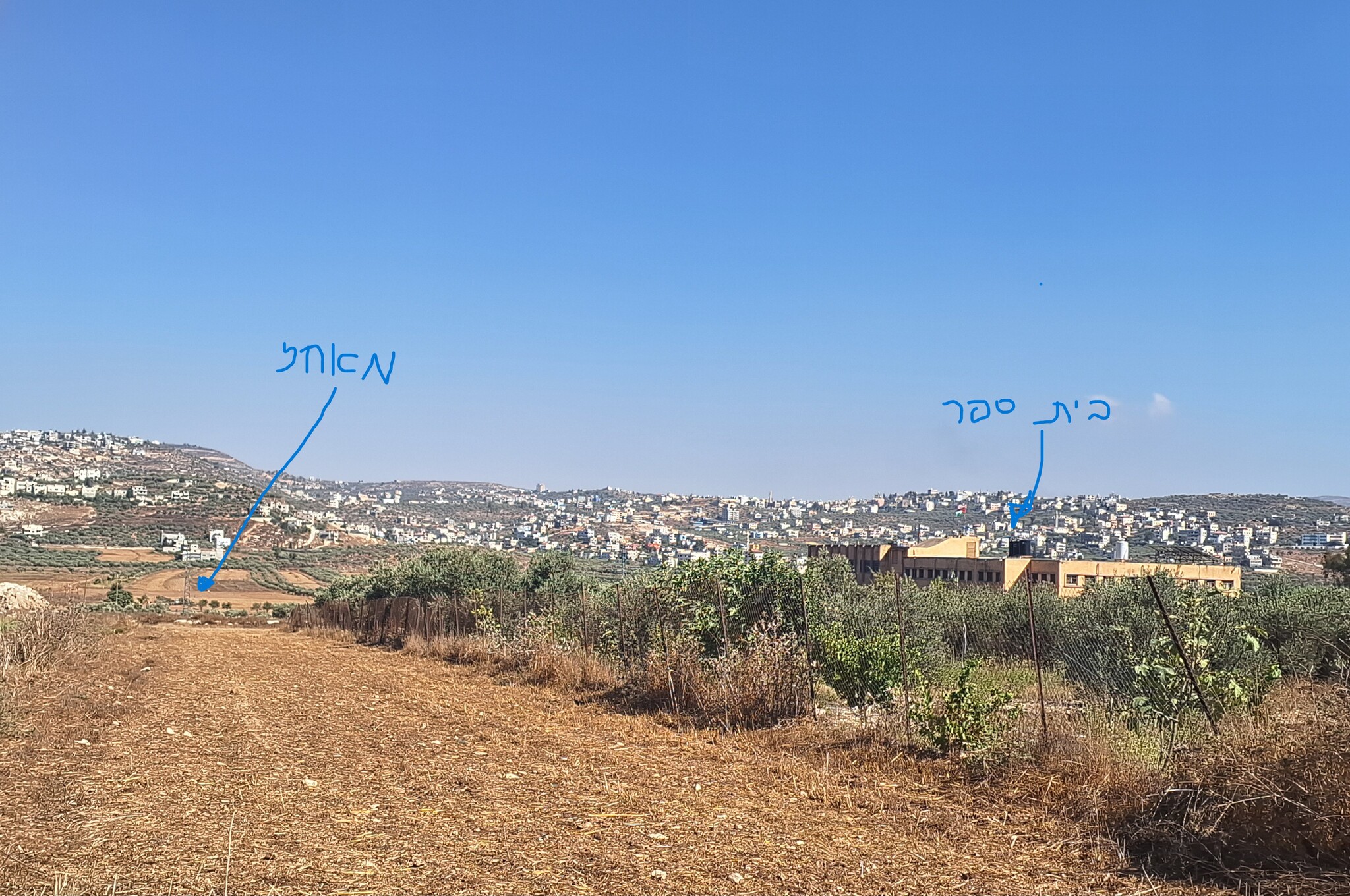 Ronit Dahan-RamatiAug-24-2026Huwara: The school on the outskirts of town and an outpost hidden among the trees
-
