
Huwwara
HUWWARA , Wednesday 17 October 2004 PM Rihah Y.,Beria L., Elat B.,Deborah L. (reporting) colour=red>At 13:40, when we arrived at the Tapuah intersection there were about 10 vehicles coming from the west, four from the Jerusalem direction and 33 from Huwwara. About 100 metres from there, in the direction of Huwwara, an army jeep waited by the road with armed soldiers aiming their weapons both away from and towards the jeep. At the intersection with Route 60, just before the checkpoint and facing south, more than 50 young men stood in the pouring rain alongside a very long line of vehicles . At first, the soldiers would not let us pass because they said there was an alert at the Huwwara checkpoint. A few minutes later they let us through. We called to complain about the long lines of men and vehicles to the Huwwara District Coordinating Office (DCO) [the army section that handles civilian matters; it generally has representatives at the checkpoints ostensibly to alleviate the lot of the Palestinians]. They said they knew of the problem and were taking care of it. Huwwara North All this was a prelude to what we saw at Huwwara North. There were about 30 detainees who’d been there since the morning. Because of a “security situation” none of the detainees had been released. [Detainees are, typically, men aged from 16 to 30 or 35 who have no passage permits; recently, young women, too, have been detained. The detainees’ ID details are phoned through to the General Security Services (GSS, also known as the Shabak or the Shin Bet, the Hebrew acronym for the GSS) for checking against a central list of security suspects and the answers are then relayed back to the checkpoints. This cumbersome process can take considerable time, and that can be prolonged even more if the soldiers wait to accumulate a batch of ID cards before passing them on to the GSS , or if they behave in a similarly tardy manner at the end of the process, waiting until they have a batch of GSS clearances before they release individual detainees. Meanwhile, the detainees are virtually prisoners at the checkpoint where the soldiers retain the ID cards until the entire process is completed]. It was pouring with rain and hundreds of people were waiting to pass through the checkpoint from Nablus. We were told by an officer that the checkpoint had been closed for two hours and that it had just re-opened. The situation deteriorated from minute to minute. The pressure of people built up to the point where the whole roofed-over area was packed with people and all the turnstiles leading to the checking positions were jammed. [these are not simple turnstiles such as one finds in a subway station, but high, revolving gates made of steel bars: each segment is barely large enough to admit one average-sized person; there is virtually no room to spare for anything that person may be carrying , whether a child or a parcel; passage for pregnant women or for the elderly is extremely difficult and frightening] . People were squashed together with their young children and infants, with their plastic bags and their luggage. There were a great many soldiers on hand, including officers and DCO officials ; but no amount of yelling, or explaining that people must move back or the turnstiles would not revolve properly, helped in any way. It was a terrible sight. Everything was almost at a standstill, with only a few people managing to pass through from time to time. The long wait , the torrents of rain, the cold, the pushing and shoving had a fearful effect on people and many seemed in a state of shock, frustrated, and angry. Children were crying, screaming and shivering violently with the cold. One soldier really did his best to maneuvre the turnstile so that women and children could pass through. He made efforts to coordinate his pushing with shouting to the soldier at the checking station 50 metres away to press the remote-control button that would release the turnstile, and he kept this up for at least half-an-hour. He also tried very patiently to explain to the people what he was doing. On the other hand, there was another soldier who felt nothing could be done until everyone had moved back from the turnstiles , and he stood there helplessly. A third soldier screamed at me: “They are not human beings. They are monkeys. They only understand when you shoot at them and kill them! They are baboons! Jews would never act like they acted at Arafat’s funeral!”…and so on. Our phone calls to the army’s “humanitarian” hotline and to the DCO were useless because they insisted that Huwwara North was closed and that was the reason that nothing was moving. I told them I was standing there and could see with my own eyes that the soldiers were trying to let people pass but that the pressure of the crowds was quite simply too much. At one point, some detainees were released, but others remained because they still needed to be checked further. Even the soldiers admitted that the detainees had been there for between four and six hours, and this without access to lavatories, without food or drink , and with the rain pouring down the whole time. Anyone who did manage to pass through stood in the torrential rain a few metres away from the checking stations waiting for children, wives, husbands , sisters, etc. There was no dry place for them to be. Huwwara SouthThe situation here was better. Rihah and Beria were there for about an hour and then joined us in at the northern checkpoint. They reported that as they’d arrived at Huwwara South there’d been a change of shifts. The previous shift had detained many people who had the correct permits. The new shift released those people immediately and from then on things were kept moving. We left at 16:00 even though the situation at Huwwara North continued to be distressing. On our way home, we made some more phone calls, hoping to impress on as many people as possible in the army that the situation was intolerable. Something must be done about those turnstiles: they literally prevented people from moving and caused them instead to panic hopelessly.
Huwwara
See all reports for this place-
The Huwwara checkpoint is an internal checkpoint south of the city of Nablus, at the intersection of Roads 60 and 5077 (between the settlements of Bracha and Itamar). This checkpoint was one of the four permanent checkpoints that closed on Nablus (Beit Furik and Awarta checkpoints to the east and the Beit Iba checkpoint to the west). It was a pedestrian-only barrier. As MachsomWatch volunteers, we watched therre since 2001 two shifts a day - morning and noon, the thousands of Palestinians leaving Nablus and waiting for hours in queues to reach anywhere else in the West Bank, from the other side of the checkpoint the destination could only be reached by public transport. In early June 2009, as part of the easing of Palestinian traffic in the West Bank, the checkpoint was opened to vehicular traffic. The passage was free, with occasional military presence in the guard tower. Also, there were vehicle inspections from time to time. Since the massacre on 7.10.2023, the checkpoint has been closed to Palestinians.
On February 26, 2023, about 400 settlers attacked the town's residents for 5 hours and set fire to property, such as houses and cars. Disturbances occurred in response to a shooting of two Jewish residents of Har Bracha by a Palestinian Terrorist. The soldiers stationed in the town did not prevent the arson and rescued Palestinian families from their homes only after they were set on fire. No one was punished and Finance Minister Smotrich stated that "the State of Israel should wipe out Hawara." Left and center organizations organized solidarity demonstrations and support actions for the residents of Hawara.Hawara continued to be in the headlines in all the months that followed: more pogroms by the settlers, attacks by Palestinians and a massive presence of the army in the town. It amounted to a de facto curfew of commerce and life in the center of the city. On October 5, 2023, MK Zvi established a Sukkah in the center of Hawara and hundreds of settlers backed the army blocked the main road and held prayers in the heart of the town all night and the next day. On Saturday, October 7, 23 The "Swords of Iron" war began with an attack by Hamas on settlements surrounding Gaza in the face of a poor presence of the IDF. Much criticism has been made of the withdrawal of military forces from the area surrounding Gaza and their placement in the West Bank, and in the Hawara and Samaria region in particular, as a shield for the settlers who were taking over and rioting.
On November 12, 2023, the first section of the Hawara bypass road intended for Israeli traffic only was opened. In this way, the settlers can bypass the road that goes through the center of Hawara, which is the main artery for traffic from the Nablus area to Ramallah and the south of the West Bank. For the construction of the road, the Civil Administration expropriated 406 dunams of private land belonging to Palestinians from the nearby villages. The settlers are not satisfied with this at the moment, and demand to also travel through Hawara itself in order to demonstrate presence and control.(updated November 2023)
.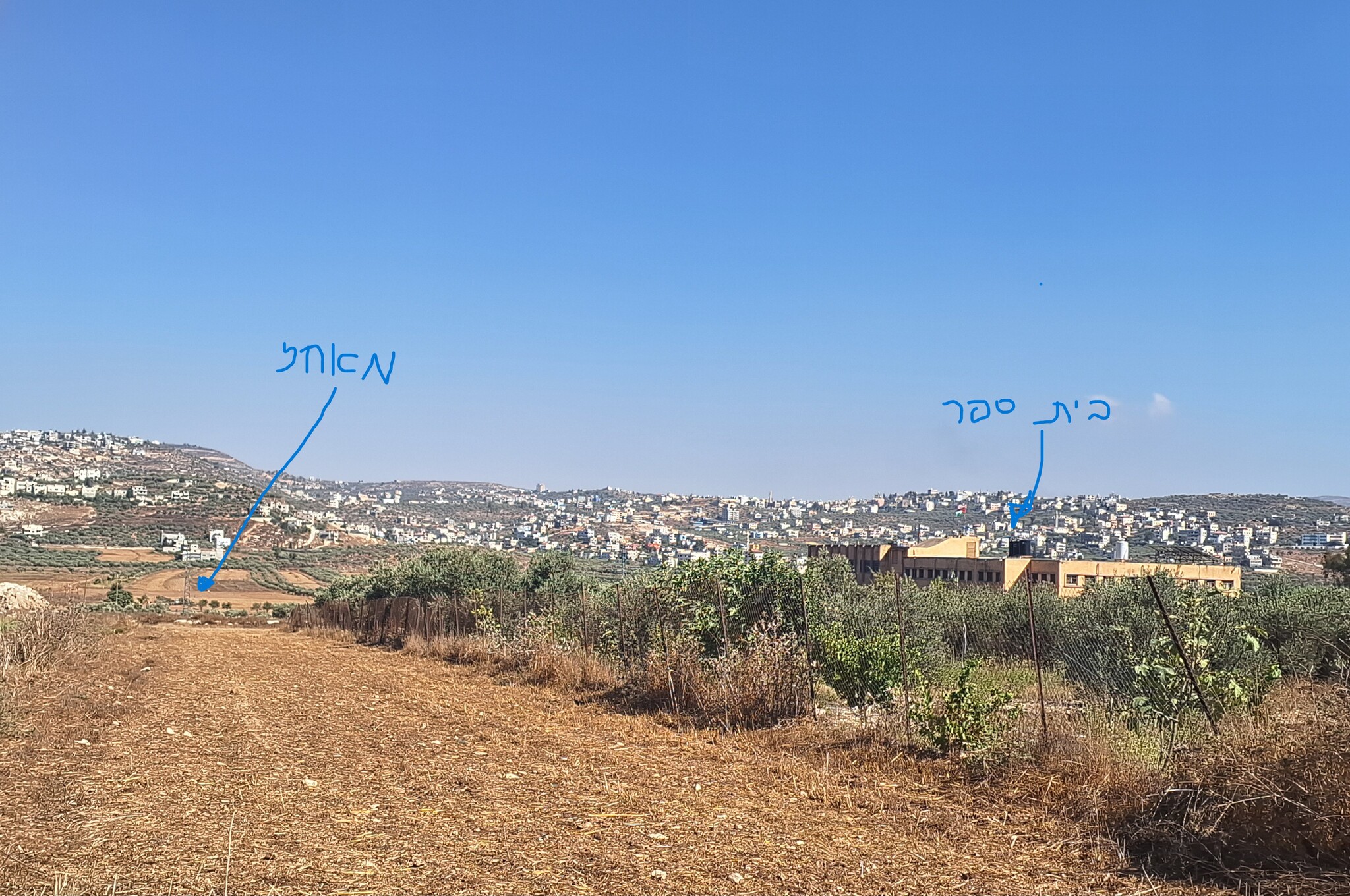 Ronit Dahan-RamatiAug-24-2026Huwara: The school on the outskirts of town and an outpost hidden among the trees
-
Jerusalem
See all reports for this place-
The places in East Jerusalem which are visited routinely by MachsomWatch women are Silwan and Sheikh Jarrah. During the month of Ramadan, also the Old City and its environs are monitored.
-
