
Huwwara, Beit Furik, Sarra AM
HUWWARA, BEIT FURIK, SARRA, Sunday 15 August 2004 AMObservers: Hanna L., Nora P., Ditza I., Shifra S., Tali Y., Dina A. (reporting) and a guest colour=red> GeneralThe checkpoint was all dolled up : turnstile gates, shade, commanders who have taken a special course (I can’t believe I’m writing this…) – Good morning, thank you, hello ma’am, what can I do for you? Order and discipline. It’s amazing . But if I thought last week that cynicism had the upper hand, this week I saw just how pathetic this place really was. It won’t help. The injustice screamed out even louder.We weren’t exactly welcomed here in the past, but now they seemed to be determined to make us invisible . Soldiers didn’t respond, commanders adopted a “functional” approach – they answered politely while ignoring the essence of our questions. I felt these were definitely orders – and orders from the system, at that. Last week we were told that wasn’t so, there’s no such order. But the soldier/officer may choose to answer, or not answer us. I think this is a measure of the effect that our activity has had on the media and the fact that we have managed to make an impact on the public with the checkpoint issue as just one aspect of the occupation.The simple act of observation and documentation patently does have an impact. There’s nothing that angers them more than our little notebooks.08:00 – A line of cars was held up at Tapuach junction.08:10 – Huwwara SouthThere were 35 detainees, and only a relatively sparse queue of Palestinians waiting to go through the checkpoint. Three soldiers were on duty there with rifles pointed at civilians. A volunteer was cozying up to the soldiers. A settler van arrived and there were shouts of “The shits are here”. One of the soldiers informed me that the only person who’d talk to us would be the representative of the District Co-ordinating Office (DCO), but not the soldiers [the DCO is the army section that handles civilian matters; it usually has representatives at the checkpoints, ostensibly to alleviate the lot of the Palestinians]. Students who hadn’t yet received their student cards but had registered to study were sent to the detainees’ shed, and their ID cards were taken for checking [ by the General Security Services (GSS)], never mind that their exam was due to start at 09:30. At 08:45, when some of them got [security] clearance, the checkpoint commander, L., wrote one line on each one’s papers that would enable them to get back. No doubt that he has passed the [checkpoint commanders’] course – he was politeness itself, though he did keep them at a distance so they knew their place while he jotted down the words that would save them hours on their way back. Woe to anyone who did not find him clever or nice. L. spoke English well and practised it with anyone who approached him, in proper “customer service” style. Unlike him, soldier G. was especially rough. The number of detainees fluctuated between 15 and 35 throughout the morning [detainees are typically men between the ages of 16 and 30 who do not have passage permits; their I D details are relayed by the checkpoint soldiers to the GSS where they are checked against a central list of security suspects: this cumbersome procedure in any case usually takes a long time and that time can be even longer if the soldiers wait to accumulate a batch of ID cards before phoning through the details; similarly, they may wait until they have a batch of replies before they start releasing detainees. Throughout this period, the detainees are virtually prisoners at the checkpoint since the soldiers retain the ID cards until clearance comes through]. 08:15 Huwwara North There was a young Palestinian, handcuffed, inside the “pen”. The soldiers claimed he’d gone wild on the south side of the checkpoint , raised his hand against the soldiers and tried to escape. He was there with his wife who, he claimed, was carrying a dead foetus which she must have aborted at the Nablus hospital. According to the soldiers on the north side, he was likely to be taken into custody. At the army’s so-called ‘humanitarian’ hotline they said nothing could be done. Either arrest him or decide to free him. Hanna L. managed to talk round the DCO officer here ( a lieutenant on reserve duty), and at 09:45 the man was released.10:00 – Beit Furik There were hardly any people. The village was under curfew following recent events. Here too the soldiers ignored us.10:30 – Sarra We went into Sarra because we hadn’t been here for nearly two months. The place was empty, deserted, three soldiers yawned away, it was hot, the Israeli flag waved over the outpost and its mighty concrete blocks.
Huwwara
See all reports for this place-
The Huwwara checkpoint is an internal checkpoint south of the city of Nablus, at the intersection of Roads 60 and 5077 (between the settlements of Bracha and Itamar). This checkpoint was one of the four permanent checkpoints that closed on Nablus (Beit Furik and Awarta checkpoints to the east and the Beit Iba checkpoint to the west). It was a pedestrian-only barrier. As MachsomWatch volunteers, we watched therre since 2001 two shifts a day - morning and noon, the thousands of Palestinians leaving Nablus and waiting for hours in queues to reach anywhere else in the West Bank, from the other side of the checkpoint the destination could only be reached by public transport. In early June 2009, as part of the easing of Palestinian traffic in the West Bank, the checkpoint was opened to vehicular traffic. The passage was free, with occasional military presence in the guard tower. Also, there were vehicle inspections from time to time. Since the massacre on 7.10.2023, the checkpoint has been closed to Palestinians.
On February 26, 2023, about 400 settlers attacked the town's residents for 5 hours and set fire to property, such as houses and cars. Disturbances occurred in response to a shooting of two Jewish residents of Har Bracha by a Palestinian Terrorist. The soldiers stationed in the town did not prevent the arson and rescued Palestinian families from their homes only after they were set on fire. No one was punished and Finance Minister Smotrich stated that "the State of Israel should wipe out Hawara." Left and center organizations organized solidarity demonstrations and support actions for the residents of Hawara.Hawara continued to be in the headlines in all the months that followed: more pogroms by the settlers, attacks by Palestinians and a massive presence of the army in the town. It amounted to a de facto curfew of commerce and life in the center of the city. On October 5, 2023, MK Zvi established a Sukkah in the center of Hawara and hundreds of settlers backed the army blocked the main road and held prayers in the heart of the town all night and the next day. On Saturday, October 7, 23 The "Swords of Iron" war began with an attack by Hamas on settlements surrounding Gaza in the face of a poor presence of the IDF. Much criticism has been made of the withdrawal of military forces from the area surrounding Gaza and their placement in the West Bank, and in the Hawara and Samaria region in particular, as a shield for the settlers who were taking over and rioting.
On November 12, 2023, the first section of the Hawara bypass road intended for Israeli traffic only was opened. In this way, the settlers can bypass the road that goes through the center of Hawara, which is the main artery for traffic from the Nablus area to Ramallah and the south of the West Bank. For the construction of the road, the Civil Administration expropriated 406 dunams of private land belonging to Palestinians from the nearby villages. The settlers are not satisfied with this at the moment, and demand to also travel through Hawara itself in order to demonstrate presence and control.(updated November 2023)
.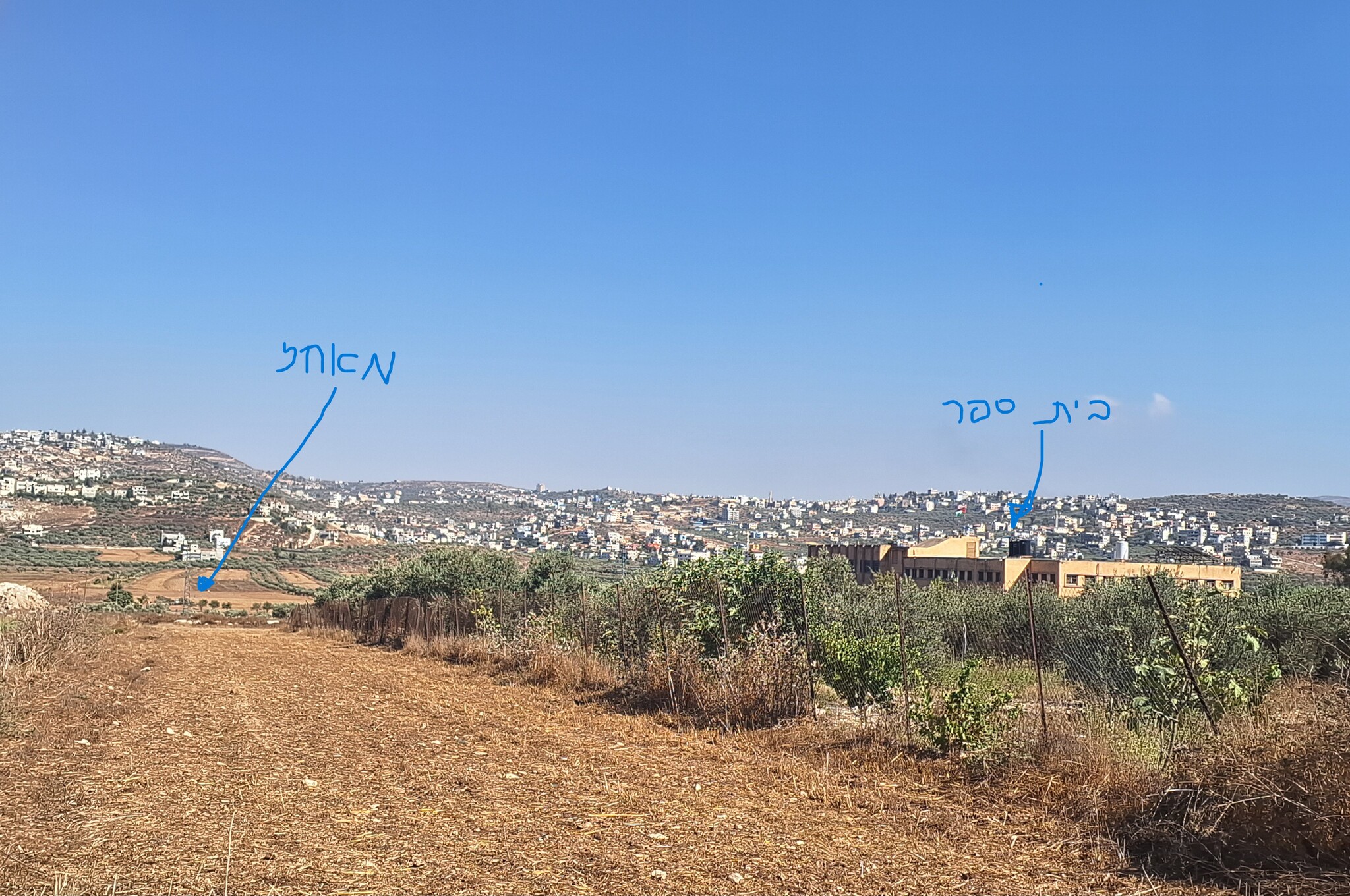 Ronit Dahan-RamatiAug-24-2026Huwara: The school on the outskirts of town and an outpost hidden among the trees
-
Sarra
See all reports for this place-
Sarra
The checkpoint is installed between the Palestinian village of Sera and the district city of Nablus,
Since 2011, internal barriers Located among the West Bank Israeli settlements have somehow allowed, Palestinian residents to travel and move and reach various Palestinian cities.
After the terrible massacre by the Hammas on October 7 upon Israelis in the communities around Gaza, internal checkpoints manned by the army were installed to prevent free passage for Palestinians.
Many restrictions were imposed on the Palestinians in the West Bank. The prevention of movement shuttered the possibility of making a living in Israel. The number of Palestinian attacks by Israeli extremist settlelers increased along with the radicalization of the army against the Palestinians.
The conduct at the Sera checkpoint is one of the manifestations of the restrictions on all aspects of the Palestinians' lives.
-
