
Huwwara Beit Furik Za’atara Jnc.
Huwwara, Beit Furik, Za’atara Jnc., Arwwata – Monday, 8.5.06 PMObservers: Edna k., Merav A. (reporting)Translation: Hanna K.14:20 Road No. 5 – The morning shift reports to us that on their way back in the morning they encountered on the road near Elkana a big group of Palestinian men who had been caught by the army and the police. We find the group at the same place, and the soldiers naturally tell us that they have been staying there for less than an hour. The group holds 35 Palestinians who were on their way to look for work in Israel without work permits. The soldiers say that within ten minutes a bus is due to take them to the Zaatara Junction. We exchanged phone numbers with two of the group and went on.We shall see them arriving at Zaatara only one hour later, at 15:35.We enetered the access road to Barukin and saw that the Army was not saving any effort, three earth mounds and an iron gate block the access road to the village. The inhabitants of the village have to climb over the earth mounds and to walk a distance of about 50 meters to reach the cars on the other side. There is no military presence.14:50 -the gates of Marda and Zeita are open.14:55 Zaatara Junction CP – three cars from the west, seven from the north. The checking is slow but there is no queue as the traffice is slight. There is one checking point from the west and two from the north. The soldiers report to us that the movement restrictions are as usual, apart from the separation there is a list of problematic places, people who are registered as their inhabitants cannot pass.15:35 -The bus of the detainees from Elkana arrives at Zaatara, the soldiers give them their IDs back and let them go. One man from the group approaches us and tells us that his driving license was in the same folder as the ID, and when the policemen took his papers to be checked they returned his ID but the driver’s license disappeared. His car is there, at Zaatara, but he cannot drive home without the license. At the CP there is a police patrol vehicle and we turn to them in an attempt to locate the policemen who took the license, but they are not to be found. The policeman refuses to attempt at finding a solution to enable him to reach his home (“I wouldn’t have enabled this to my own brother”).15:50 -On the entrance road to Beita there is a new earth mound which blocks the road.15:55 -The town of Huwwara is under curfew. One of the inhabitants reports to us that two hours before, military jeeps passed and ordered to close all the shops. On our way back, at 18:20, the town is still under curfew. 16:05 The Huwwara Junction CP – 15 cars in the queue, a minibus is being checked meticulously, all the passengers have been ordered to leave it.16:15 Huwwara CP – There are three detainees, the first is released when we reach the CP.The second is a young man from Balata who heard on the previous evening that the army was looking for him, and came to hand himself in. With him are members of his family , they have been sitting there since the morning, and will remain there after we will have left the CP. Around 19:00 we called them and they were still at the CP. The young man’s father tells us that they have no idea why he is wanted. They sit there, very nervous, and from time to time begin crying.The third detainee is a taxi driver who crossed the imaginary line – approached the CP too much – and whose papers and keys were confiscated by the CP commander in the morning. According to him the keys and the papers were confiscated at 8:00 in the morning and the commander told him to go home and to return at noon to take them. The CP commander is first lieutenant R. who arrived there at noon only. According to him the taxi driver was detained in the morning but escaped. The driver returned at noon to get his ID, and since then he is detained as a punishment for escaping in the morning and for having entered the forbidden area with his taxi. He doesn’t believe that the CP commander of the morning just let the driver go.R. goes around with a pile of IDs of taxi drivers which the CP commander of the morning left him. It seems the morning commander was especially negligent, judging by the great number of drivers who ran away. We explain to him that he has no right to detain for punishment purposes and he claims that on the days before there was the visit of the deputy brigade commander and he got new orders, and that now it is allowed to punish. We contact the “humanitarian” center of the army and to the brigade spokesman. Both repeat the same answer – the orders have not been changed, it is not allowed to detain as a punishing measure.R. explains to us that when a taxi driver crosses the imaginary line he in fact is a security and transport risk and that therefore he has the right to detain him. In spite of all our pleading the driver is released at 18:00 only, ten hours after his keys were confiscated and after three hours of detention at the CP.Another person who tried to bypass the CP by way of the entrance path to Nablus, is being detained. He claims that he is from Ramallah, and this is his first time here, and he therefore crossed by mistake at the wrong path. R. insists on detaining him as a punishment. After less than an hour he is released.Most of the time of our stay at the CP the women and elderly people’s queue didn’t function. From time to time it was opened for short periods. The traffice is relatively sparse, just a few people in the queue.During our conversation with the taxi driver the CP commander hears that he says that he has been put in the “sewage pit” and corrects him: “this is no sewage pit, this is a waiting shed”. All in all R.’s mouth is producing pearls. He explains to us that the CP is situated where it is because at that point the border between Israel and the Palestinian Authority passes. He has never heard of the Green line. Towards the end of the shift he tells us that he is happy that Machsomwatch are at the CPs because we help him and the army to maintain a moral balance. it is not clear what that means exactly, balance between what? In any case it is not clear what moral balance is maintained, we didn’t find it.17:20 Beit Furik – there is hardly any traffic, the taxi drivers report that all the restriction have been lifted, both on pedestrians and on cars. The soldiers at the CP confirm this.17:50 back to the Huwwara CP – A student who forgot his ID at home is not allowed to pass. He contacted his home and they gave him the number, but R. insists that he must the the card itself, and that somebody should bring him the card from home. The student lives in Zeita and two CPs separate him and his home and make this request an impossible one. In the end R. listens to our pleading and lets the student go on his way.18:20 The Huwwara Junction CP – 18 cars. The soldiers make a car, in which there is an inhabitant of Salama, go back. He does not understand why at the Huwwara CP he was allowed to pass and here he is not allowed to go on. There are two detainees at the CP, a taxi driver and a passenger, they tried to bypass the CP. They are already detained since an hour and a half, the soldiers at the CP are hostile and are only prepared to say that the detainees will be released “when their time comes”. Twenty minutes later we hear from the detainees that they were released. The army “humanitarian” center, which we approached in the matter of these detainees returns our call at 20:00 and say that the answer they received from the brigade is that all this has never happened – nobody was detained at the Huwwara Junction CP. We must be hallucinating.18:50 Zaatara Junction CP – there are not cars in the queue from the north, five cars from the west.
Huwwara
See all reports for this place-
The Huwwara checkpoint is an internal checkpoint south of the city of Nablus, at the intersection of Roads 60 and 5077 (between the settlements of Bracha and Itamar). This checkpoint was one of the four permanent checkpoints that closed on Nablus (Beit Furik and Awarta checkpoints to the east and the Beit Iba checkpoint to the west). It was a pedestrian-only barrier. As MachsomWatch volunteers, we watched therre since 2001 two shifts a day - morning and noon, the thousands of Palestinians leaving Nablus and waiting for hours in queues to reach anywhere else in the West Bank, from the other side of the checkpoint the destination could only be reached by public transport. In early June 2009, as part of the easing of Palestinian traffic in the West Bank, the checkpoint was opened to vehicular traffic. The passage was free, with occasional military presence in the guard tower. Also, there were vehicle inspections from time to time. Since the massacre on 7.10.2023, the checkpoint has been closed to Palestinians.
On February 26, 2023, about 400 settlers attacked the town's residents for 5 hours and set fire to property, such as houses and cars. Disturbances occurred in response to a shooting of two Jewish residents of Har Bracha by a Palestinian Terrorist. The soldiers stationed in the town did not prevent the arson and rescued Palestinian families from their homes only after they were set on fire. No one was punished and Finance Minister Smotrich stated that "the State of Israel should wipe out Hawara." Left and center organizations organized solidarity demonstrations and support actions for the residents of Hawara.Hawara continued to be in the headlines in all the months that followed: more pogroms by the settlers, attacks by Palestinians and a massive presence of the army in the town. It amounted to a de facto curfew of commerce and life in the center of the city. On October 5, 2023, MK Zvi established a Sukkah in the center of Hawara and hundreds of settlers backed the army blocked the main road and held prayers in the heart of the town all night and the next day. On Saturday, October 7, 23 The "Swords of Iron" war began with an attack by Hamas on settlements surrounding Gaza in the face of a poor presence of the IDF. Much criticism has been made of the withdrawal of military forces from the area surrounding Gaza and their placement in the West Bank, and in the Hawara and Samaria region in particular, as a shield for the settlers who were taking over and rioting.
On November 12, 2023, the first section of the Hawara bypass road intended for Israeli traffic only was opened. In this way, the settlers can bypass the road that goes through the center of Hawara, which is the main artery for traffic from the Nablus area to Ramallah and the south of the West Bank. For the construction of the road, the Civil Administration expropriated 406 dunams of private land belonging to Palestinians from the nearby villages. The settlers are not satisfied with this at the moment, and demand to also travel through Hawara itself in order to demonstrate presence and control.(updated November 2023)
.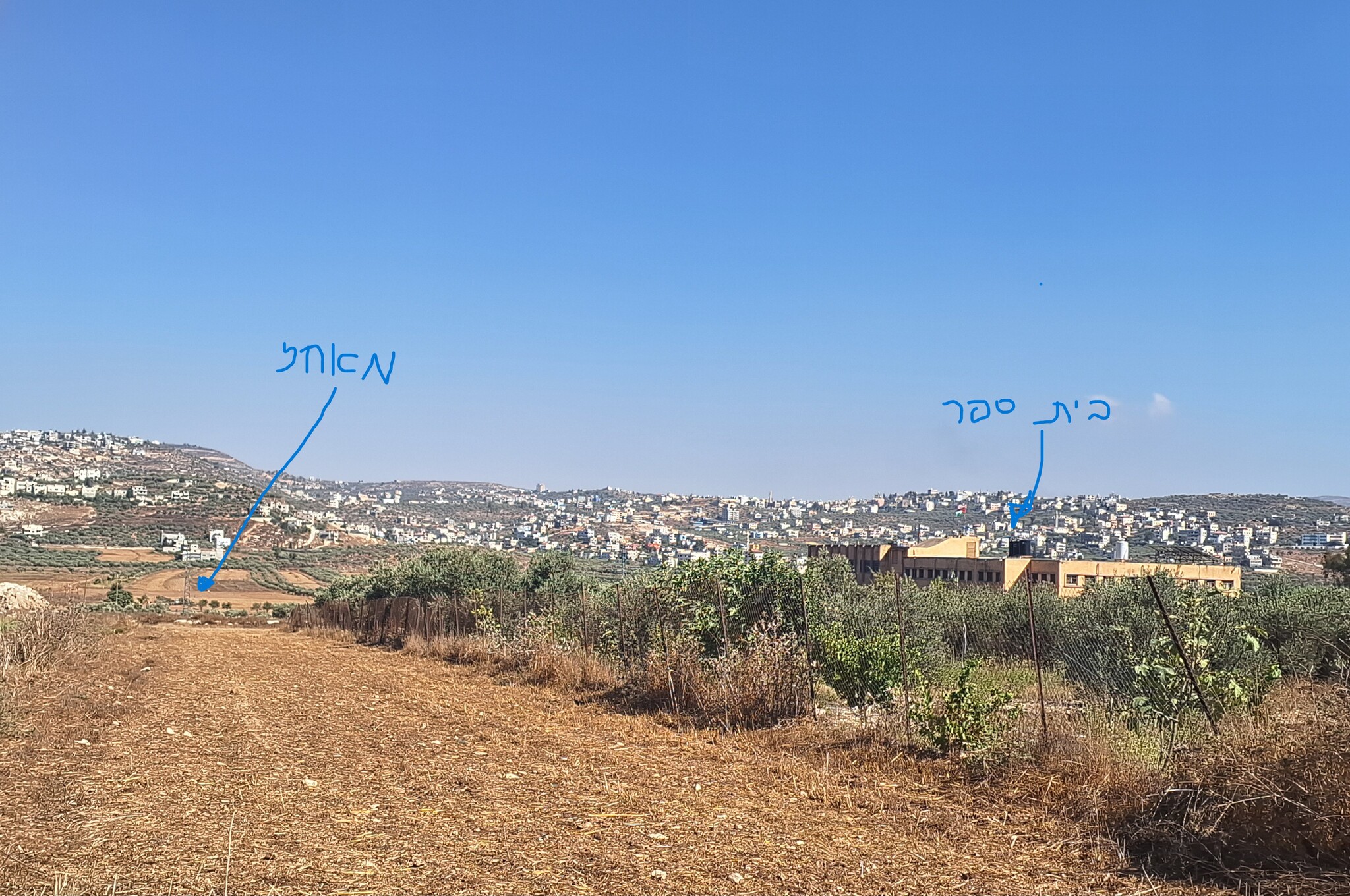 Ronit Dahan-RamatiAug-24-2026Huwara: The school on the outskirts of town and an outpost hidden among the trees
-
Marda
See all reports for this place-
Marda
There are about 2500 inhabitants in the village. A large part of their lands was confiscated for the benefit of the settlement of Ariel, some of whose buildings are adjacent to the village.
They often feel under siege. At both entrances to the village from the main road (505) there are checkpoints and the army does close the yellow arms from time to time. The inhabitants of Marda own olive groves behind a fence. Rarely are they allowed to cultivate their agricultural plots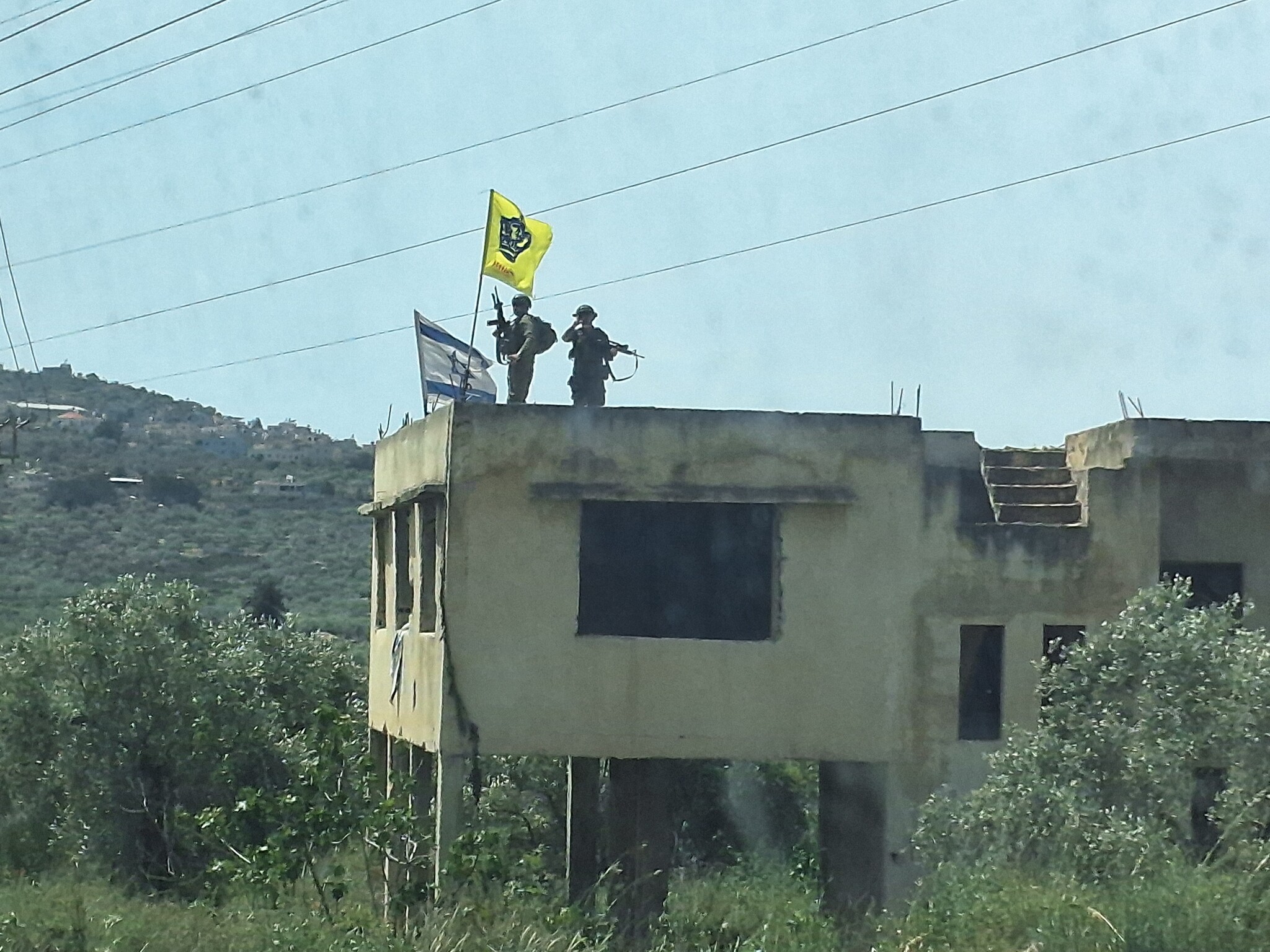 Ronit Dahan-RamatiApr-14-2026Marda. IDF post on the roof of a Palestinian home with the Messiah flag
-
