
Huwwara – Ghetto Marda
Huwwara, Beit Furik, Za’atara Junc., Burin Junc. and Ghetto Marda, Wednesday 28.6.06 PMObservers: Neora, Hagar L. (reporting)Translation: Hanna K.This shift took place under the influence of a general confusion of the army following the two abductions: that of a soldier at the Gaza strip border and that of a settler from Itamar. The Israeli self-righteousness forgot all too quickly the abduction of a wounded and unconscious wanted Palestinian from the hospital in Nablus about a month ago by the Samaria brigade paratroopers.Passage and Movement Restictions:The village of Marda – the gate was closed in the morning hours, no entry or exit for vehicles, pedestrians are checked at all the entries of the fence along road No. 5 (in addition to the main gate there are two opening for pedestrians in the fence along road no. 5. The western gate was blocked already about a month ago by two high earth obstructions). Entry to the village on foot is allowed only for the inhabitants of the village. We understood from the soldiers that the gate won’t be opened soon. For the information of the soldiers reading our reports: today the army set up the Marda Ghetto.The Reassembling Plan gathers speed. The aim: to make as many Marda inhabitants as possible leave the village “out of their own free will”. We already witnessed the closure of the gate at Marda when the fence and the gate were set up. The following villages are, according to my estimate: those located along road no. 5 but “too close” to the road: Haras, Kiff el-Haras, Zawya. Later the turn of the village that are located in the Reassembling area.Nablus – There is an exit restriction for men falling within a certain age group, but it is difficult to decide what this group is, as at different place we got different information. At the Huwwara CP we learn that the restriction is for men aged 18-25 for the inhabitants of Nablus and the villages surrounding it. From the Humanitarian Center the information was that the restriction concerned men aged 15-30 from Nablus and the refugee camps in the vicinity, at Beit Furik the soldiers’ information is that the restriction concerns men aged 16-25 from Nablus.Leaving Nablus is possible for holders of “passage permits in time of encirclement” of this age group. The permits have to be issued by DCO Nablus, which, as is well known, is located south of the CP and in order to reach it one has to leave via the Huwwara CP, drive to Huwwara and from the to Awwarta and then to the DCO (which is located 500 meters from the CP as the crow flies). But how should anybody reach the DCO if he is not allowed to leave?When I ask how, then, an inhabitant of Nablus can obtain such a permit , the answer of the DCO via the humanitarian center is: The family can send somebody aged less thant 15 and more than 30 to the DCO, file a request in the name of the person who was prevented from passing. Or, he might file a request via the Chamber of Trade in Nablus (I thought that the army does not have relations with Palestinian insititutions). Happy tidings that one does not have to present oneself in person at the DCO to request an authorization – happy indeed is the one who believes the truth of the DCO’s explanations. The explanation at the Huwwara CP – they can send a written request by post, and receive by return mail a confirmation that they had submitted a request. With this confirmation they can pass just once at the CP. Also “…they can pass through the back to back CP at Awwarta??? At the back to back CP at Awwarta they chuckled at my question about the possibility of a pedestrian passage.To sum up – it seems probable that this is another humanitarian bluff of the civil administration – or perhaps, in a more positive case – an impossible bureaucratic imbroglio.Details according to the timetable:14:30 – Marda – the iron gate at the main entrance to the village is closed. The soldiers check the people entering, without vehicles. We understood that only the inhabitants of Marda are allowed to enter. The reason: “there is a warning”. In the morning the rason was: “they threw stones”‘ then the reason changed and became “children put stones on the road” and till noon the reason again changed to “there is a warning”.14:35 – Za’atara Junction. 4 cars from the west, six cars from the north. We did not stop.14:40 – Beita -The wholesale market at the outskirts of the village is open.15:05 – Burin Junction. A rolling CP on road no. 60 in the direction towards the west. 12 taxis, a minibus and trucks stand in the queue to the west, a longer queue the end of which we cannot see, in the direction east. One crew checks, settler taxis squeeze their way through the queue.15:10 – Huwwara CP, the southern CP site: a large number of taxis and private cars. A very lively movement of pedestrians. The fruit and vegetable market is active in the southern CP building.15:15 – Huwwara CP, the northern site: About 100 pedestrians at the CP, very few cars at the entrance to Nablus, about 18 cars in the exit queue from Nablus. The car checking progresses at a reasonable pace.There are three soldiers checking at the pedestrian queue, and there is in addition a humanitarian queue. About 100 people at the CP. In spite of the number of checking soldiers, the checking progresses very slowly. The passage time for a young pedestrian is 52 minutes. The checking is thorough: the contents of bags, the rolling up of trousers, the lifting of shirts, a full turnaround, the passing of metal detectors along the body. From time to time people are sent back to the end of the queue. From where we stand we cannot see why. The screening device is in action.16:35 – Beit Furik CP. Few pedestrians and cars. The people pass immediately on arrival. Taxis from Beit Furik which arranged for a permit are allowed to pass to Nablus, aswell as private vehicles. The CP is officially open till 19:00, but if there are people the soldiers let people pass till eight o’clock too.17:20 –AwwartaIn the back to back CP A not very heavy traffic of trucks. The CP is opened in order at 06:00 and is closed at 18:00. There is no passage for pedestrians.17:35 – Huwwara CP – about 50 people at the CP, mainly students. A military policewoman checks the men. We explain to her commander that this hurts the men and that even in Israel a woman is not sent to check men or vice versa. It does not seem that our request will be responded to, his answer is “this is a mixed unit of men and women soldiers”.18:05 – Burin Junction, we are no. 6 in the queue to the west. We passed 10 minutes later. In the direction to the east there are 8 cars. We thought to return by road 55, passed at the Jit Junction and were sorry to see that the CP on road 55 in the direction of Kedumim is manned. There were hardly any cars . We didn’t stop. On the way we remembered that we should see whether the CP at Marda was removed, we drove by the road that passes beneath Emmanuel to road no. 5, we returned to Marda and discovered that the gate was not yet opened and understood from the soldiers that it would not be opened soon.
Huwwara
See all reports for this place-
The Huwwara checkpoint is an internal checkpoint south of the city of Nablus, at the intersection of Roads 60 and 5077 (between the settlements of Bracha and Itamar). This checkpoint was one of the four permanent checkpoints that closed on Nablus (Beit Furik and Awarta checkpoints to the east and the Beit Iba checkpoint to the west). It was a pedestrian-only barrier. As MachsomWatch volunteers, we watched therre since 2001 two shifts a day - morning and noon, the thousands of Palestinians leaving Nablus and waiting for hours in queues to reach anywhere else in the West Bank, from the other side of the checkpoint the destination could only be reached by public transport. In early June 2009, as part of the easing of Palestinian traffic in the West Bank, the checkpoint was opened to vehicular traffic. The passage was free, with occasional military presence in the guard tower. Also, there were vehicle inspections from time to time. Since the massacre on 7.10.2023, the checkpoint has been closed to Palestinians.
On February 26, 2023, about 400 settlers attacked the town's residents for 5 hours and set fire to property, such as houses and cars. Disturbances occurred in response to a shooting of two Jewish residents of Har Bracha by a Palestinian Terrorist. The soldiers stationed in the town did not prevent the arson and rescued Palestinian families from their homes only after they were set on fire. No one was punished and Finance Minister Smotrich stated that "the State of Israel should wipe out Hawara." Left and center organizations organized solidarity demonstrations and support actions for the residents of Hawara.Hawara continued to be in the headlines in all the months that followed: more pogroms by the settlers, attacks by Palestinians and a massive presence of the army in the town. It amounted to a de facto curfew of commerce and life in the center of the city. On October 5, 2023, MK Zvi established a Sukkah in the center of Hawara and hundreds of settlers backed the army blocked the main road and held prayers in the heart of the town all night and the next day. On Saturday, October 7, 23 The "Swords of Iron" war began with an attack by Hamas on settlements surrounding Gaza in the face of a poor presence of the IDF. Much criticism has been made of the withdrawal of military forces from the area surrounding Gaza and their placement in the West Bank, and in the Hawara and Samaria region in particular, as a shield for the settlers who were taking over and rioting.
On November 12, 2023, the first section of the Hawara bypass road intended for Israeli traffic only was opened. In this way, the settlers can bypass the road that goes through the center of Hawara, which is the main artery for traffic from the Nablus area to Ramallah and the south of the West Bank. For the construction of the road, the Civil Administration expropriated 406 dunams of private land belonging to Palestinians from the nearby villages. The settlers are not satisfied with this at the moment, and demand to also travel through Hawara itself in order to demonstrate presence and control.(updated November 2023)
.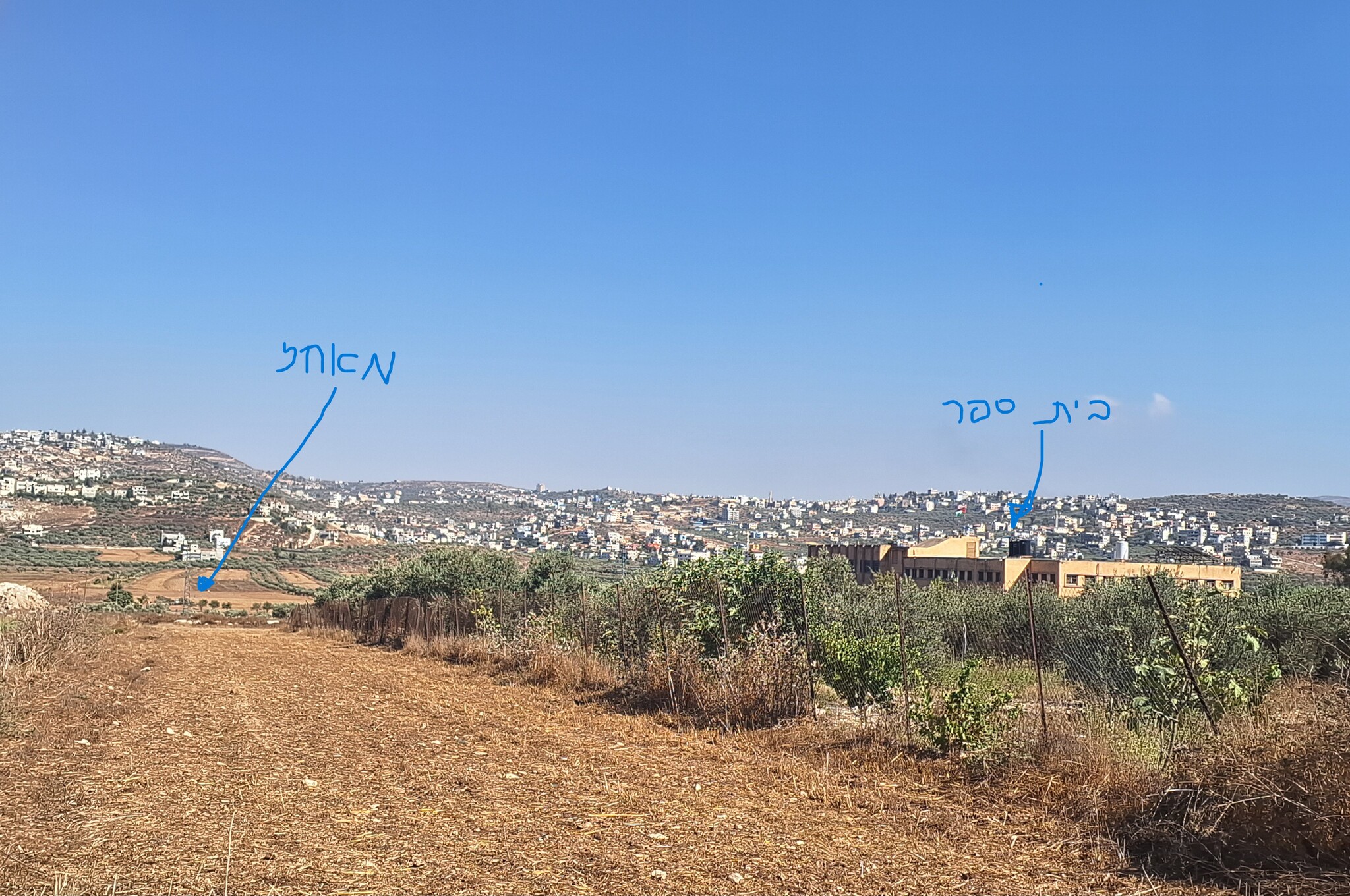 Ronit Dahan-RamatiAug-24-2026Huwara: The school on the outskirts of town and an outpost hidden among the trees
-
Marda
See all reports for this place-
Marda
There are about 2500 inhabitants in the village. A large part of their lands was confiscated for the benefit of the settlement of Ariel, some of whose buildings are adjacent to the village.
They often feel under siege. At both entrances to the village from the main road (505) there are checkpoints and the army does close the yellow arms from time to time. The inhabitants of Marda own olive groves behind a fence. Rarely are they allowed to cultivate their agricultural plots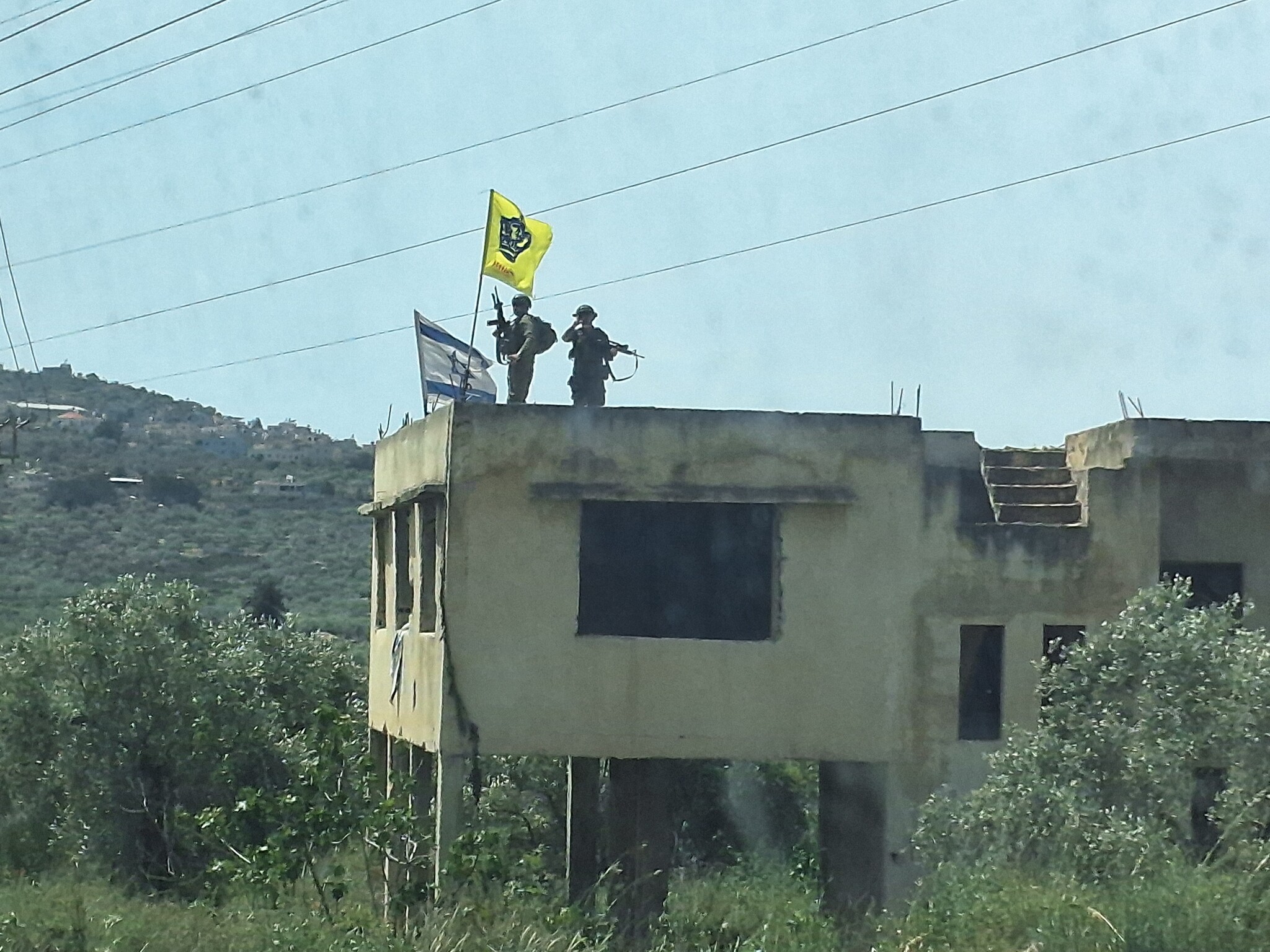 Ronit Dahan-RamatiApr-14-2026Marda. IDF post on the roof of a Palestinian home with the Messiah flag
-
